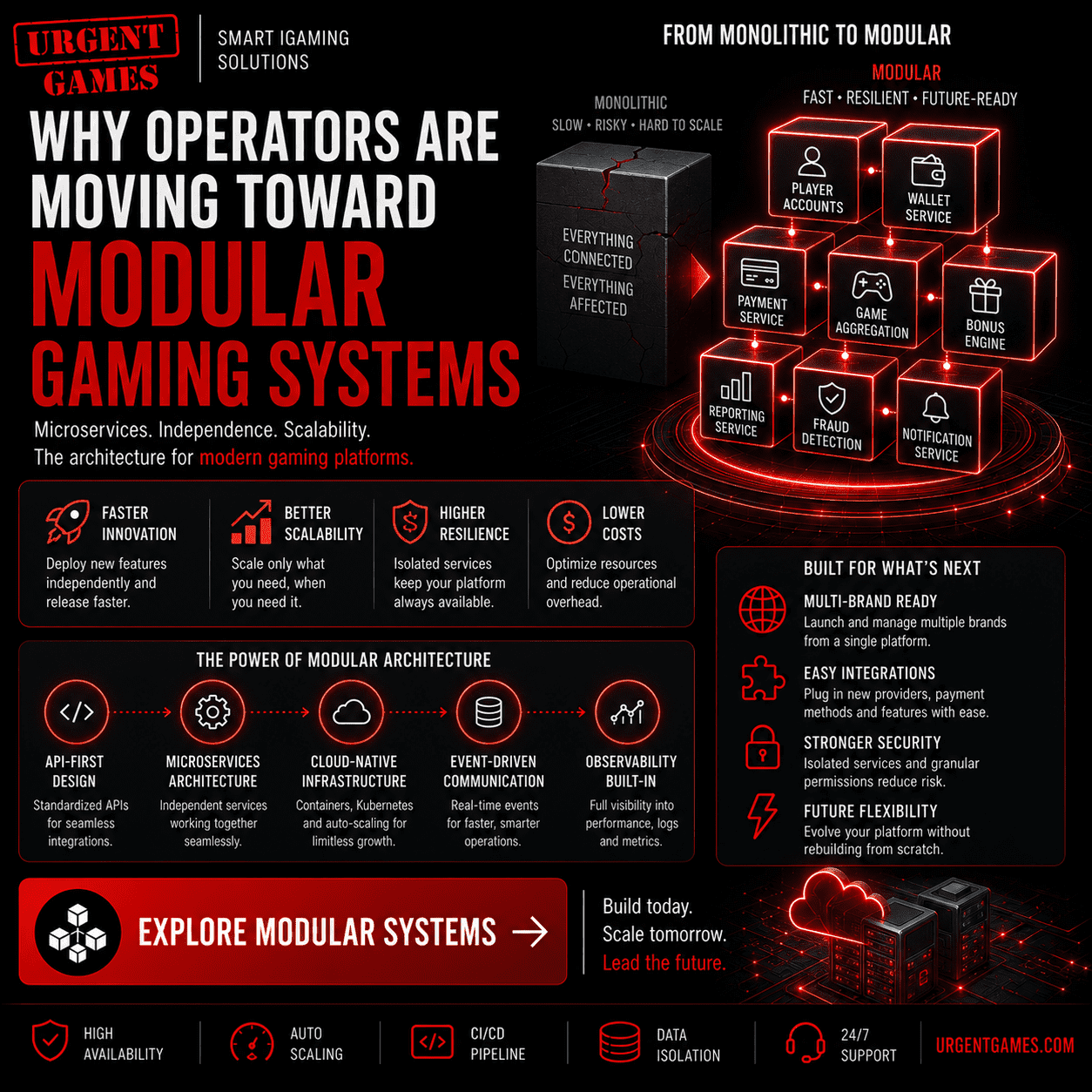
A modular gaming platform has become the preferred architecture for modern iGaming operators looking to scale faster, integrate new providers with minimal friction, and deliver new features without the limitations of traditional monolithic systems. As online gaming continues to evolve, operators must support multiple casino providers, sportsbooks, payment methods, live dealer content, AI-powered personalization, and global player bases. Meeting these demands requires an architecture that is flexible, resilient, and designed for continuous innovation.
Legacy monolithic platforms, once the industry standard, often struggle to keep pace with today's rapidly changing market. By contrast, modular platforms built on microservices enable operators to modernize individual components, deploy updates independently, and scale services based on demand.
In this article, you'll learn what a modular gaming platform is, why operators are increasingly adopting this architecture, and how it delivers long-term business and technical advantages.
What Is a Modular Gaming Platform?
A modular gaming platform is an architecture composed of independent, loosely coupled services that communicate through APIs and event-driven messaging. Each module performs a specific business function and can be developed, deployed, scaled, and maintained independently.
Common modules include:
- Wallet management
- Player account management
- Authentication and identity verification
- Payment processing
- Casino aggregation
- Sportsbook services
- Bonus and promotion management
- Fraud detection
- CRM and player engagement
- Reporting and analytics
This approach allows operators to evolve individual services without affecting the entire platform.
Suggested Internal Link: Gaming Platform Development
Why Traditional Monolithic Platforms Create Challenges
Many legacy gaming platforms were built as a single application with tightly connected components. While this simplified early development, it creates significant limitations as platforms grow.
Common challenges include:
- Large coordinated releases
- Shared databases
- Lengthy testing cycles
- High deployment risk
- Difficult maintenance
- Limited scalability
Even a small update may require redeploying the entire platform, increasing the likelihood of downtime and delaying innovation.
How a Modular Gaming Platform Improves Development Speed
Microservices separate business capabilities into independent services, allowing engineering teams to work simultaneously without conflicts.
Benefits include:
- Faster feature development
- Independent deployments
- Smaller testing scope
- Lower release risk
- Parallel development across multiple teams
This enables operators to introduce new features more frequently while maintaining platform stability.
Faster Releases Create Competitive Advantage
Modern operators frequently need to launch:
- New casino providers
- Sportsbook integrations
- Payment methods
- Regional compliance updates
- Promotional campaigns
Because each module can be updated independently, a modular gaming platform significantly reduces time-to-market and allows operators to respond quickly to changing business opportunities.
Independent Scaling Improves Infrastructure Efficiency
Not every service experiences the same workload.
For example:
- Wallet services process thousands of financial transactions every second.
- Reporting services experience heavier demand during scheduled reporting periods.
- Live casino modules may spike during major sporting events or peak evening hours.
With independent scaling, operators allocate computing resources where they are needed most, reducing infrastructure costs while maintaining high performance.
Improved Platform Resilience Through Service Isolation
One of the greatest strengths of a modular gaming platform is fault isolation.
If a bonus engine or notification service experiences an issue, the wallet, sportsbook, and casino services can continue operating normally.
This reduces downtime, improves reliability, and creates a better player experience.
API-First Design Simplifies Integrations
Modern modular platforms use standardized APIs to integrate with:
- Casino game providers
- Sportsbook platforms
- Payment gateways
- Identity verification providers
- CRM systems
- Analytics platforms
API-first development reduces integration complexity while making future expansion significantly easier.
Suggested Internal Link: Casino API Integration
Suggested External Link: Kubernetes Documentation
Multi-Brand Operations Become Easier
Many operators manage several gaming brands across multiple jurisdictions.
A modular gaming platform enables organizations to:
- Share core infrastructure
- Customize branding
- Configure regional settings
- Support multiple currencies
- Offer multilingual experiences
Without duplicating entire systems, operators can launch new brands faster and more cost-effectively.
Cloud-Native Infrastructure Supports Sustainable Growth
Modular platforms naturally align with cloud-native technologies, including:
- Containers
- Kubernetes
- Auto-scaling
- Managed cloud services
- Service meshes
Cloud-native deployment offers:
- Higher availability
- Improved scalability
- Faster deployments
- Better resource utilization
This flexibility helps operators grow without dramatically increasing operational complexity.
Event-Driven Architecture Improves Responsiveness
Many modular gaming platforms use event-driven communication.
Examples include:
- Deposit completed
- Bet placed
- Win settled
- Bonus activated
- Withdrawal approved
Each event can trigger multiple downstream services simultaneously, improving responsiveness while reducing direct service dependencies.
Continuous Integration and Continuous Deployment
CI/CD pipelines enable operators to deliver updates quickly through:
- Automated testing
- Incremental deployments
- Smaller releases
- Rollback capabilities
This minimizes maintenance windows and lowers operational risk.
Better Security Through Service Isolation
Service isolation strengthens security by allowing operators to:
- Apply least-privilege access
- Segment sensitive services
- Monitor activity independently
- Protect payment and wallet modules separately
A compromise in one service is less likely to affect the entire platform.
Easier Technology Evolution
Technology evolves rapidly.
Instead of rebuilding an entire platform, operators can modernize individual services such as the wallet, reporting engine, or bonus management system while leaving other components unchanged.
This reduces technical debt and extends platform longevity.
Improved Observability
Modern observability platforms provide centralized visibility into:
- Logs
- Metrics
- Distributed traces
- API performance
- Infrastructure health
- Transaction flows
Improved monitoring enables faster issue detection and shorter recovery times.
Better Disaster Recovery
Critical services can be:
- Replicated
- Load balanced
- Failed over independently
Targeted recovery strategies reduce downtime and improve business continuity.
AI Integrates More Easily
AI-powered services are becoming increasingly common across iGaming.
Examples include:
- Fraud detection
- Player personalization
- Customer support automation
- Responsible gaming monitoring
- Risk scoring
Because these capabilities operate as independent services, they can be introduced without redesigning the entire platform.
Key Metrics Operators Should Monitor
Engineering Metrics
- Deployment frequency
- Mean Time to Recovery (MTTR)
- Service latency
- API response times
Infrastructure Metrics
- Auto-scaling events
- Resource utilization
- Uptime
- Error rates
Business Metrics
- Time-to-market
- Provider onboarding speed
- Feature release cadence
- Operational efficiency
Common Architecture Mistakes
Avoid these common pitfalls:
- Building tightly coupled services
- Sharing databases across microservices
- Ignoring observability
- Overengineering too early
- Weak API governance
The Future of Modular Gaming Platforms
Future gaming platforms will increasingly embrace:
- Event-driven microservices
- AI-powered automation
- Serverless workloads
- Cloud-native deployments
- Intelligent orchestration
Operators that invest in modular architectures today will be better positioned to adapt to new regulations, technologies, and player expectations tomorrow.
Frequently Asked Questions
What is a modular gaming platform?
A modular gaming platform is an iGaming system built from independent services that communicate through APIs, allowing operators to scale, deploy, and maintain components separately.
Why are operators adopting microservices?
Microservices improve deployment speed, resilience, scalability, and integration capabilities while reducing operational risk.
Can modular gaming platforms support multiple brands?
Yes. Operators can share core infrastructure while customizing branding, languages, currencies, and regional configurations for different markets.
Are modular gaming platforms more secure?
Service isolation enables stronger access controls, improved monitoring, and reduced attack surfaces compared with traditional monolithic systems.
Final Thoughts
The future of iGaming is built on flexible, scalable architectures—not larger monolithic applications.
A modern modular gaming platform empowers operators to launch faster, scale efficiently, improve resilience, simplify integrations, and continuously innovate. As competition intensifies, platforms designed to evolve will be best positioned for long-term success.