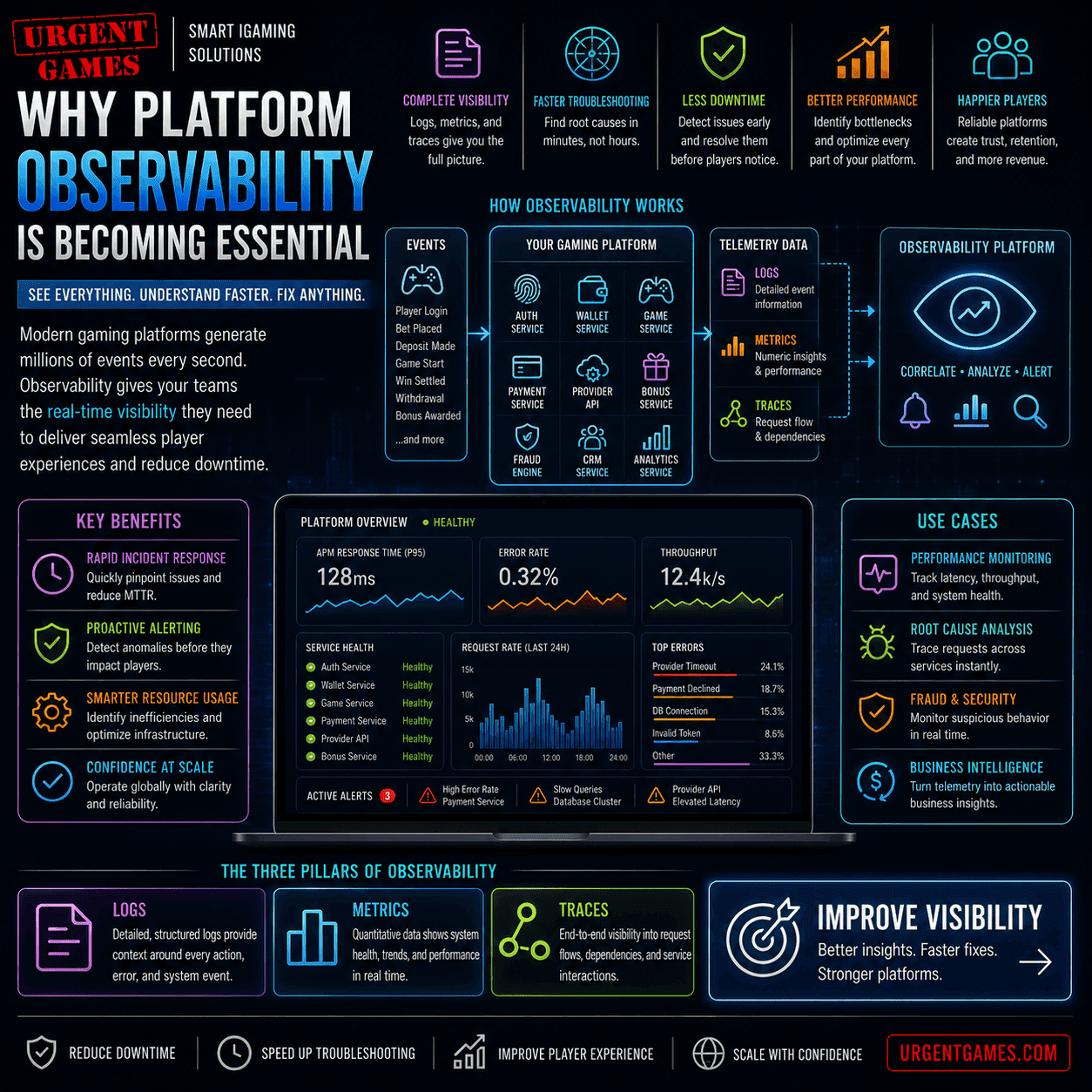
Implementing robust gaming observability is now a top operational priority for modern enterprise iGaming platforms. Today's online gaming architectures are more complex than ever. A single player session may involve authentication services, wallet infrastructure, casino providers, sportsbook APIs, payment gateways, fraud detection, CRM systems, and analytics platforms.
When everything works together, players enjoy a seamless experience. When something breaks, identifying the root cause can become incredibly difficult.
This is why gaming observability has become a critical capability for enterprise gaming platforms. Unlike traditional monitoring, observability provides engineering teams with the visibility needed to understand not only what failed, but why it failed—often before players notice an issue. For operators supporting thousands of concurrent players and millions of daily transactions, observability is no longer optional. It is fundamental to platform reliability.
What Is Gaming Observability?
Observability is the ability to understand the internal state of a complex software system using the telemetry data it generates.
Rather than relying on isolated alerts, gaming observability combines three primary sources of telemetry:
-
Logs: Detailed records of application events.
-
Metrics: Numerical data measuring system performance over time.
-
Distributed Traces: End-to-end maps tracking individual requests across microservices.
Together, these pillars provide complete visibility into platform health and player behavior.
Traditional Monitoring vs. Gaming Observability
Traditional monitoring focuses on surface-level infrastructure metrics, while full gaming observability dives deep into distributed application state.
| Query Focus | Traditional Monitoring | Enterprise Gaming Observability |
| Primary Goal | Detect known failure states | Diagnose unknown root causes |
| Key Questions | Is the server online? Is CPU usage high? Did the service crash? | Why did the wallet fail? Which API caused latency? What dependency triggered the outage? |
| Data Scope | Single-host metrics and status checks | Correlated logs, metrics, and end-to-end distributed traces |
| Action Type | Reactive alert creation | Proactive root cause investigation and automated response |
Modern enterprise platforms require both systems working in harmony.
Core Pillars of a Gaming Observability Strategy
1. Logs Provide High-Fidelity Context
Logs record detailed contextual information about application execution. Essential log events include player authentication, API requests, wallet transactions, payment processing, provider responses, and structured error messages. Standardizing on structured logging enables faster troubleshooting and accurate root-cause analysis during incidents.
2. Metrics Reveal Performance Trends
Metrics provide aggregate numerical insights into system behavior. Operators should track API response times, CPU utilization, memory consumption, error rates, transaction throughput, and queue depth. Monitoring these trends helps teams catch performance degradation long before it causes a site-wide outage.
3. Distributed Tracing Connects the Dots
Modern gaming platforms consist of dozens of microservices. Distributed tracing assigns a unique identifier to follow a single request across every service.
For example:
Tracing immediately pinpoints exact latency bottlenecks across your service stack, dramatically reducing Mean Time to Resolve (MTTR). For a deep dive into implementing vendor-neutral telemetry standards, read the official OpenTelemetry Documentation.
Key Benefits of Advanced Gaming Observability
Faster Incident Response
When incidents occur, every minute of downtime costs revenue. Gaming observability enables operations teams to instantly identify which service failed, when the anomaly began, which players were affected, and whether third-party vendors triggered the incident.
Better Visibility Into Third-Party Providers
Most platforms rely heavily on external vendors, including casino game studios, sportsbook data feeds, payment gateways, and identity verification tools. Observability isolates whether errors originate internally or with third-party APIs, eliminating unnecessary internal debugging.
Detect Problems Before Players Do
Reactive customer support is expensive and damages brand reputation. Proactive observability empowers teams to detect rising API latency, error rate spikes, queue backlogs, memory leaks, and database contention before they impact the player experience.
Event Correlation Improves Diagnosis
A single database outage can create dozens of secondary symptoms (e.g., failed wallet calls, slow game launches, higher support ticket volume). Observability platforms correlate these simultaneous signals so engineers fix the root cause rather than fighting individual symptoms.
Real-Time Dashboards Drive Better Decisions
Modern observability dashboards present actionable live metrics, including:
-
Overall platform health and active incidents
-
Third-party provider uptime and API latency
-
Transaction success rates and deposit throughput
-
Real-time infrastructure utilization
How AI Is Enhancing Gaming Observability
Artificial intelligence and machine learning are making telemetry platforms significantly smarter. AI-powered gaming observability tools can:
-
Automatically detect behavioral anomalies without manual threshold setting
-
Predict capacity bottlenecks and potential outages
-
Suppress low-priority alert noise during major incidents
-
Correlate multi-service events to recommend exact root causes
Consequently, engineering teams spend less time searching through logs and more time deploying fixes.
Strengthening Regulatory Compliance & Continuous Improvement
Audit and Compliance Support
Detailed platform telemetry supports strict regulatory compliance, security audits, fraud investigations, and financial reporting. Maintaining end-to-end operational logs creates a tamper-evident audit trail required by gaming commissions worldwide.
Continuous Architecture Optimization
Beyond incident management, gaming observability highlights clear opportunities for continuous platform improvement, such as:
-
Optimizing slow database queries and external API calls
-
Refining infrastructure auto-scaling parameters
-
Reducing end-to-end player game launch latency
For broader strategies on managing enterprise microservices architectures, check out our guide on implementing scalable platform infrastructure.
Key Metrics Every iGaming Operator Should Track
Implementation Tip: Connect technical system metrics directly to business outcomes to measure the true financial impact of platform downtime.
-
Performance Metrics: API response time, game launch latency, database query duration, queue processing time.
-
Reliability Metrics: System uptime, overall error rate, wallet transaction success, failover execution time.
-
Infrastructure Metrics: CPU utilization, memory allocation, disk I/O, network throughput.
-
Business Metrics: Active player count, bets processed per second, deposit conversion rate, revenue by provider.
Common Gaming Observability Mistakes to Avoid
-
Monitoring Infrastructure Only: Server health alone does not guarantee a good player experience—application performance matters just as much.
-
Using Unstructured Logs: Plain text logs without standard JSON fields make cross-service log parsing slow and tedious.
-
Omitting Distributed Tracing: Attempting to debug complex microservice architectures without tracing context leads to guesswork.
-
Alert Overload: Generating alerts for every minor fluctuation causes alert fatigue, leading teams to miss critical system warnings.
-
Ignoring Business Metrics: Keeping engineering metrics isolated from business KPIs makes it difficult to prioritize technical debt fixes.
The Future of Gaming Observability
Next-generation observability architectures are rapidly evolving. Operators can expect future platforms to deliver:
-
Automated AI-driven root cause analysis
-
Predictive capacity and performance monitoring
-
Full standardization on OpenTelemetry instrumentation frameworks
-
Self-healing infrastructure with automated remediation playbooks
-
Real-time business impact correlation during ongoing incidents
Final Thoughts
Upgrade Your Platform Observability Suite
Want complete visibility across your iGaming architecture with centralized logging, real-time metrics, distributed tracing, and AI-powered telemetry analysis?
Explore our comprehensive guide on selecting enterprise monitoring tools or contact our architecture team to audit your current platform observability stack today!