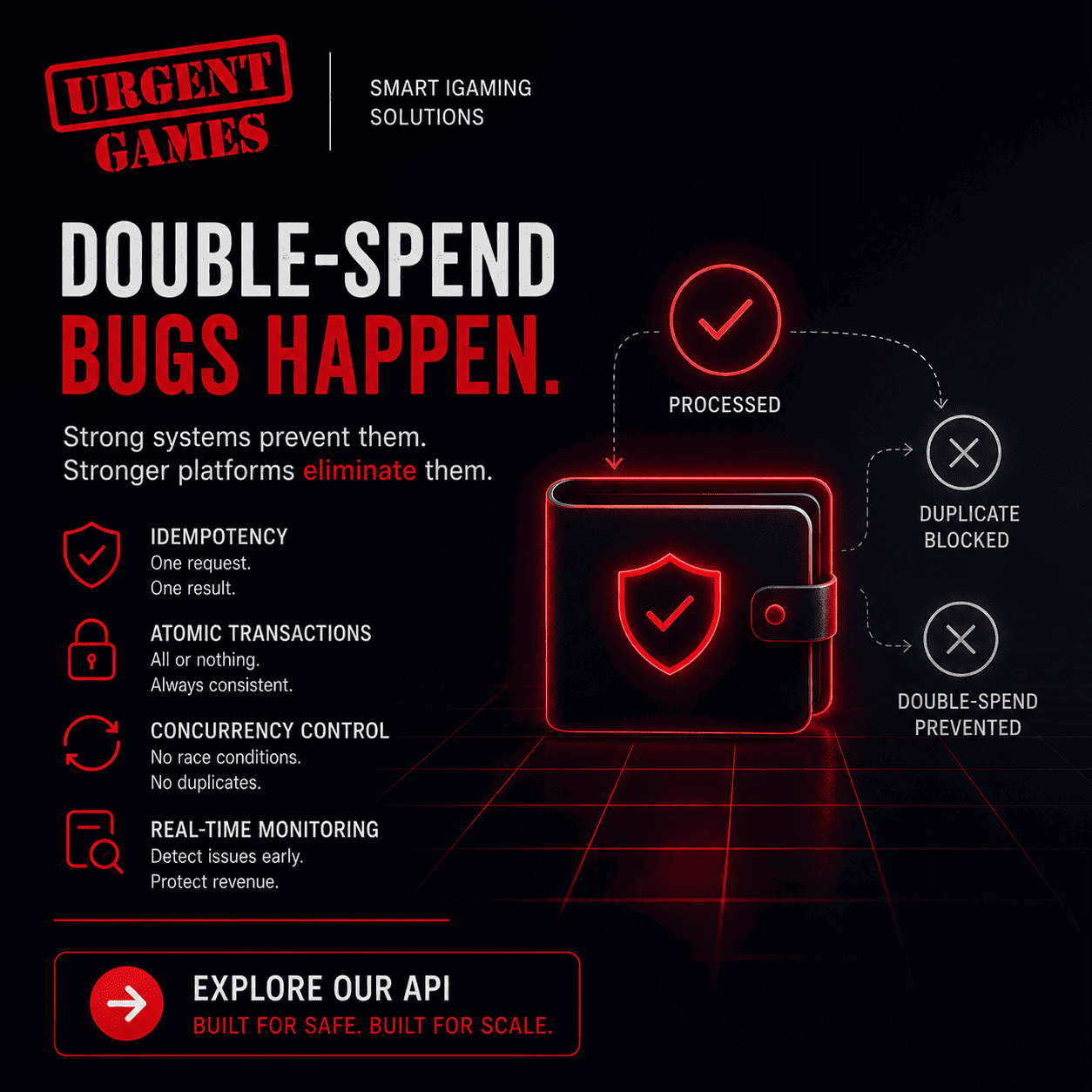
Nothing destroys trust in an iGaming platform faster than wallet inconsistencies. When players encounter duplicate withdrawals, missing balances, or repeated winnings, they quickly lose confidence in the platform. That is why double spend prevention is essential for modern iGaming wallet systems.
As gaming platforms scale in real time, financial systems must handle concurrency, retries, provider callbacks, and distributed transactions safely. Without proper safeguards, even small transaction failures can lead to duplicate processing and serious financial losses.
In this guide, we explain how double-spend bugs happen and the engineering patterns that help prevent them.
What Is Double Spend Prevention?
Double spend prevention refers to the methods used to ensure the same transaction cannot be processed multiple times.
For example:
- A player submits a withdrawal request
- The request succeeds
- A timeout occurs before the response returns
- The client retries automatically
- The withdrawal executes again
As a result, the player receives duplicate payouts.
Strong double spend prevention systems stop duplicate processing before money is lost.
Why Double Spend Prevention Matters in iGaming
Double-spend bugs can impact:
- Revenue protection
- Player trust
- Compliance reporting
- Provider reconciliation
- Financial accuracy
Additionally, these issues are difficult to reproduce because they often occur during rare timing failures or network interruptions.
Since iGaming platforms process thousands of transactions simultaneously, even minor concurrency flaws can create major financial incidents.
Common Double-Spend Scenarios
Retry Storms and Duplicate Requests
Network failures frequently trigger automatic retries. However, the original request may have already completed successfully.
Without idempotency protection, duplicate transactions process again.
Race Conditions in Wallet Systems
Race conditions occur when two requests access the same wallet balance simultaneously.
For example:
- Request A checks balance
- Request B checks balance
- Both requests approve spending
- Both deduct funds
Consequently, balances become inconsistent or negative.
Duplicate Provider Callbacks
Some providers resend callbacks repeatedly if acknowledgments are delayed.
Without transaction uniqueness validation, duplicate settlements may execute multiple times.
Queue Replay Events
Message queues occasionally replay events during:
- Infrastructure recovery
- Consumer restarts
- Retry handling
- Failure recovery
If consumers are not idempotent, replayed messages trigger duplicate wallet updates.
Why Traditional Double Spend Prevention Fails
Many operators rely on:
- Retry limits
- Manual checks
- Frontend validation
- Artificial delays
Unfortunately, these approaches do not solve the root problem.
Instead, secure wallet systems require:
- Idempotency
- Atomic transactions
- Concurrency control
- Reconciliation systems
Idempotency in Double Spend Prevention
Idempotency ensures that executing the same request multiple times produces the same outcome.
For example:
- The first withdrawal succeeds
- A duplicate request arrives later
- The system returns the original transaction result
- No duplicate payout occurs
As a result, duplicate financial execution is prevented safely.
Using Idempotency Keys for Wallet Protection
Every financial request should include a unique transaction identifier.
Example:
{
  "transaction_id": "TX12345"
}
The system should:
- Process the first request
- Store the transaction ID
- Detect duplicate requests
- Block repeated execution
Because of this, idempotency keys are foundational for secure wallet APIs.
Atomic Transactions for Double Spend Prevention
Atomic transactions ensure all operations succeed together or fail together.
A risky implementation looks like this:
- Deduct balance
- Save transaction separately
If the system crashes between those steps, wallet balances become inconsistent.
Instead, platforms should use:
- Database transactions
- Atomic state updates
- Unified persistence layers
This guarantees balance updates and transaction records remain synchronized.
Concurrency Control for iGaming Wallets
Database Row Locking
Row locking prevents simultaneous wallet modifications during balance updates.
As a result, race conditions are significantly reduced.
Optimistic Locking
Optimistic locking uses:
- Version numbers
- State verification
- Conflict detection
If another request modifies the wallet unexpectedly, conflicting updates fail safely.
Queue Serialization
Some wallet architectures process transactions sequentially per player.
This approach reduces concurrency conflicts and improves transaction consistency.
Event-Driven Wallet Architecture
Modern financial systems increasingly use:
- Immutable ledgers
- Event sourcing
- Append-only transaction logs
instead of relying entirely on mutable wallet balances.
These architectures improve:
- Auditability
- Traceability
- Recovery capability
- Financial reconciliation
Reconciliation Systems for Double Spend Prevention
Even reliable wallet systems require continuous reconciliation.
Reconciliation compares:
- Wallet balances
- Ledger balances
- Provider settlements
- Transaction histories
This helps operators detect inconsistencies early before they become expensive incidents.
Provider Callback Security Best Practices
Provider integrations are a major source of duplicate transactions.
To improve wallet protection:
- Validate callback signatures
- Enforce transaction uniqueness
- Persist data before acknowledgment
- Monitor duplicate callback activity
These safeguards help prevent repeated settlements and payout errors.
Monitoring and Observability for Wallet Systems
Strong observability improves double spend prevention by detecting issues early.
Teams should monitor:
- Duplicate transaction attempts
- Retry spikes
- Queue replay events
- Wallet mismatches
- Failed reconciliation checks
Real-time alerts help engineers respond before financial damage escalates.
Testing Double Spend Prevention Systems
Many platforms fail because they never test concurrency behavior properly.
Testing should simulate:
- Parallel wallet requests
- Delayed provider callbacks
- Queue replay events
- Infrastructure recovery
- Network failures
Stress testing is critical for validating financial integrity under load.
Common Double Spend Prevention Mistakes
Relying on Frontend Validation
Frontend checks cannot protect financial systems from retries or malicious requests.
Missing Idempotency Keys
Without idempotency keys, duplicate execution becomes highly likely.
Shared Mutable Wallet State
Shared mutable state increases race-condition risks in distributed systems.
No Reconciliation Systems
Without reconciliation, financial inconsistencies remain undetected for too long.
The Future of Double Spend Prevention
Modern iGaming platforms are adopting:
- Immutable ledger systems
- Event-driven architectures
- Distributed tracing
- Real-time consistency monitoring
These technologies improve:
- Reliability
- Compliance
- Scalability
- Financial integrity
As real-time gaming grows, wallet consistency will become even more important.
Final Thoughts on Double Spend Prevention
Players may tolerate small UI issues or occasional delays. However, they will never tolerate missing balances or duplicate withdrawals.
That is why double spend prevention is fundamental for every iGaming platform.
Reliable wallet systems protect:
- Player trust
- Revenue
- Compliance
- Long-term scalability