
 简体中文
简体中文  English
  Español
  Русский
  Türkçe
  Tiếng Việt
  Українська
  Български
  Suomi
Suomi  Ελληνικά
  Čeština
  اردو
اردو  Svenska
  עִבְרִית
  हिन्दी
  Français
  Հայերեն
  Italiano
  日本語
日本語  Română
  Polski
  Српски језик
  Latviešu valoda
  Deutsch (Sie)
  Português do Brasil
  한국어
한국어 
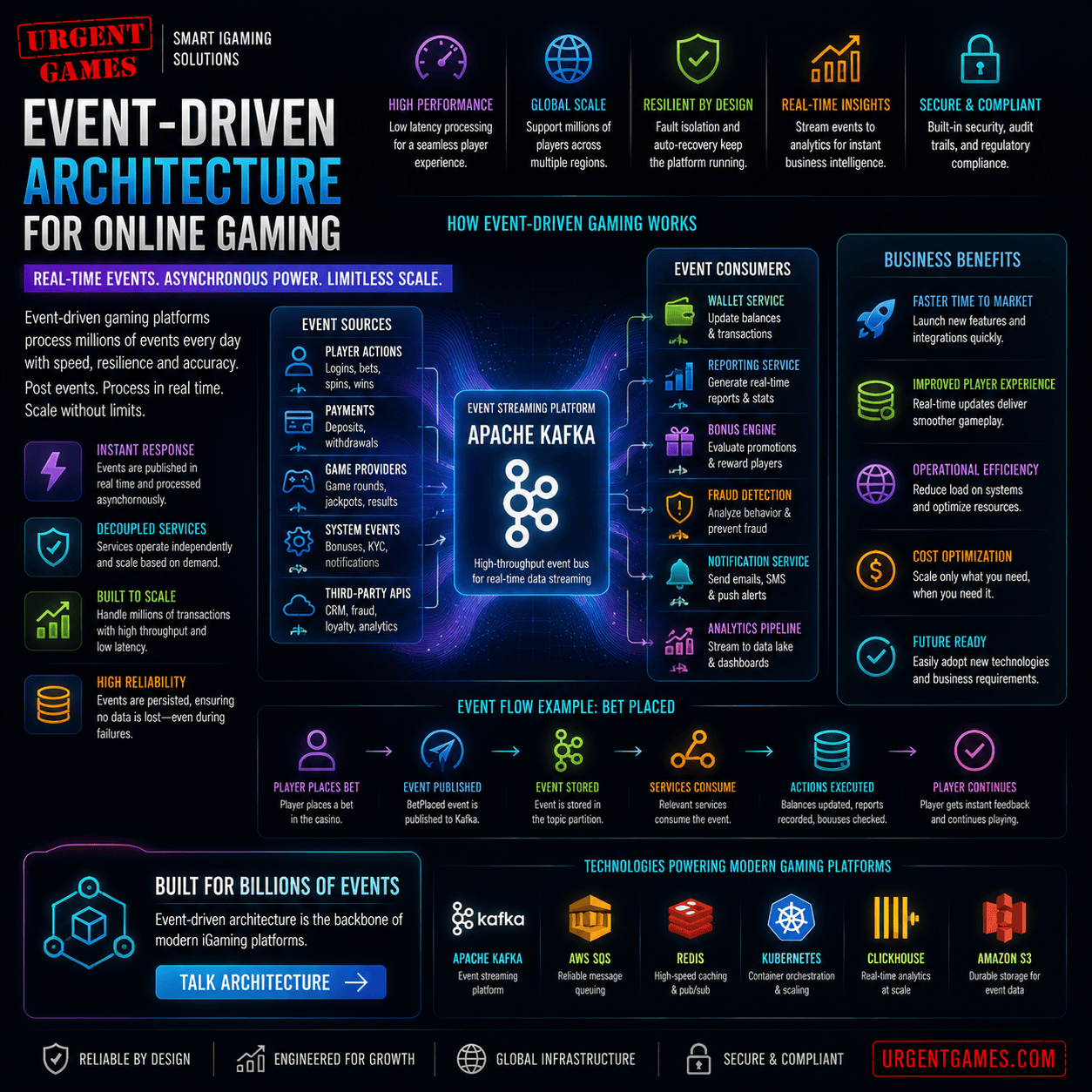
Event-Driven Architecture for Online Gaming Platforms
Modern iGaming ecosystems process an extraordinary volume of user interactions every second. Every single player touchpoint—logging in, launching a game, placing a wager, triggering a jackpot, depositing funds, claiming a bonus, or initiating a withdrawal—generates an active telemetry data point.
When you scale those atomic actions across hundreds of thousands of concurrent players, traditional synchronous, request-response architecture rapidly becomes a crippling operational bottleneck.
To overcome these latency constraints, enterprise operators are transitioning toward a robust event-driven architecture for online gaming. Instead of forcing core databases to process every downstream operation synchronously, event-driven systems publish atomic events to distributed message brokers, allowing decoupled microservices to react independently in real time.
What Is Event-Driven Architecture in iGaming?
In an event-driven architecture for online gaming, software services communicate asynchronously by emitting and consuming state updates called events. An event represents an immutable historical fact: a specific action that has already occurred within the platform ecosystem.
Common Core Gaming Events
PlayerSessionStarted: Emitted when authentication and geo-compliance validation pass.WagerPlaced: Emitted immediately when a bet payload reaches the gateway.WinSettled: Dispatched by the game provider upon game-round resolution.DepositCompleted: Dispatched when a payment gateway verifies a transaction.
Rather than tightly coupling the core wallet to reporting, loyalty points, compliance, and fraud detection engines via direct REST calls, the platform publishes an event (e.g., BetPlaced) to a centralized event bus like Apache Kafka. Downstream services consume this event asynchronously without impacting the active gameplay stream.
Processing Workflows: Synchronous vs. Event-Driven Pipelines
To understand why traditional systems struggle under high traffic, consider how a single wager is processed under both architectural patterns.
The Monolithic Request-Response Bottleneck
In a legacy synchronous setup, placing a wager blocks the player’s client until every secondary service acknowledges processing:
[Player Client] ──(Sync HTTP Post)──> [Monolith Engine]
                                         ├──> Sync Call: [Wallet Service] (Wait...)
                                         ├──> Sync Call: [Game Provider] (Wait...)
                                         ├──> Sync Call: [Fraud Engine]  (Wait...)
                                         └──> Sync Call: [Loyalty DB]    (Wait...)
If a single downstream service (like the loyalty database) experiences latency, the entire wagering flow stalls, leading to dropped bets and player frustration.
The Event-Driven Asynchronous Pipeline
In a modern event-driven architecture, the core transaction isolates the gameplay action, handing off non-critical business logic to background event consumers.
Structural Advantages Matrix
Deploying a distributed event bus provides clear technical and operational benefits over traditional monolithic frameworks.
| Operational Dimension | Monolithic Synchronous Design | Event-Driven Architecture |
| System Coupling | Tightly coupled; downstream outages crash the core workflow. | Decoupled; failing background services do not affect gameplay. |
| Scaling Flexibility | Requires scaling the entire application monolith. | Allows independent horizontal scaling of individual consumer services. |
| 欺诈检测 | Batch processing introduces significant detection delays. | Real-time event streaming allows sub-second anomaly detection. |
| Auditing & Compliance | Requires complex database join queries across tables. | Event sourcing provides an immutable, chronological ledger out of the box. |
Common Implementation Mistakes to Avoid
Architecture Warning: Events describe past facts—they are not direct remote procedure calls (RPC). Using events as synchronous command replacements introduces severe distributed state complexity.
Treating Events as Synchronous API Calls: Over-engineering simple synchronous operations (like simple login password validation) with event loops causes unnecessary processing latency.
Neglecting Event Schema Versioning: Changing event payload schemas without strict backward compatibility breaks downstream consumer microservices. Implement a centralized Schema Registry (e.g., Avro/JSON Schema).
Ignoring Queue Depth and Consumer Lag: Failing to monitor consumer lag across message partitions can cause silent backpressure, delaying real-time fraud alerts and bonus grants.
To explore how high-throughput systems protect wallet integrity under peak concurrency, review our technical guide on designing scalable casino architecture.
Future-Proofing iGaming Infrastructure with Event Streams
As regulatory requirements grow stricter and player expectations for instant payouts increase, implementing a resilient event-driven architecture for online gaming is no longer optional for enterprise operators. By decoupling core financial transactions from background telemetry, operators gain unmatched scalability, real-time observability, and fault-tolerant operational stability.
Scale Your iGaming Infrastructure
Building a high-performance, fault-tolerant event streaming platform requires proven architectural blueprints. Explore our companion technical guides to continue modernizing your stack.
Explore Our Complete Guide on High-Concurrency Distributed Wallet Design
Review Our Blueprint for Implementing Real-Time API Health and Latency Monitoring
常见问题解答
Why is Apache Kafka preferred for an event-driven architecture for online gaming platforms?
Apache Kafka offers exceptionally high write throughput, distributed fault tolerance, horizontal partition scaling, and durable on-disk event storage. These capabilities make it ideal for handling millions of real-time gaming transactions without data loss.
How does event-driven architecture improve fraud detection in iGaming?
Instead of running delayed batch scripts over night, event streaming feeds player actions (DepositCompleted, RapidWagerPlaced) into real-time machine learning pipelines instantly. Suspicious patterns trigger automated safety locks in sub-second timeframes.