
 Tiếng Việt
  English
  简体中文
简体中文  Español
  Русский
  Türkçe
  Українська
  Български
  Suomi
Suomi  Ελληνικά
  Čeština
  اردو
اردو  Svenska
  עִבְרִית
  हिन्दी
  Français
  Հայերեն
  Italiano
  日本語
日本語  Română
  Polski
  Српски језик
  Latviešu valoda
  Deutsch (Sie)
  Português do Brasil
  한국어
한국어 
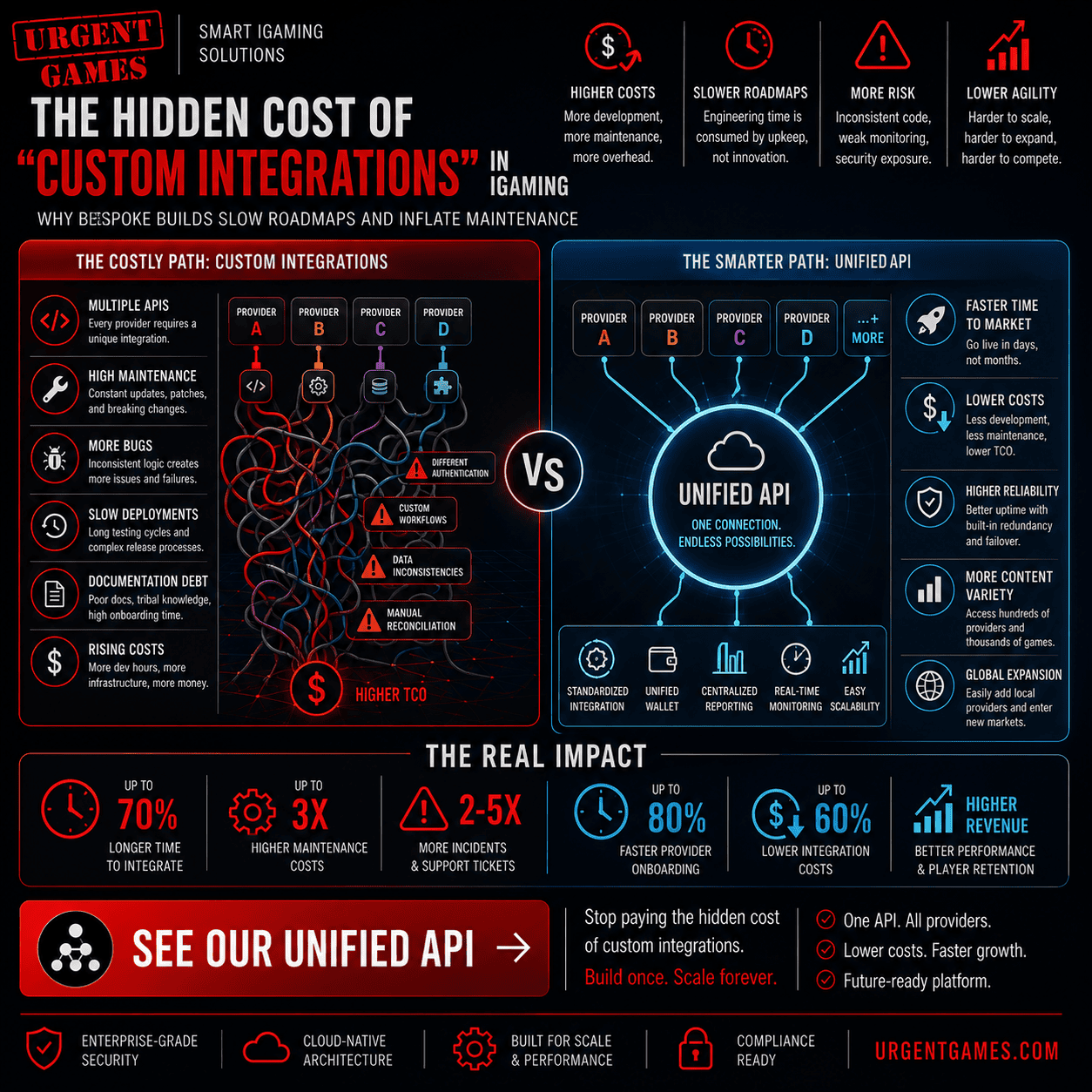
The Hidden Cost of Custom Integrations: Why Casino API Integration Is the Smarter Choice for iGaming
In today’s competitive iGaming industry, tích hợp API sòng bạc has become one of the most important decisions operators make when building scalable gaming platforms. While custom software development once represented a competitive advantage, modern operators are discovering that maintaining dozens of proprietary integrations creates technical debt, slows innovation, and increases operational costs. A standardized tích hợp API sòng bạc approach enables faster growth, easier maintenance, and a more reliable gaming ecosystem.
Why Custom Integrations Become Expensive
At first, integrating directly with a single game provider appears simple.
Then another provider is added.
Then another.
Soon, operators find themselves maintaining dozens of unique integrations.
Each provider may require:
- Các phương pháp xác thực khác nhau
- Different request formats
- Different callback structures
- Different wallet implementations
- Môi trường thử nghiệm riêng biệt
Every additional integration increases operational complexity while reducing engineering efficiency.
How Casino API Integration Simplifies Operations
Một hiện đại tích hợp API sòng bạc strategy replaces multiple provider-specific connections with a unified API layer.
Instead of building and maintaining separate integrations for every content provider, operators integrate once and gain access to multiple providers through a standardized interface.
This approach delivers:
- Triển khai nhanh hơn
- Consistent workflows
- Bảo trì đơn giản
- Reduced engineering effort
- Greater platform scalability
The goal is no longer to build everything from scratch.
The goal is to build smarter.
Technical Debt Grows Quietly
Technical debt rarely appears overnight.
It accumulates gradually.
Every custom workaround, provider-specific exception, and undocumented process adds friction to future development.
Eventually, engineering teams face:
- Longer release cycles
- More production incidents
- Increased regression testing
- Higher maintenance costs
- Slower innovation
Instead of accelerating business growth, custom development begins slowing it down.
Every Provider Requires Ongoing Maintenance
Provider APIs constantly evolve.
Ví dụ bao gồm:
- Endpoint updates
- Authentication changes
- Trò chơi mới ra mắt
- Security improvements
- Yêu cầu tuân thủ
When every provider uses its own integration, engineering teams must update each connection independently.
Maintenance costs continue growing every year.
Testing Complexity Increases With Every Integration
Every software release requires validation across multiple integrations.
Testing typically includes:
- Giao dịch ví
- Player authentication
- Trò chơi ra mắt
- Quản lý phiên
- Bonus functionality
- Độ chính xác của báo cáo
As integrations increase, QA cycles become significantly larger.
Release confidence decreases while testing costs continue rising.
Slower Product Roadmaps Hurt Business Growth
Engineering resources are limited.
Every hour spent maintaining legacy integrations is an hour not spent building:
- New platform features
- Trải nghiệm người chơi tốt hơn
- Market expansion
- Payment improvements
- Performance optimization
Custom integration work often delays strategic business initiatives.
Opportunities arrive faster than development capacity.
Documentation Becomes Increasingly Difficult
Every custom integration requires accurate documentation.
Without proper documentation:
- Developer onboarding slows
- Knowledge becomes siloed
- Operational risk increases
- Support becomes more difficult
When experienced developers leave, undocumented integrations become expensive to maintain.
Documentation debt often becomes just as costly as technical debt.
Different APIs Create Operational Inconsistency
One provider may authenticate users differently.
Another structures transactions differently.
A third returns completely different error codes.
Engineering teams spend valuable time translating between systems instead of building products that generate revenue.
Standardization eliminates unnecessary complexity.
Wallet Integrations Multiply Financial Risk
Financial systems require consistency and reliability.
Custom wallet implementations often introduce:
- Balance discrepancies
- Settlement delays
- Vấn đề hòa giải
- Xử lý giao dịch trùng lặp
- Increased financial risk
A standardized wallet architecture improves reliability while reducing long-term maintenance.
Security Management Becomes More Challenging
Every custom integration expands the security surface.
Operators must manage:
- Xác thực
- Mã hóa
- API permissions
- Secrets management
- ghi nhật ký kiểm toán
- Kiểm soát truy cập
Maintaining dozens of independent security models increases operational risk.
Unified APIs simplify governance and security compliance.
Monitoring Fragmentation Creates Blind Spots
Custom integrations often generate independent:
- Nhật ký
- Số liệu
- Thông báo
- Dashboards
Without centralized visibility, troubleshooting incidents becomes significantly slower.
Unified monitoring enables engineering teams to identify and resolve issues much faster.
Provider Onboarding Takes Too Long
Launching a new gaming provider should create new revenue opportunities.
Instead, custom integrations often require:
- Weeks of development
- Kiểm thử QA
- Deployment planning
- Production validation
Long onboarding cycles delay content launches and reduce competitive agility.
Unified Casino API Integration Eliminates Redundant Work
Modern aggregation platforms provide:
- Standardized authentication
- Unified wallet communication
- Consistent reporting
- Shared transaction models
- Common API structures
Engineering teams integrate once while supporting multiple providers.
This dramatically reduces ongoing maintenance effort.
Modular Architecture Supports Long-Term Growth
Standardized APIs perform best within modular platform architectures.
Independent services simplify:
- Provider management
- xử lý thanh toán
- Báo cáo
- Phát hiện gian lận
- Quản lý tài khoản người chơi
Changes remain isolated instead of impacting the entire platform.
Scalability improves naturally.
Better Developer Productivity
When engineers spend less time maintaining integrations, they spend more time creating value.
Các lợi ích bao gồm:
- Faster product releases
- Higher software quality
- Better innovation
- Reduced developer burnout
- Increased engineering efficiency
Engineering becomes a growth driver rather than a maintenance department.
Lower Total Cost of Ownership
Custom development may appear less expensive initially.
However, long-term ownership includes:
- Maintenance
- Cơ sở hạ tầng
- Testing
- Documentation
- Ủng hộ
- Incident response
- Cập nhật tuân thủ
A unified tích hợp API sòng bạc strategy lowers Total Cost of Ownership (TCO) by eliminating repetitive engineering work.
Hỗ trợ mở rộng toàn cầu
Operators expanding internationally frequently introduce:
- Local gaming providers
- Phương thức thanh toán khu vực
- Country-specific compliance requirements
- Additional reporting obligations
Standardized integration frameworks allow businesses to expand into new markets without rebuilding core infrastructure.
Growth becomes faster, simpler, and more predictable.
Preparing for the Future of iGaming
The iGaming industry continues evolving rapidly.
Modern operators increasingly need to support:
- Cá nhân hóa hỗ trợ bởi AI
- Phân tích thời gian thực
- New game categories
- Emerging payment technologies
- Cơ sở hạ tầng đám mây
- Automated deployments
Flexible integration architecture makes future innovation significantly easier.
Reducing unnecessary complexity today prepares platforms for tomorrow’s opportunities.
Các chỉ số quan trọng mà nhà điều hành nên theo dõi
Các chỉ số kỹ thuật
- Provider onboarding time
- Tần suất triển khai
- Thời gian trung bình để hồi phục (MTTR)
- Integration maintenance hours
Các chỉ số kinh doanh
- Thời gian đưa sản phẩm ra thị trường
- Revenue generated by new providers
- Feature delivery speed
- Engineering productivity
Các chỉ số hoạt động
- Tỷ lệ lỗi API
- Wallet reconciliation accuracy
- Integration uptime
- Support incidents
Common Casino API Integration Mistakes
❌ Building Every Provider Separately
Creates unnecessary duplication and long-term maintenance costs.
❌ Poor Documentation
Makes onboarding slower and increases operational risk.
❌ Fragmented Monitoring
Reduces visibility and slows incident resolution.
❌ Custom Wallet Implementations
Complicate reconciliation and financial operations.
❌ Delaying Standardization
Technical debt grows with every additional provider.
The Future of Casino API Integration
The next generation of gaming platforms is increasingly adopting:
- API thống nhất
- Kiến trúc hướng sự kiện
- Modular microservices
- Triển khai dựa trên nền tảng đám mây
- Quy trình đăng ký nhà cung cấp tự động
- AI-assisted integration management
Operators need infrastructure that accelerates growth instead of slowing it down.
Một hiện đại tích hợp API sòng bạc strategy enables faster innovation while keeping maintenance costs under control.
Lời kết
Custom integrations are not inherently bad.
The challenge arises when every provider, payment gateway, and external service requires its own unique implementation.
Một hiện đại tích hợp API sòng bạc strategy focuses on standardization, modularity, and scalability.
By reducing unnecessary complexity, operators can:
- Accelerate product development
- Chi phí vận hành thấp hơn
- Cải thiện độ tin cậy của nền tảng
- Simplify maintenance
- Scale internationally with confidence
The most successful gaming platforms are not built by writing the most code.
Bởi vì trong ngành công nghiệp game trực tuyến hiện đại:
Simplicity doesn’t limit growth.