 English
  简体中文
简体中文  Español
  Русский
  Türkçe
  Tiếng Việt
  Українська
  Български
  Suomi
Suomi  Ελληνικά
  Čeština
  اردو
اردو  Svenska
  עִבְרִית
  हिन्दी
  Français
  Հայերեն
  Italiano
  日本語
日本語  Română
  Polski
  Српски језик
  Latviešu valoda
  Deutsch (Sie)
  Português do Brasil
  한국어
한국어 
Why Unified Reporting Is Critical for Operators
The modern iGaming ecosystem generates more data than ever before.
Every second, operators collect information from:
- Casino providers
- Sportsbooks
- Wallet systems
- Payment gateways
- CRM platforms
- Affiliate programs
- Fraud monitoring tools
- Compliance systems
While data is valuable, fragmented data creates challenges.
Many operators struggle with reporting because critical information exists across multiple disconnected systems.
As a result, teams spend more time gathering data than acting on it.
This is why modern gaming businesses increasingly invest in unified casino reporting.
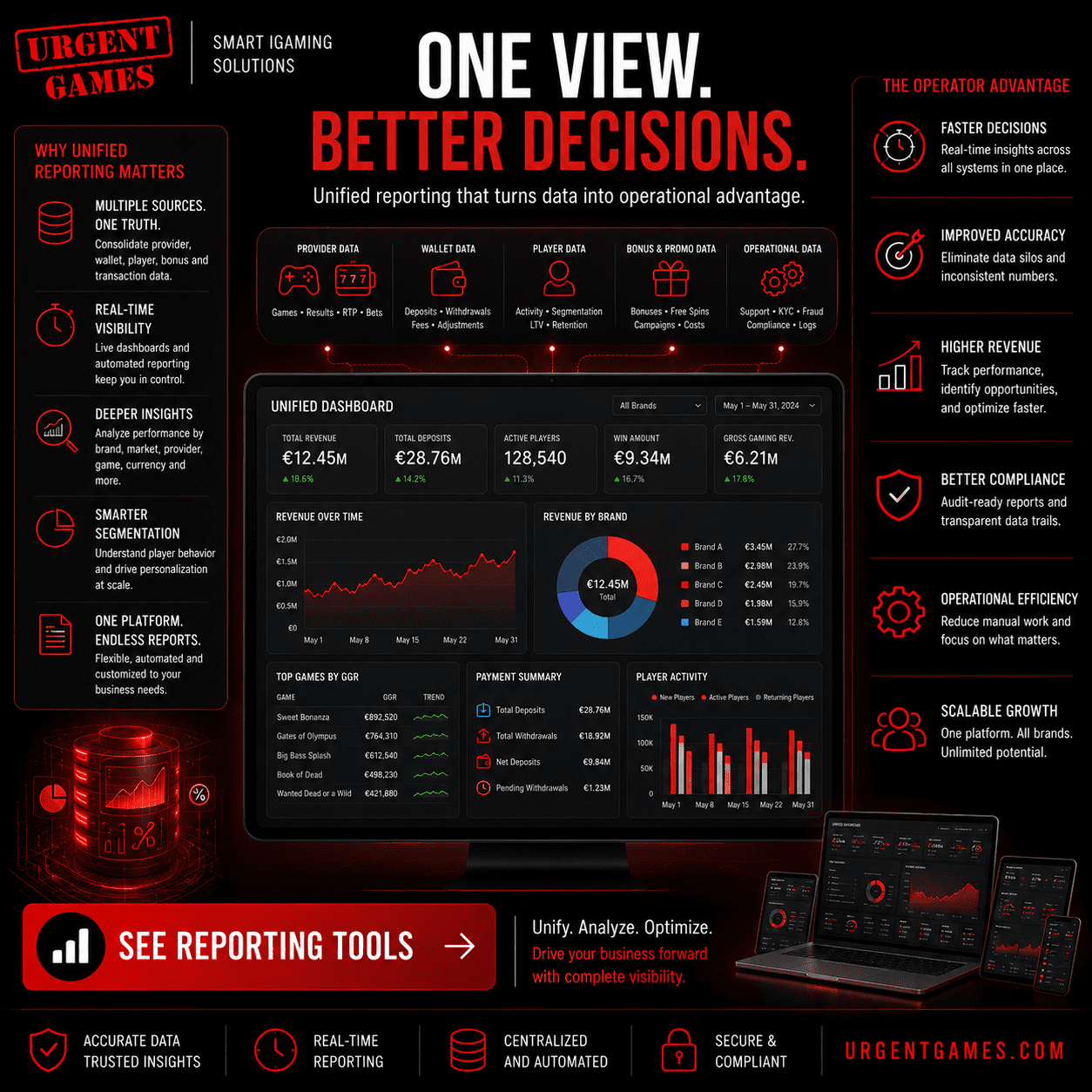
A unified reporting strategy consolidates provider, wallet, operational, and player data into a single source of truth, enabling faster decisions, better visibility, and improved profitability.
In today’s competitive market, reporting is no longer just about understanding what happened.
It’s about understanding what should happen next.
The Reporting Problem Most Operators Face
Many gaming operators operate multiple systems simultaneously.
Examples include:
- Multiple casino providers
- Sportsbook integrations
- Wallet infrastructure
- Payment processors
- Marketing platforms
Each system often provides its own reporting dashboard.
At first glance this seems useful.
However, problems quickly emerge.
Different systems frequently show:
- Different numbers
- Different timestamps
- Different definitions
- Different reporting formats
This creates confusion and delays.
Data Silos Create Operational Blind Spots
One of the biggest challenges in gaming operations is:
Data fragmentation.
When data exists in separate systems, teams struggle to see the complete picture.
For example:
The wallet may show:
- Deposit activity
The provider may show:
- Gameplay activity
The CRM may show:
- Retention metrics
Without consolidation, understanding player behavior becomes difficult.
Why Unified Reporting Matters
Unified reporting creates:
One source of truth.
Instead of relying on multiple dashboards, operators gain visibility through a centralized reporting environment.
This improves:
- Accuracy
- Efficiency
- Decision-making
Teams spend less time searching for data and more time acting on insights.
Better Decisions Start With Better Visibility
Business leaders need answers quickly.
Questions like:
- Which providers perform best?
- Which markets generate the highest value?
- Which promotions drive retention?
- Which payment methods perform best?
Should not require multiple systems to answer.
Unified reporting enables real-time visibility across operations.
Wallet Data Is More Valuable Than Many Operators Realize
The wallet sits at the center of the gaming ecosystem.
It captures:
- Deposits
- Withdrawals
- Bonuses
- Adjustments
- Financial activity
When wallet data is combined with gameplay data, operators gain a much deeper understanding of player behavior.
Financial context improves decision quality.
Provider Reporting Alone Is Not Enough
Provider dashboards are useful.
However, they only show part of the story.
A provider can reveal:
- Game popularity
- Session activity
- Revenue performance
But it cannot always explain:
- Deposit behavior
- Retention impact
- Cross-provider activity
Consolidated reporting fills these gaps.
Real-Time Reporting Creates Competitive Advantage
Traditional reporting often relies on:
- Daily reports
- Weekly summaries
- Manual exports
Modern operators increasingly require:
Real-time visibility.
Benefits include:
- Faster responses
- Better monitoring
- Improved operational control
The sooner teams identify opportunities or risks, the sooner they can act.
Fraud Detection Improves With Unified Data
Fraud patterns often span multiple systems.
Examples include:
- Wallet activity
- Device behavior
- Gameplay patterns
- Withdrawal requests
When reporting systems are disconnected, fraud indicators may be missed.
Unified reporting creates a more complete risk profile.
Better visibility improves fraud prevention.
Compliance Reporting Becomes Easier
Compliance teams frequently require information from:
- Wallet systems
- Provider records
- Audit logs
- Transaction histories
Without centralized reporting, preparing audits becomes time-consuming.
Unified reporting streamlines:
- Investigations
- Regulatory reporting
- Audit preparation
Compliance becomes more efficient.
Marketing Teams Benefit Too
Marketing performance depends on understanding:
- Player value
- Acquisition channels
- Retention behavior
- Deposit activity
Unified reporting enables more accurate measurement of:
- Campaign ROI
- Lifetime value
- Player segmentation
Better insights lead to better marketing decisions.
Multi-Brand Operators Need Centralized Visibility
Operators managing multiple brands face additional complexity.
Without unified reporting:
Each brand may operate independently.
This creates challenges around:
- Revenue analysis
- Resource allocation
- Performance benchmarking
Centralized reporting enables:
Cross-brand intelligence.
Operational Efficiency Improves
Manual reporting processes often involve:
- Exporting spreadsheets
- Combining data manually
- Reconciling inconsistencies
These activities consume valuable time.
Automation and centralized reporting reduce operational overhead significantly.
Teams become more productive.
Real-Time Analytics Improve Retention
Unified reporting helps operators understand:
- Session behavior
- Churn signals
- Retention drivers
By combining wallet, gameplay, and engagement data, operators can identify trends much earlier.
Early insights improve player retention strategies.
Observability and Reporting Work Together
Modern platforms increasingly combine:
- Reporting
- Monitoring
- Analytics
Into a unified operational view.
This enables teams to understand both:
- Business performance
- Technical performance
From a single environment.
Key Metrics Every Operator Should Track
Financial Metrics
- Deposits
- Withdrawals
- Net gaming revenue
- Average revenue per user
Operational Metrics
- Provider performance
- Session activity
- API health
- Uptime
Player Metrics
- Retention
- Churn
- Lifetime value
- Activity frequency
Compliance Metrics
- Audit readiness
- Transaction monitoring
- Risk indicators
Common Reporting Mistakes
❌ Relying on provider dashboards alone
Only part of the picture is visible.
❌ Manual spreadsheet reporting
Difficult to scale and prone to errors.
❌ No centralized source of truth
Different teams make decisions using different data.
❌ Delayed reporting
Opportunities and risks are discovered too late.
The Future of Unified Casino Reporting
The next generation of reporting platforms increasingly includes:
- Real-time dashboards
- AI-powered insights
- Predictive analytics
- Automated compliance reporting
- Cross-provider intelligence
Why?
Because operators need decisions at the speed of their business.
Final Thoughts
Data has become one of the most valuable assets in modern gaming.
But data only creates value when it is accessible, accurate, and actionable.
Modern unified casino reporting enables operators to:
- Improve decision-making
- Reduce operational complexity
- Strengthen compliance
- Enhance fraud monitoring
- Optimize player experiences
The operators that consolidate their reporting infrastructure gain a significant competitive advantage.
Because in modern iGaming:
Better visibility leads to better decisions.
Better decisions lead to better growth.