
 English
  简体中文
简体中文  Español
  Русский
  Türkçe
  Tiếng Việt
  Українська
  Български
  Suomi
Suomi  Ελληνικά
  Čeština
  اردو
اردو  Svenska
  עִבְרִית
  हिन्दी
  Français
  Հայերեն
  Italiano
  日本語
日本語  Română
  Polski
  Српски језик
  Latviešu valoda
  Deutsch (Sie)
  Português do Brasil
  한국어
한국어 
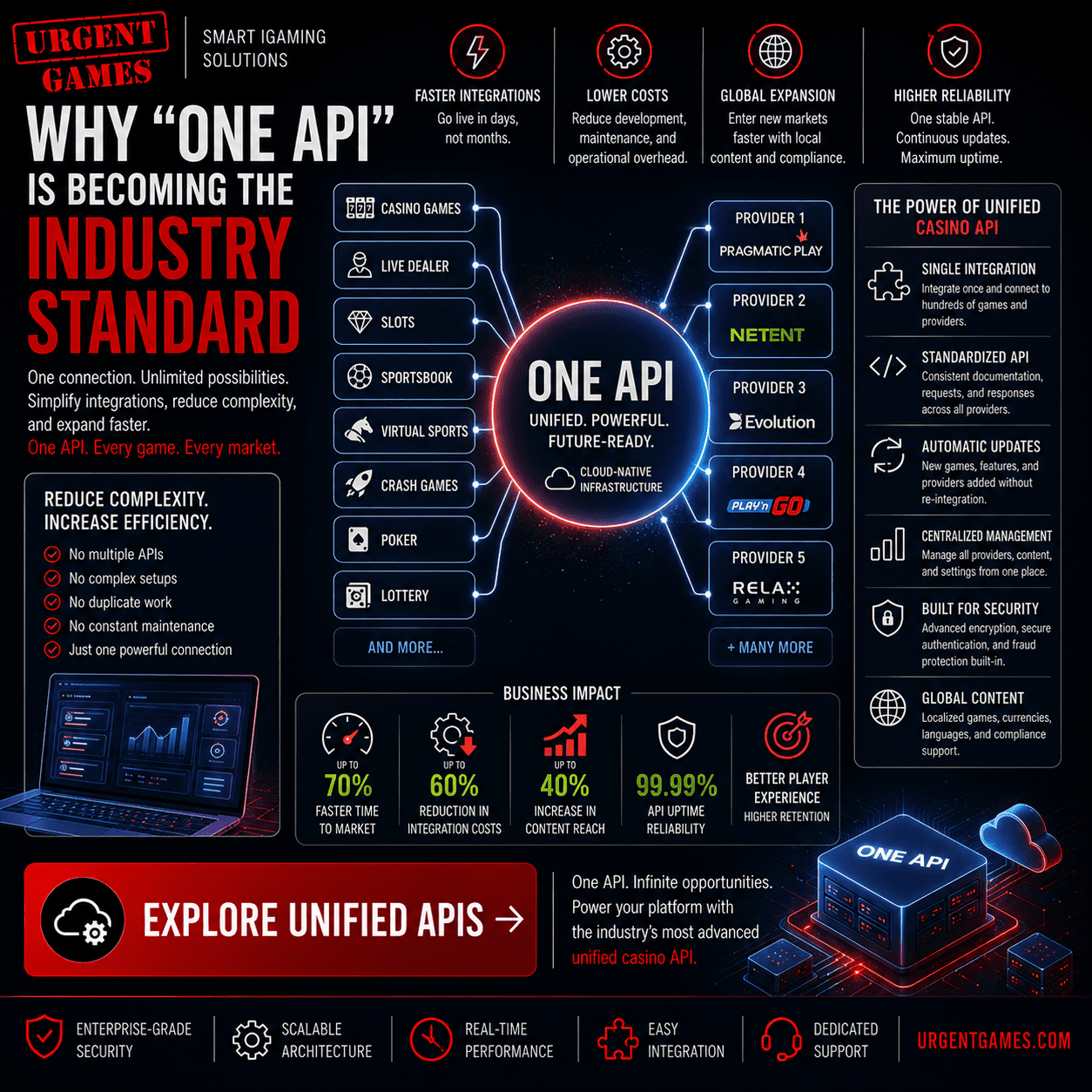
Why “One API” Is Becoming the Industry Standard
The online gaming industry has never moved faster.
Operators are expected to launch quickly, enter new markets, onboard new providers, support new payment methods, and deliver exceptional player experiences—all while maintaining security, compliance, and high availability.
The challenge?
Every new integration adds complexity.
Historically, operators integrated each provider individually.
That meant:
- Multiple APIs
- Different authentication methods
- Different documentation
- Different maintenance schedules
- Separate testing environments
As platforms expanded, managing dozens of integrations became increasingly expensive and difficult.
This is why modern operators are moving toward the unified casino API model.
Instead of integrating with every provider individually, operators integrate once and gain access to an entire ecosystem of gaming content and services.
The result is faster deployments, lower operational costs, and significantly greater scalability.
What Is a Unified Casino API?
A unified casino API provides a single integration point that connects operators with multiple gaming providers through one standardized interface.
Instead of maintaining separate integrations for:
- Slots
- Live Casino
- Crash Games
- Virtual Sports
- Poker
- Lottery
- Table Games
Operators manage one API that delivers consistent communication across all providers.
This dramatically simplifies development and ongoing maintenance.
Why Traditional Integrations Create Complexity
Every provider typically introduces unique requirements.
Examples include:
- Different authentication models
- Custom callback structures
- Proprietary transaction formats
- Unique game launch procedures
- Separate reporting systems
Engineering teams spend considerable time learning and maintaining each implementation.
As provider count increases, complexity grows exponentially.
One Integration Unlocks Hundreds of Games
The biggest advantage of a unified API is efficiency.
Rather than spending weeks integrating every provider individually, operators connect once and immediately access:
- Thousands of casino games
- Multiple content studios
- Live dealer products
- New providers as they become available
This accelerates platform growth while reducing development effort.
Faster Time-to-Market
Launching quickly creates measurable business value.
Operators that reduce deployment time can:
- Enter markets sooner
- Begin acquiring players earlier
- Generate revenue faster
- Test new opportunities quickly
A unified API shortens implementation timelines by eliminating repetitive integration work.
Speed becomes a competitive advantage.
Lower Development Costs
Maintaining dozens of individual APIs requires:
- More developers
- More testing
- More documentation
- More troubleshooting
A unified API reduces duplication.
Engineering teams spend less time maintaining integrations and more time building new features.
This improves both productivity and return on investment.
Standardization Simplifies Operations
Consistency matters.
A unified API provides standardized:
- Authentication
- Request formats
- Error handling
- Wallet communication
- Session management
Teams no longer need to learn a different system for every provider.
Standardization reduces errors and accelerates onboarding.
Easier Provider Expansion
Gaming content evolves rapidly.
Operators frequently add:
- New game studios
- Regional providers
- Promotional content
- Emerging game categories
With a unified API, adding new providers often requires little or no additional development.
Expansion becomes significantly easier.
Better Player Experiences
Players rarely think about APIs.
They care about:
- Fast game launches
- Reliable gameplay
- Accurate balances
- Consistent performance
Unified integrations improve backend consistency, which directly enhances the player experience.
Reliable infrastructure builds confidence.
Centralized Wallet Integration
One of the biggest operational challenges is wallet management.
Without standardization, every provider may communicate differently.
A unified API creates:
- Consistent wallet transactions
- Reliable balance synchronization
- Simplified reconciliation
- Faster financial processing
Financial operations become more predictable.
Unified Reporting Creates Better Visibility
Provider dashboards often operate independently.
A unified API enables centralized reporting across:
- Game performance
- Revenue
- Player activity
- Provider analytics
- Transaction history
Business leaders gain a complete operational view instead of switching between multiple systems.
Better Monitoring and Observability
Monitoring dozens of independent integrations is challenging.
Unified APIs simplify operational visibility by providing centralized monitoring for:
- API performance
- Provider availability
- Error rates
- Transaction health
- Response times
Issues become easier to detect and resolve.
Higher Reliability
Modern unified API platforms typically include:
- Automatic failover
- Redundant infrastructure
- Load balancing
- High availability architecture
This improves platform resilience while reducing operational risk.
When one provider experiences issues, the overall platform remains stable.
Security Becomes Easier to Manage
Managing multiple integrations often creates inconsistent security practices.
A unified API centralizes:
- Authentication
- Encryption
- Access control
- Audit logging
- Security monitoring
Standardized security reduces vulnerabilities while simplifying compliance.
Supporting Global Expansion
Operators entering new markets often require:
- Local game providers
- Regional payment methods
- Language support
- Currency localization
A unified API makes international expansion significantly faster by providing access to localized services through one platform.
Global growth becomes more manageable.
Future-Proofing Your Platform
The gaming industry continues to evolve.
New technologies emerge regularly, including:
- AI-powered experiences
- Blockchain gaming
- Crash games
- New payment methods
A unified API enables operators to adopt innovation without rebuilding existing infrastructure.
Future expansion becomes much easier.
Key Metrics Operators Should Monitor
Technical Metrics
- API response time
- Error rate
- Uptime
- Integration latency
Business Metrics
- Time-to-market
- Provider onboarding speed
- Revenue growth
- Player engagement
Operational Metrics
- Integration costs
- Maintenance effort
- Incident frequency
- Deployment speed
Common Integration Mistakes
❌ Building separate APIs for every provider
Creates unnecessary complexity.
❌ Inconsistent authentication
Increases operational risk.
❌ Duplicate wallet integrations
Complicates reconciliation.
❌ Fragmented reporting
Reduces business visibility.
❌ Delayed provider onboarding
Slows market expansion.
The Future of Unified Casino APIs
The next generation of casino APIs will increasingly include:
- AI-assisted integrations
- Automated provider onboarding
- Event-driven architecture
- Real-time analytics
- Cloud-native scalability
- Built-in compliance services
Why?
Because operators need platforms that evolve with the industry rather than slowing them down.
Final Thoughts
Modern operators compete on speed, flexibility, and operational efficiency.
A unified casino API delivers all three.
By replacing dozens of individual integrations with a single standardized connection, operators can:
- Reduce development costs
- Accelerate market expansion
- Improve platform reliability
- Simplify operations
- Deliver better player experiences
The future of iGaming isn’t built on managing more integrations.
It’s built on managing fewer integrations more intelligently.
Because in today’s gaming industry:
One connection can unlock unlimited opportunities.