
 English
  简体中文
简体中文  Español
  Русский
  Türkçe
  Tiếng Việt
  Українська
  Български
  Suomi
Suomi  Ελληνικά
  Čeština
  اردو
اردو  Svenska
  עִבְרִית
  हिन्दी
  Français
  Հայերեն
  Italiano
  日本語
日本語  Română
  Polski
  Српски језик
  Latviešu valoda
  Deutsch (Sie)
  Português do Brasil
  한국어
한국어 
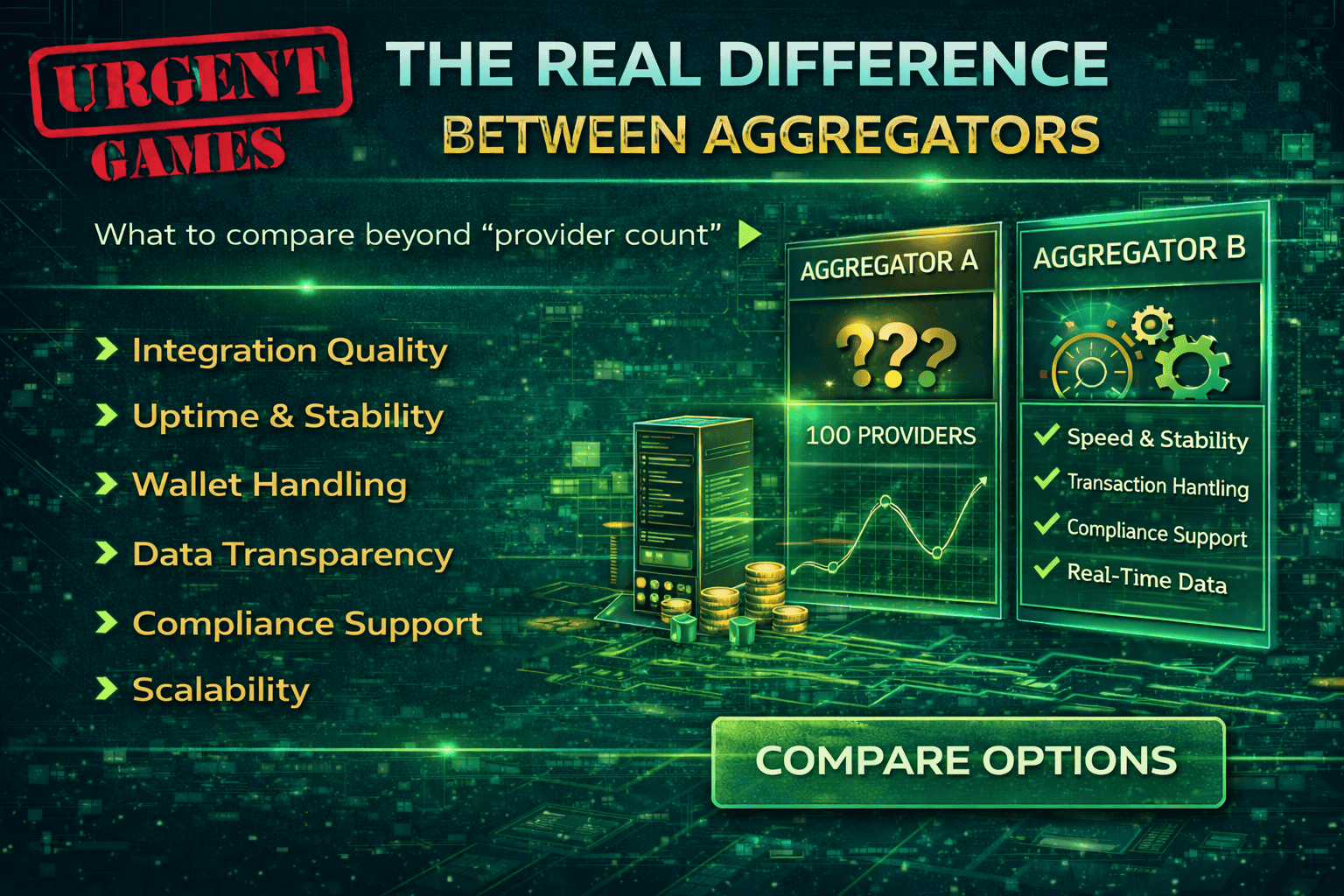
Introduction: Why “Provider Count” is Misleading
A proper casino aggregator comparison starts by ignoring the most common metric—provider count.
Ask most operators how they evaluate an aggregator, and they’ll say:
“How many providers do they have?”
It sounds logical. However, it’s one of the least useful metrics today.
Because:
- 5,000 games don’t matter if performance is poor
- 100 providers don’t matter if integrations fail
- A large catalog doesn’t guarantee engagement
So instead of focusing on size, a smart casino aggregator comparison looks deeper—at infrastructure, reliability, and long-term impact.
Casino Aggregator Comparison: Infrastructure Over Catalog Size
An aggregator is not just a content library—it’s a core system layer.
It directly affects:
- Player experience
- Revenue consistency
- Operational efficiency
- Time-to-market
👉 Key insight: Choosing the wrong aggregator limits your growth—not just your game selection.
Integration Quality in Casino Aggregator Comparison
Anyone can promise “easy integration.” Very few deliver it.
What to evaluate:
- API clarity and documentation
- Integration speed (days vs weeks)
- Consistency across providers
- Sandbox environments
For API best practices, see:
https://cloud.google.com/apis/design
Why it matters:
Poor integration leads to bugs, delays, and ongoing maintenance issues.
Uptime & Stability: A Critical Comparison Factor
This is where many aggregators fail quietly.
What to evaluate:
- SLA uptime guarantees
- Incident frequency
- Recovery speed
Why it matters:
Downtime directly impacts revenue and trust.
Red flags:
- Frequent disconnections
- Slow loading games
- Session instability
Latency & Performance Across Aggregators
Speed is essential.
What to evaluate:
- Game load time
- API response time
- Regional performance
Why it matters:
Even small delays can reduce engagement and conversions.
👉 Internal link suggestion:
Read your “Real-Time Gaming Infrastructure Guide”
Wallet & Transaction Handling
This is one of the most critical areas in any casino aggregator comparison.
What to evaluate:
- Transaction reliability
- Bet/win synchronization
- Retry and rollback logic
- Idempotency handling
Why it matters:
Poor systems can cause:
- Balance issues
- Player disputes
- Compliance risks
Game Standardization Layer
Providers behave differently. A strong aggregator hides that complexity.
What to evaluate:
- Unified API structure
- Standard game events
- Consistent formats
Why it matters:
Without standardization, your team must build custom fixes repeatedly.
Reporting & Data Transparency
Data must be clear and usable.
What to evaluate:
- Real-time reporting
- Data granularity
- Export tools
- Reconciliation systems
For analytics structure, see:
https://cloud.google.com/architecture/data-analytics
Why it matters:
Better data leads to better decisions.
Content Control & Flexibility
You should control your catalog—not the aggregator.
What to evaluate:
- Game enable/disable controls
- Region-based restrictions
- Brand-level customization
Why it matters:
Flexibility is essential for scaling across markets.
Compliance & Certification Support
Regulations are becoming stricter.
What to evaluate:
- Market certifications
- Compliance documentation
- Responsible gaming tools
Why it matters:
Your ability to expand depends on compliance readiness.
Support & Communication
Support quality becomes critical when issues arise.
What to evaluate:
- Response time
- Technical expertise
- Incident communication
Why it matters:
Fast support minimizes downtime and risk.
Scalability in Casino Aggregator Comparison
Your aggregator must grow with you.
What to evaluate:
- Traffic handling capacity
- Speed of adding new providers
- Infrastructure flexibility
Why it matters:
Switching aggregators later is costly and risky.
What Actually Differentiates Top Aggregators
The best aggregators are defined by execution—not size.
They:
- Integrate cleanly
- Run reliably
- Scale efficiently
- Provide clear data
- Reduce operational effort
The Psychology Behind Aggregator Decisions
Operators often choose based on:
- Sales pitches
- Large provider lists
- Short-term deals
However, problems appear later:
- When systems fail
- When scaling slows
- When data becomes unreliable
👉 Key insight: This isn’t a content decision—it’s a risk decision.
Common Mistakes in Aggregator Selection
1. Overvaluing Provider Count
More isn’t always better
2. Ignoring Technical Depth
Sales teams don’t run systems
3. Underestimating Migration Costs
Switching is difficult
4. Skipping Real Testing
Sandbox ≠ production
The Future of Aggregator Platforms
Aggregators are evolving beyond game libraries.
They are becoming:
- Full platform layers
- Real-time data engines
- Performance optimization systems
- Risk-aware infrastructure
As a result, future decisions will focus on performance—not just content.
Final Thoughts: Choose What Scales
The right aggregator gives you more than games.
It gives you:
- Stability
- Speed
- Flexibility
- Confidence
In the end, a strong casino aggregator comparison comes down to one thing:
Some platforms help you grow—others slow you down.
🚀 CTA: Compare Options
If you’re evaluating aggregators and want to make a decision based on performance—not just promises—
Compare your options with Urgent Games and choose infrastructure built for scale.