
 English
  简体中文
简体中文  Español
  Русский
  Türkçe
  Tiếng Việt
  Українська
  Български
  Suomi
Suomi  Ελληνικά
  Čeština
  اردو
اردو  Svenska
  עִבְרִית
  हिन्दी
  Français
  Հայերեն
  Italiano
  日本語
日本語  Română
  Polski
  Српски језик
  Latviešu valoda
  Deutsch (Sie)
  Português do Brasil
  한국어
한국어 
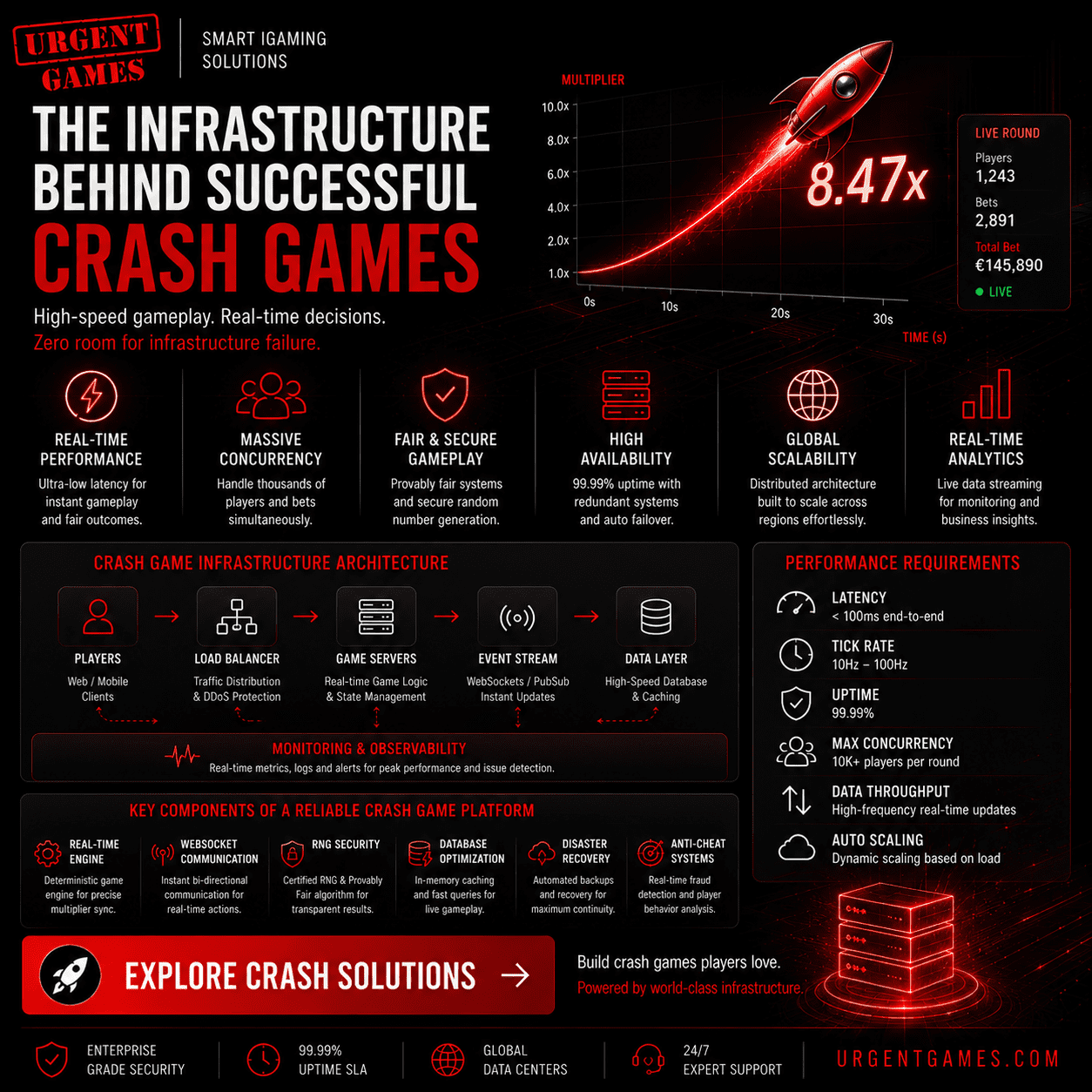
The Infrastructure Behind Successful Crash Games
Crash games have become one of the fastest-growing categories in online gaming.
Unlike traditional casino content, crash games create a unique combination of:
- Real-time interaction
- Multiplayer participation
- Instant outcomes
- Continuous engagement
Games like Aviator and other crash-style experiences have attracted millions of players worldwide because they combine simplicity with excitement.
However, behind the straightforward gameplay lies an incredibly demanding technical challenge.
A successful crash game requires infrastructure capable of processing thousands of simultaneous actions with near-zero latency.
Unlike slots, where individual spins occur independently, crash games operate as shared real-time events.
Every millisecond matters.
This is why modern operators investing in crash game infrastructure must prioritize performance, scalability, reliability, and security from the very beginning.
Because in crash gaming:
Infrastructure directly impacts player experience.
Why Crash Games Are Different
Most casino games are asynchronous.
A player:
- Opens a game
- Places a bet
- Receives a result
The interaction occurs largely between the player and the game server.
Crash games are fundamentally different.
They create:
Shared real-time experiences.
Thousands of players may participate in the same round simultaneously.
Every participant sees:
- The same multiplier
- The same game state
- The same outcome
At exactly the same moment.
Real-Time Synchronization Is Critical
A core challenge of crash games is:
State synchronization.
All connected players must receive identical updates with minimal delay.
If one player sees:
8.25x
While another sees:
8.18x
Trust quickly erodes.
Consistency is essential.
Latency Directly Impacts Gameplay
Crash games are highly sensitive to latency.
Players make cashout decisions in fractions of a second.
Even small delays can create:
- Frustration
- Perceived unfairness
- Support complaints
Modern crash game environments often target:
Sub-100ms end-to-end latency.
The lower the latency, the better the experience.
Why WebSockets Are Commonly Used
Traditional HTTP communication is often insufficient for crash games.
Most modern platforms utilize:
WebSockets.
Benefits include:
- Persistent connections
- Instant updates
- Low overhead
- Real-time communication
This enables continuous synchronization between servers and players.
Massive Concurrency Requirements
Popular crash games can attract:
- Thousands of concurrent players
- Thousands of simultaneous bets
- Continuous event streams
The platform must handle:
High concurrency without degradation.
Infrastructure bottlenecks quickly become visible to players.
Scalability Is Non-Negotiable
Traffic patterns in crash games can change rapidly.
Marketing campaigns, influencers, and peak activity periods can create sudden spikes.
Modern infrastructure must support:
- Horizontal scaling
- Dynamic resource allocation
- Auto-scaling environments
Scalability protects player experience.
Load Balancing Prevents Performance Issues
Crash platforms typically distribute traffic across multiple servers.
Load balancers help:
- Prevent overload
- Improve availability
- Distribute connections efficiently
No single server should become a bottleneck.
The Importance of Event Streaming
Crash games generate constant streams of events.
Examples include:
- Player joins
- Bet placements
- Multiplier updates
- Cashouts
- Round completion
Event-driven architectures improve:
- Responsiveness
- Reliability
- Scalability
Event streaming is a core architectural component.
Database Performance Matters
Crash games generate substantial transactional activity.
The platform must process:
- Bets
- Settlements
- Wallet updates
- Analytics events
Efficient database design becomes critical.
Modern systems often leverage:
- In-memory caching
- Distributed databases
- Optimized indexing
Slow databases create slow gameplay.
Wallet Infrastructure Must Be Fast
Every crash round involves:
- Bet placement
- Balance deduction
- Cashout processing
- Settlement updates
Wallet operations must occur instantly.
Delays can create:
- Balance inconsistencies
- User frustration
- Support tickets
Financial infrastructure must operate in real time.
High Availability Is Essential
Crash games run continuously.
Downtime impacts:
- Revenue
- Player trust
- Retention
Modern operators often target:
99.9%+ uptime.
This requires:
- Redundancy
- Failover systems
- Continuous monitoring
Fairness and Transparency Matter
Players expect crash games to be fair.
Many operators implement:
Provably fair systems.
These mechanisms allow outcomes to be verified and increase player confidence.
Transparency has become an important competitive advantage.
Security Cannot Be Overlooked
Crash games create attractive targets for:
- Fraud attempts
- Bot activity
- Exploitation
Security layers should include:
- Transaction validation
- Rate limiting
- Anti-bot systems
- Session monitoring
Security protects both players and operators.
Anti-Cheat Systems Are Increasingly Important
As crash games grow, abuse attempts become more sophisticated.
Operators increasingly implement:
- Behavioral analysis
- Pattern detection
- Real-time monitoring
To identify suspicious activity.
Fair competition improves long-term sustainability.
Monitoring and Observability Are Critical
Modern crash platforms continuously monitor:
- Latency
- Connection health
- Server utilization
- Transaction performance
Observability helps teams identify problems before players notice them.
Visibility enables proactive operations.
Real-Time Analytics Drive Better Decisions
Crash games generate valuable operational insights.
Analytics help operators understand:
- Player behavior
- Session length
- Cashout patterns
- Revenue performance
Data supports optimization.
Multi-Region Infrastructure Improves Performance
Global player bases create additional challenges.
Players in different regions expect similar responsiveness.
Many operators deploy:
Multi-region infrastructure.
Benefits include:
- Reduced latency
- Better redundancy
- Improved scalability
Cloud-Native Architecture Supports Growth
Modern crash platforms increasingly utilize:
- Containers
- Kubernetes
- Auto-scaling clusters
- Managed cloud services
Cloud-native architecture enables:
Rapid growth without operational complexity.
Key Metrics Operators Should Monitor
Performance Metrics
- Latency
- Tick rate
- Connection stability
Infrastructure Metrics
- Server utilization
- Database response times
- Auto-scaling performance
Business Metrics
- Concurrent players
- Round participation
- Revenue per session
Reliability Metrics
- Uptime
- Error rates
- Recovery times
Common Infrastructure Mistakes
❌ Underestimating concurrency
Traffic grows faster than expected.
❌ Ignoring latency
Small delays affect gameplay significantly.
❌ Weak monitoring
Problems remain hidden too long.
❌ Insufficient redundancy
Outages become costly.
❌ Slow wallet processing
Financial friction damages trust.
The Future of Crash Game Infrastructure
The next generation of crash platforms will increasingly leverage:
- Real-time event streaming
- AI-powered monitoring
- Predictive scaling
- Multi-region deployment
- Advanced anti-cheat systems
Why?
Because player expectations continue increasing.
Final Thoughts
Crash games may appear simple on the surface.
Behind every successful platform lies sophisticated infrastructure designed to support:
- Real-time gameplay
- Massive concurrency
- Low latency
- Financial accuracy
- Global scalability
Modern crash game infrastructure is not just about keeping games online.
It is about creating experiences that feel instant, fair, and reliable.
Because in crash gaming:
The faster the game moves, the stronger the infrastructure must be.