
 Српски језик
  English
  简体中文
简体中文  Español
  Русский
  Türkçe
  Tiếng Việt
  Українська
  Български
  Suomi
Suomi  Ελληνικά
  Čeština
  اردو
اردو  Svenska
  עִבְרִית
  हिन्दी
  Français
  Հայերեն
  Italiano
  日本語
日本語  Română
  Polski
  Latviešu valoda
  Deutsch (Sie)
  Português do Brasil
  한국어
한국어 
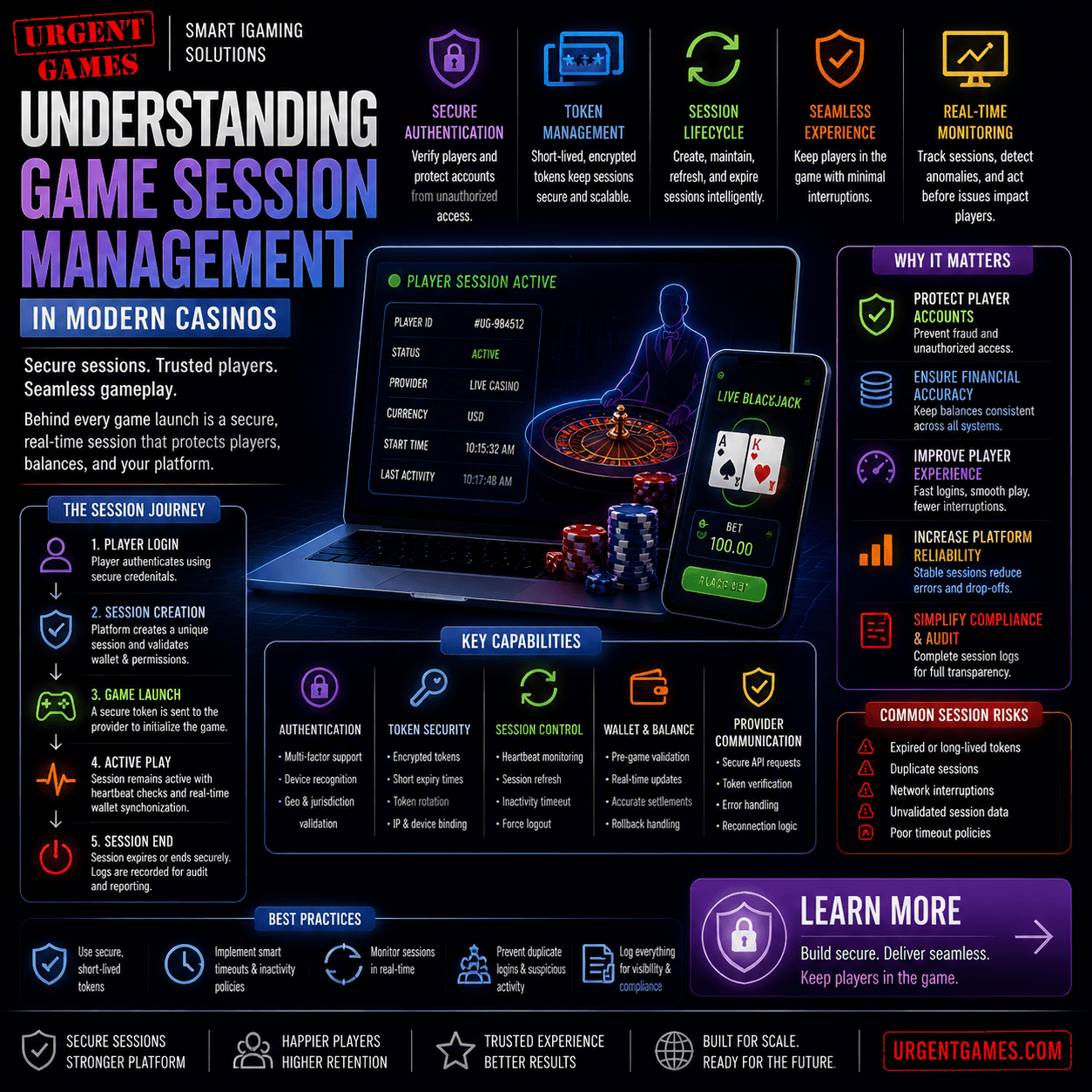
Every time a player launches an online casino game, a complex series of events takes place behind the scenes in just a few milliseconds. The player simply clicks “Play.” Behind that single click sits casino game session management, a critical engineering framework that ensures secure, seamless, and uninterrupted gameplay.
While players rarely notice the heavy lifting occurring in the background, platform operators know that poorly managed sessions can result in failed game launches, severe security vulnerabilities, balance inconsistencies, and frustrated users. Modern casino game session management isn’t just a technical requirement—it’s the absolute cornerstone of player trust and platform reliability.
What Is Casino Game Session Management?
In modern iGaming infrastructure, casino game session management refers to the process of securely establishing, maintaining, and terminating the real-time communication pipeline between the player, the core igaming platform backend, and the external game software provider.
A standard lifecycle begins the microsecond a player triggers a game and relies on a strictly ordered execution sequence:
Why Robust Session Management Matters
Every active session represents an open, trusted financial connection. Without airtight architectural guardrails surrounding your session handling, operators face crippling liabilities:
Unauthorized System Access: Exploiters hijacking legacy active states to bleed accounts dry.
Duplicate Session Exploits: Players launching the same game across multiple browser tabs to generate concurrent wallet calls, forcing negative balance loops.
Wallet Inconsistencies: Mismatches between what the game provider logs as spent versus what the platform core wallet has debited.
Interrupted Gameplay: Poor session persistence causing crashes right as a high-stakes bonus round triggers.
The Authentication Engine & Secure Tokens
Before a game session can be generated, identity must be validated. Modern setups check a user’s standard credentials alongside geo-location IP tracking to guarantee the user is sitting inside a legally permitted market jurisdiction.
Rather than continuously sending sensitive user credentials back and forth over the network with every spin or bet, modern casino game session management relies strictly on tokenization. Short-lived JSON Web Tokens (JWT) or secure session keys provide an isolated layer of defense.
Token Integrity Rule: Tokens must always be cryptographically randomized, highly time-restricted, encrypted in transit using TLS 1.3, and structured to auto-expire after a short window of server inactivity.
Maintaining Wallet Validation and Real-Time Synchronization
Before the game engine allows a player to spin a slot machine or place a blackjack wager, the platform core performs a strict wallet validation step.
[Game Engine Request] ──> [Session Management Token Check] ──> [Real-Time Core Wallet Balance Sync]
This synchronization layer intercepts the game launch to check:
Sufficient Balance: Ensuring real funds or active bonus balances are fully settled.
Responsible Gaming Guardrails: Checking loss limits, cool-off timers, and absolute self-exclusion databases in real-time. If an account is locked, the session is killed instantly before the software initializes.
Preventing Vulnerabilities: Duplicate Sessions and Timeouts
One of the greatest headaches in casino infrastructure is handling duplicate active sessions. If a user attempts to log into the same player account across multiple devices or windows simultaneously, the session manager must act decisively.
Best practices dictate a strict Single Active State policy. If a new session request is authenticated, the backend should issue a connection drop to the older session token, ensuring only one live portal can communicate with the platform’s transactional wallet database.
Similarly, sessions must rely on continuous active tracking. By utilizing server-side “heartbeat” requests—silent, low-overhead pings sent from the client at fixed intervals—the system keeps the channel alive during active play but seamlessly triggers a timeout if the browser goes quiet.
Key Metrics Operators Must Monitor
To keep infrastructure performing optimally under peak traffic loads, DevOps teams should keep close tabs on these mission-critical metrics:
| Metric Category | Key Performance Indicators | What It Reveals |
| Authentication Logs | Login Success Rate / Token Validation Failures | Highlights active brute-force attacks or bad API gateways. |
| Session Performance | Session Creation Time / Game Launch Latency | Directly correlates to player conversion and drop-off rates. |
| Security Signals | Duplicate Session Frequency / IP Anomaly Detections | Pinpoints automated bots or account-sharing exploits. |
Future Trends in Session Architectures
Optimize Your iGaming Backend Infrastructure
Building resilient, high-throughput session protocols requires deep compliance knowledge and robust web infrastructure. For more technical deep dives, check out our companion guides on internal data synchronization or explore our development tools.