
 English
  简体中文
简体中文  Español
  Русский
  Türkçe
  Tiếng Việt
  Українська
  Български
  Suomi
Suomi  Ελληνικά
  Čeština
  اردو
اردو  Svenska
  עִבְרִית
  हिन्दी
  Français
  Հայերեն
  Italiano
  日本語
日本語  Română
  Polski
  Српски језик
  Latviešu valoda
  Deutsch (Sie)
  Português do Brasil
  한국어
한국어 
Scalable Casino Infrastructure: Why Smart Operators Prioritize It Before Marketing
Introduction
Scalable casino infrastructure is the foundation of sustainable growth in modern iGaming. While many operators focus heavily on marketing campaigns, affiliate partnerships, influencer promotions, and acquisition bonuses, long-term success depends on whether the platform can reliably support growing player volumes.
Every operator wants growth.
More players mean more opportunities to generate revenue. In addition, higher deposit volumes can improve profitability. Ultimately, sustainable growth builds long-term business value.
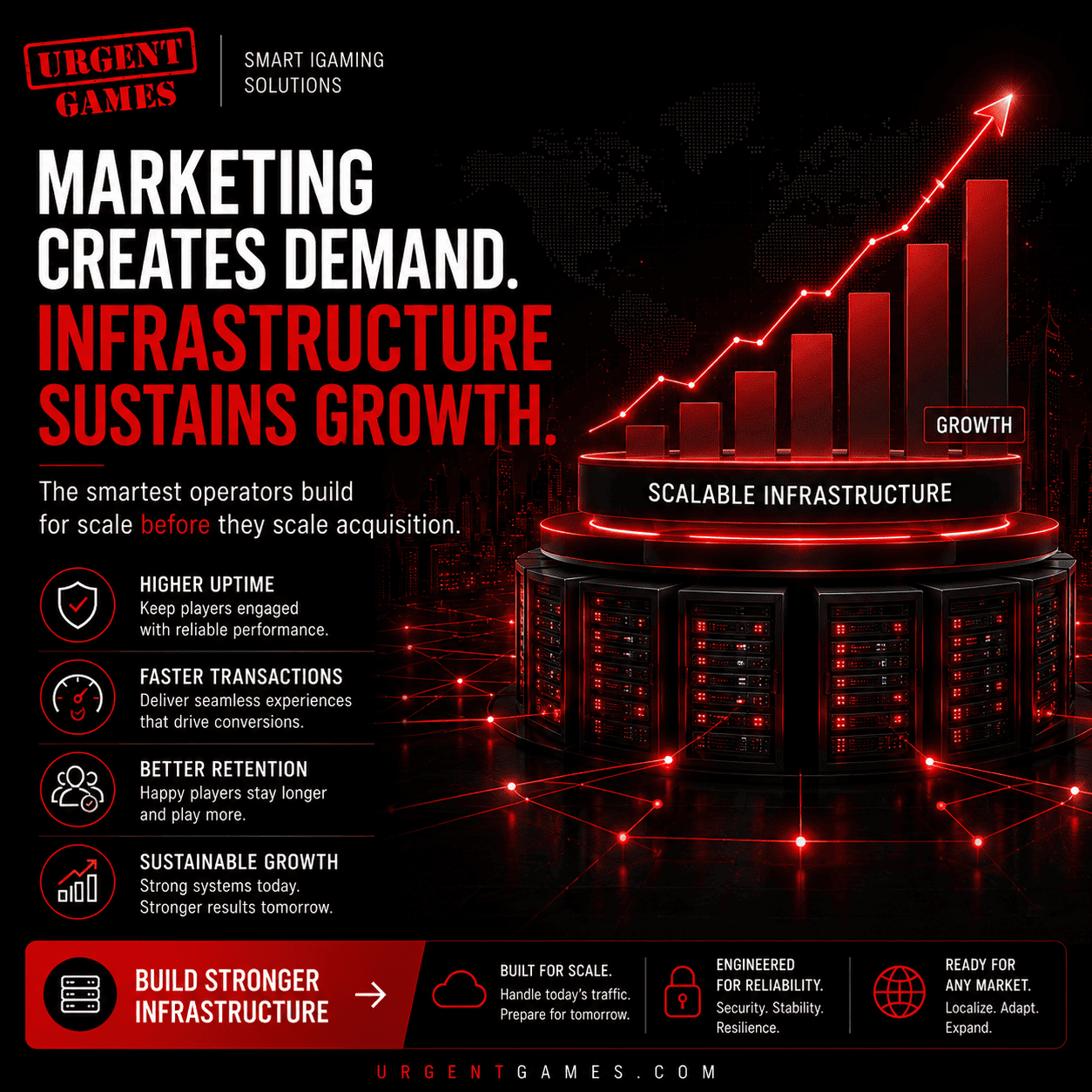
However, there is an important balance to understand. Marketing creates demand, but infrastructure determines whether that demand can be handled effectively and turned into real retention and revenue.
For this reason, successful gaming companies increasingly invest in scalable casino infrastructure before aggressively increasing acquisition budgets.
Because attracting players only creates value when the platform can consistently support them.
Why Scalable Casino Infrastructure Matters Before Growth
Marketing success often feels exciting at first.
Traffic increases. Registrations rise. Deposits improve.
However, things change quickly when growth accelerates, because hidden weaknesses begin to surface.
For example, systems that work well with 1,000 players may struggle significantly at 50,000 players.
As a result, operators often experience a repeating cycle:
More marketing leads to more traffic, and more traffic can eventually lead to system failures.
Therefore, scalability must be considered early rather than later.
How Scalable Casino Infrastructure Prevents Growth Bottlenecks
Infrastructure issues usually do not appear suddenly.
Instead, they build up quietly over time until higher traffic exposes them.
Common examples include:
- Slow APIs
- Weak wallet systems
- Poor database design
- Limited scalability
- Single points of failure
During normal operations, these issues may not seem serious. However, under pressure they quickly become critical problems.
In contrast, strong infrastructure prevents these bottlenecks and keeps systems stable even during rapid growth.
Player Acquisition Is Expensive
Modern acquisition costs continue to rise across the industry.
Operators invest heavily in:
- Paid advertising
- Affiliate programs
- Sponsorships
- Influencer campaigns
Because of this, every new player represents a real financial investment.
Consequently, infrastructure problems can reduce the return on marketing spend.
If new users experience slow load times or failed transactions, they are far less likely to stay.
Downtime Turns Marketing Spend Into Waste
Imagine launching a successful campaign that drives a sudden traffic spike.
At first, everything looks positive.
However, under pressure, issues begin to appear:
- Login systems fail
- Deposits timeout
- Games become unavailable
As a result, players leave the platform. Although the marketing campaign succeeds in bringing traffic, the platform fails to deliver a stable experience. Consequently, acquisition spend becomes less effective.
Therefore, platform reliability should always be treated as part of the growth strategy.
First Impressions Matter
Most players decide whether they trust a platform within minutes.
Typically, their first experience includes:
- Registration flow
- Deposit process
- Game loading speed
- Mobile performance
Because of this, infrastructure plays a direct role in shaping trust.
If the system is slow or unstable, users may leave before they fully engage.
Reliability Is a Growth Strategy
Many operators still treat reliability as a purely technical concern. However, it directly impacts business growth.
A reliable platform leads to several benefits:
- Better retention
- Higher lifetime value
- More referrals
- Stronger brand reputation
In addition, positive experiences encourage users to return more often. Over time, this creates a compounding effect similar to marketing.
Therefore, reliability should be seen as a core growth driver rather than a background function.
Core Components of Scalable Casino Infrastructure
Before scaling acquisition, operators should evaluate key systems carefully.
Wallet Infrastructure
It is important to ensure that balances update instantly and consistently.
Additionally, systems should handle spikes in transaction volume without delays or errors.
API Performance
APIs must remain responsive even during peak traffic.
Moreover, third-party integrations should remain stable under heavy load.
Database Scalability
Databases should be able to support:
- More users
- More transactions
- More reporting requirements
All without performance loss.
Monitoring and Visibility
Equally important is the ability to detect issues early.
With strong monitoring, teams can identify problems before players notice them.
Why Fast Growth Creates Technical Debt
Rapid scaling often forces teams to move quickly.
As a result, temporary solutions are introduced, such as:
- Quick integrations
- Manual processes
- Short-term fixes
While these approaches solve immediate problems, they often create long-term complexity.
Over time, this becomes technical debt, which is more expensive to fix later.
Multi-Provider Systems Require Strong Foundations
Modern platforms rely on multiple external systems, including:
- Game aggregators
- Payment providers
- Sportsbook integrations
- Risk engines
Each integration adds complexity.
Therefore, without a scalable system design, operational risk increases significantly.
Infrastructure Directly Impacts Retention
Retention is often influenced by marketing, but infrastructure plays a larger role than many operators expect.
For example, players often leave because of:
- Slow withdrawals
- Login issues
- Session interruptions
- Wallet inconsistencies
As a result, users tend to remain on platforms that feel stable and consistent.
Why Mobile Gaming Requires Scalable Casino Infrastructure
Today, mobile traffic dominates the iGaming industry.
Because of this, users expect:
- Fast loading times
- Smooth gameplay
- Instant transactions
However, mobile networks can expose weaknesses more easily than desktop environments.
Therefore, strong infrastructure is essential for delivering consistent mobile performance.
Scaling Infrastructure Costs Less Than Recovery
Some operators delay investment because infrastructure improvements appear expensive at first.
However, the real cost of poor performance is often much higher.
For example, outages can lead to revenue loss. Likewise, churn reduces long-term earnings. In addition, reputation damage can take years to repair.
Perhaps most importantly, poor performance reduces marketing efficiency.
Consequently, preventing issues is far more cost-effective than fixing them later.
The Multi-Tenant Advantage
Modern platforms increasingly use multi-tenant architecture.
This approach offers several benefits:
- Faster deployment of new brands
- Shared infrastructure resources
- Lower operational overhead
- Easier geographic expansion
In turn, scalability becomes more efficient and manageable.
Monitoring Is an Operator Advantage
Leading operators do not wait for problems to occur.
Instead, they detect and resolve issues early.
Modern monitoring systems provide visibility into:
- API response times
- Provider performance
- Transaction failures
- Session stability
- System bottlenecks
Because of this visibility, teams can act faster and reduce downtime risk.
Marketing Performance Depends on Platform Performance
Marketing results are closely tied to platform stability.
For example:
- Fast sites improve conversions
- Smooth registration increases sign-ups
- Stable deposits improve retention
- Reliable gameplay increases engagement
Therefore, infrastructure and marketing must work together rather than separately.
Common Operator Mistakes
Scaling acquisition too early
Growth often exposes hidden weaknesses.
Treating infrastructure as a cost
In reality, strong systems directly improve revenue.
Ignoring monitoring tools
Without visibility, small issues become large failures.
Relying on short-term fixes
Temporary solutions often create long-term complexity.
The Future of Scalable Casino Infrastructure in iGaming
The industry is moving toward more advanced systems, including:
- Cloud-based architecture
- Event-driven design
- Multi-region deployment
- Real-time monitoring
- Automated failover systems
- Unified API ecosystems
Why is this happening?
Because modern growth depends on system reliability, not just marketing strength.
Building Scalable Casino Infrastructure for Long-Term Growth
Marketing can attract players.
However, infrastructure determines whether they stay.
A strong and scalable system enables:
- Higher retention
- Better conversion rates
- Stronger uptime
- Faster expansion
- Sustainable long-term growth
Ultimately, infrastructure is not something added after growth. Instead, it is what makes growth possible in the first place.
Because in modern iGaming, successful operators are not only marketing-driven.