
 Română
  English
  简体中文
简体中文  Español
  Русский
  Türkçe
  Tiếng Việt
  Українська
  Български
  Suomi
Suomi  Ελληνικά
  Čeština
  اردو
اردو  Svenska
  עִבְרִית
  हिन्दी
  Français
  Հայերեն
  Italiano
  日本語
日本語  Polski
  Српски језик
  Latviešu valoda
  Deutsch (Sie)
  Português do Brasil
  한국어
한국어 
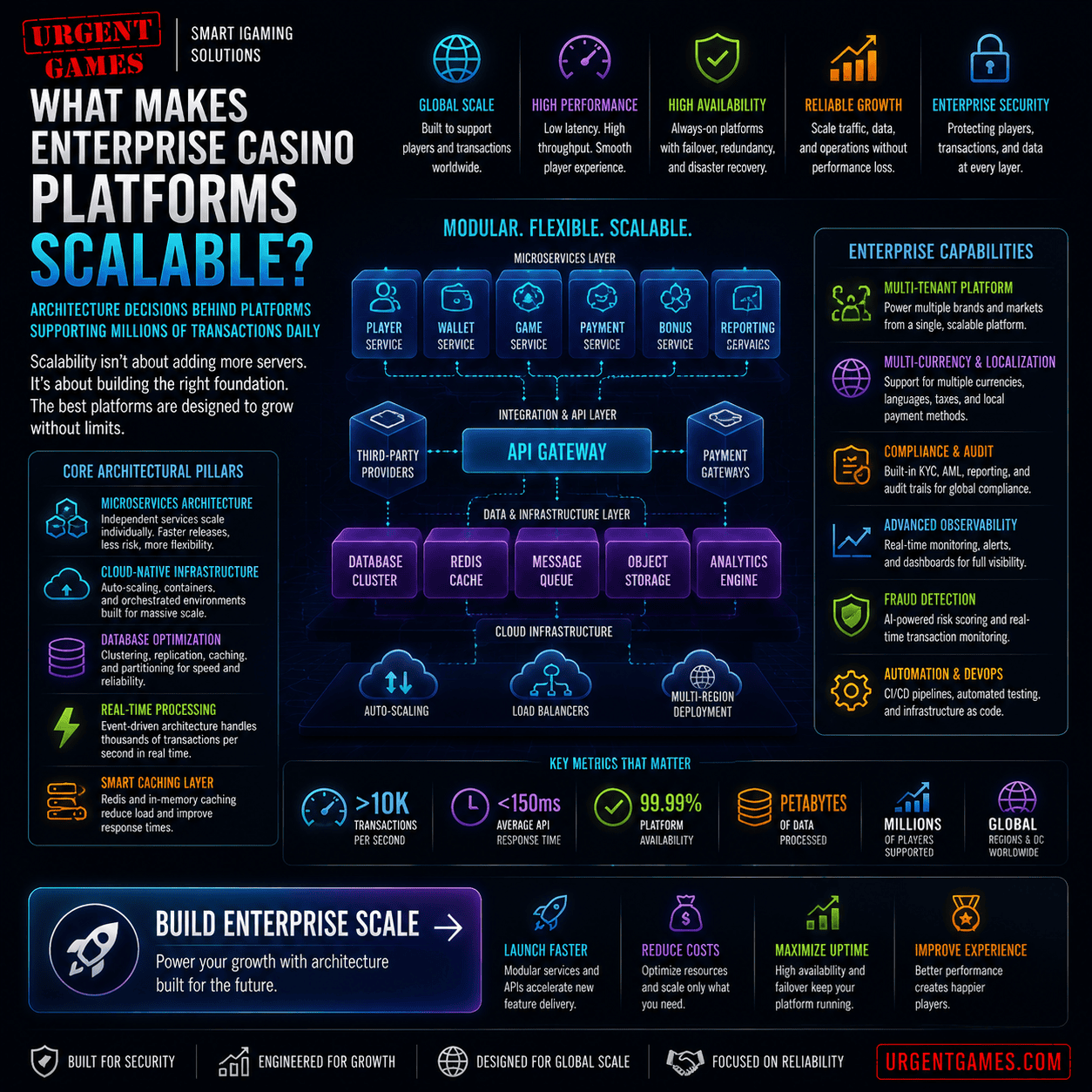
Scalable Casino Architecture: Building Enterprise iGaming Platforms
Building a successful online gaming platform is about far more than just launching games. The true technical challenges emerge when the platform experiences exponential growth.
While a small operator may comfortably handle a few hundred players, basic payment flows, and limited game catalogs, enterprise gaming platforms must reliably support:
Millions of daily financial transactions across global jurisdictions.
Tens of thousands of simultaneous, high-concurrency player sessions.
Multi-brand, multi-tenant white-label environments.
Hundreds of third-party aggregator and payment gateway integrations.
At this massive volume, traditional monolithic frameworks rapidly buckle under the pressure. The difference between an enterprise platform that seamlessly absorbs traffic surges and one that suffers catastrophic outages during peak events comes down to structural scalable casino architecture choices made long before the traffic arrives.
Why True Scalability Goes Beyond Adding Hardware
A common misconception among platform engineering teams is that scaling simply means provisioning larger cloud instances. While raw compute capacity is necessary, true system scalability is rooted in software design, decoupled data orchestration, service isolation, and automated infrastructure management.
Key Dimensions of Enterprise Scalability
Service Isolation: Decoupling core business functions so a spike in game launches never impacts wallet settlement.
Data Partitioning: Structuring database clusters to handle massive read/write volumes without resource contention.
Event-Driven Communication: Utilizing asynchronous messaging to process bets, bonuses, and telemetry in real time.
Fault Tolerance: Designing multi-region active-active environments with automated, self-healing failover mechanics.
Technical Pillars of Scalable Casino Architecture
1. Microservices and Container Orchestration
Monolithic applications bind player profiles, payment processing, bonus engines, and game catalogs into a single code base. By contrast, a modern scalable casino architecture breaks these domains into independent, containerized microservices managed via Kubernetes.
[API Gateway / Edge Router]
   ├──> [Player Management Service] (Autoscaled)
   ├──> [High-Throughput Wallet Engine] (Dedicated DB Cluster)
   ├──> [Game Aggregator Router] (Low-Latency Cache Layer)
   └──> [Real-Time Fraud & Telemetry Pipeline] (Event Stream)
Each microservice scales independently according to its specific workload demands. During major sporting events or promotional drops, compute resources automatically route to wallet settlement and authorization nodes without over-provisioning background reporting services.
2. High-Concurrency Distributed Wallet Engine
The wallet service is the most critical component of any gaming platform. It must process bets, wins, refunds, deposits, and withdrawals with absolute transaction consistency, real-time balance reconciliation, and non-negotiable idempotency controls.
Performance Optimization Strategy Matrix
To maintain ultra-low latency across global player bases, enterprise architectures implement multi-layered caching, read-replica scaling, and edge routing.
| Architecture Layer | Core Technology Stack | Primary Operational Function |
| Edge Routing & CDN | Cloudflare Enterprise / AWS CloudFront | Dynamic DDoS protection, geo-routing, and static asset caching. |
| In-Memory Cache Layer | Redis Enterprise Cluster | Session management, game catalog lookup, and balance caching. |
| Event Streaming Engine | Apache Kafka / Apache Pulsar | Asynchronous processing of bets, game rounds, and telemetry logs. |
| Primary Data Store | PostgreSQL / CockroachDB | Distributed, ACID-compliant ledger storage with dynamic partitioning. |
Common Architectural Mistakes to Avoid
Engineering Warning: Relying on synchronous, monolithic database calls across third-party API integrations introduces cascading failure risks during high-concurrency traffic spikes.
Tightly Coupling Game Logic to Core Wallet DBs: Direct database writes during every spin create severe locking bottlenecks. Use asynchronous event streams to handle non-critical state updates.
Neglecting Edge Latency for Global Players: Routing all worldwide traffic back to a single origin server degrades the player experience. Deploy regional edge gateways to optimize round-trip times.
To learn how high-throughput systems manage connection state and prevent server lag, check out our guide on implementing low-latency casino caching systems.