
 English
  简体中文
简体中文  Español
  Русский
  Türkçe
  Tiếng Việt
  Українська
  Български
  Suomi
Suomi  Ελληνικά
  Čeština
  اردو
اردو  Svenska
  עִבְרִית
  हिन्दी
  Français
  Հայերեն
  Italiano
  日本語
日本語  Română
  Polski
  Српски језик
  Latviešu valoda
  Deutsch (Sie)
  Português do Brasil
  한국어
한국어 
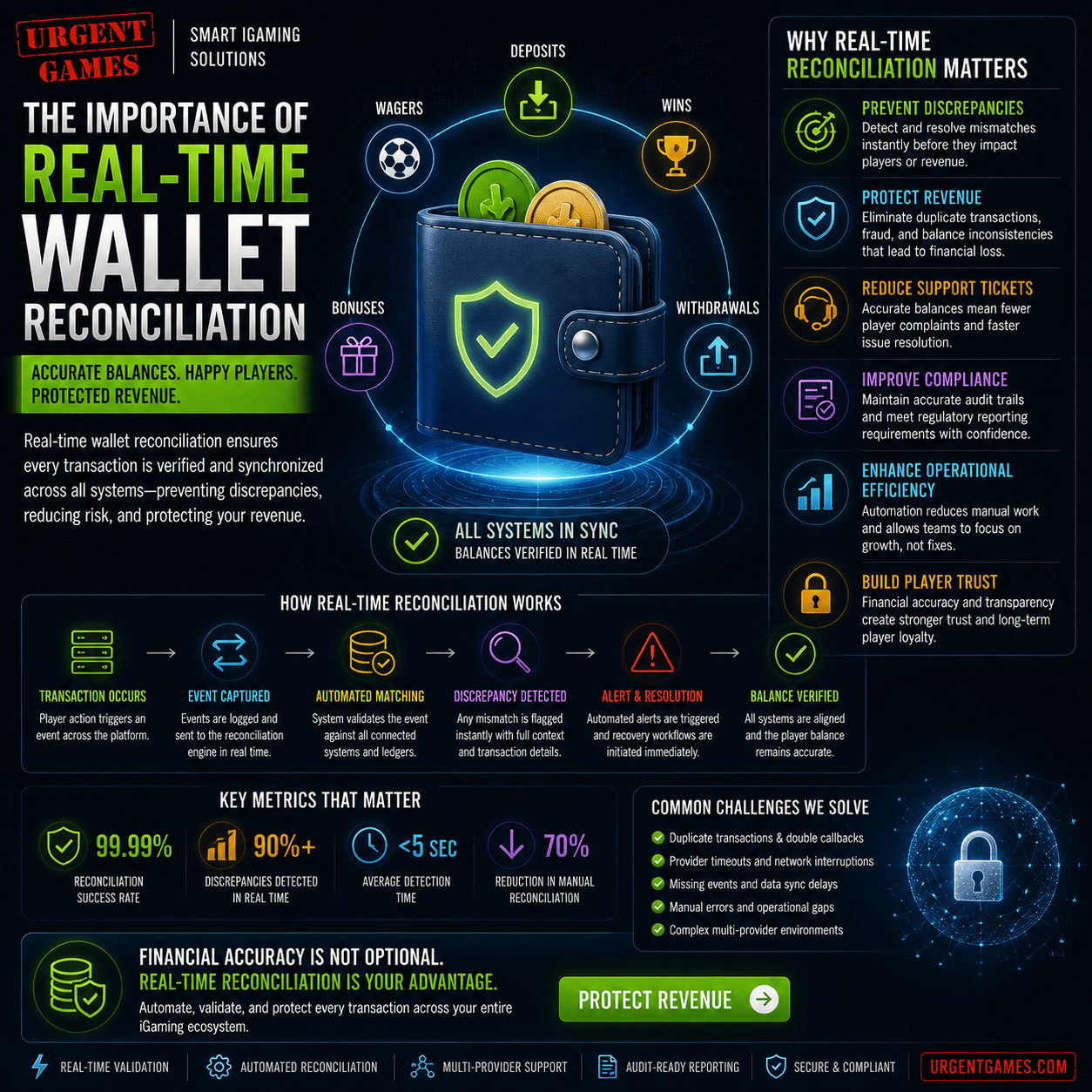
Real-Time Wallet Reconciliation: iGaming Financial Accuracy
Executing real-time wallet reconciliation is critical because every deposit, wager, bonus, win, refund, and withdrawal directly impacts a player’s wallet balance. In a modern iGaming platform, these transactions occur across multiple systems simultaneously—including payment gateways, casino game providers, sportsbooks, bonus engines, affiliate networks, and internal ledger databases. Even the smallest synchronization delay can create balance mismatches that lead to player disputes, financial loss, and strict regulatory penalties.
This is why implementing continuous ledger matching has become an essential operational priority for iGaming platforms. Maintaining a real-time wallet reconciliation strategy ensures that every transaction is accurately recorded, verified, and synchronized across every connected system—protecting both player trust and operator revenue.
What Is Real-Time Wallet Reconciliation in iGaming?
Financial reconciliation is the automated process of comparing financial records across disparate systems to confirm they reflect identical transaction histories and ledger balances.
A robust reconciliation system validates that:
Player balances reflect accurate debit and credit events.
Provider game callbacks match internal transaction logs.
Payment gateway settlements align with database records.
Bonus engine awards adhere to system rules.
Multi-currency ledgers remain synchronized in real time.
When discrepancies occur, real-time detection flags them before they escalate into major customer service disputes or revenue leaks.
Why Real-Time Processing Beats Traditional Batch Reconciliation
Traditional reconciliation relies on end-of-day batch processing. For high-volume gaming platforms handling thousands of transactions per second, waiting 24 hours to audit financial logs is too late.
[Transaction Triggered] ──> [Event Bus Ingestion] ──> [Idempotent Hash Check] ──> [Ledger Audit] ──> [Instant Balance Verification]
Implementing real-time wallet reconciliation allows operators to:
Correct Mismatches Instantly: Resolve failed callbacks before players notice balance errors.
Prevent Duplicate Transactions: Ensure network retries do not result in double payouts.
Detect Fraud Early: Stop unauthorized balance adjustments and bonus abuse immediately.
Reduce Support Tickets: Provide customer service teams with instant transaction audit trails.
For industry standards on securing digital payment channels, consult the PCI Security Standards Council Guidance.
Addressing Multi-Provider Complexity with Idempotency
Modern platforms integrate dozens of third-party game studios, live dealer feeds, sportsbooks, and payment processors. Every external API integration introduces potential failure points such as network timeouts, duplicate webhooks, or failed retries.
Safeguarding Transactions via Idempotency
To maintain consistency across external integrations, systems must enforce idempotency. Every transaction is assigned a unique transaction identifier ($UUID$), ensuring that repeated API calls process exactly once:
If a provider sends a duplicate callback due to a network lag, the reconciliation engine detects the duplicate $UUID$ and prevents double deposits or repeated wins.
Architectural Pillars of Event-Driven Reconciliation
To learn how distributed architecture supports platform reliability, read our guide on building global casino infrastructure.
Key Metrics for Monitoring Financial Accuracy
Operators should track key performance indicators across three primary operational areas:
| Audit Category | Core Metric Focus | Business Impact |
| Financial Telemetry | Reconciliation success rate & discrepancy ratio | Prevents direct revenue leakage |
| Operational Metrics | Reconciliation processing speed & alert response time | Minimizes system downtime and lag |
| Player Support | Wallet-related ticket volume & payout turnaround | Improves player satisfaction and retention |
For actionable advice on maintaining real-time system visibility, read our breakdown of iGaming observability strategies.
Common Wallet Reconciliation Pitfalls to Avoid
Operational Warning: Relying exclusively on manual daily reviews guarantees undetected balance errors during peak traffic periods.
❌ Batch-Only Auditing: Delays issue identification and increases financial risk.
❌ Missing Unique Transaction IDs: Makes preventing duplicate processing almost impossible.
❌ Disconnected Provider Syncing: Leads to inconsistent ledger states across third-party games.
❌ Manual Exception Review: Human review alone cannot scale with high-volume transaction activity.
To discover how automated deployment pipelines maintain database integrity, explore our playbook on casino CI/CD continuous deployment.
The Future of Automated Wallet Auditing
Next-generation iGaming platforms are upgrading their financial infrastructure with advanced capabilities:
AI-Powered Anomaly Detection: Identifies suspicious transaction patterns in real time.
Zero-Trust Ledger Validation: Verifies state changes across distributed microservices.
Automated Exception Remediation: Resolves synchronization errors without manual IT intervention.
Protect Your Platform’s Revenue and Compliance
Maintaining financial accuracy across multi-provider platforms requires robust, automated infrastructure.
Frequently Asked Questions
What is real-time wallet reconciliation?
Real-time wallet reconciliation is the automated process of continuously verifying financial transactions across payment gateways, game providers, and internal ledgers as they occur to ensure accurate balances.
How does idempotency prevent duplicate payouts?
Idempotency assigns a unique identifier to every transaction. If a provider sends duplicate API callbacks due to network delays, the system recognizes the ID and processes the request only once.
Why is batch reconciliation insufficient for high-volume iGaming platforms?
Batch reconciliation audits transactions only at the end of the day. In high-volume gaming, this delay allows balance errors, duplicate payouts, and fraud to remain undetected for hours.
Build Enterprise-Grade Financial Accuracy Today
Contact Our Infrastructure Engineering Team Today to deploy enterprise-grade reconciliation for your iGaming platform!