
 English
  简体中文
简体中文  Español
  Русский
  Türkçe
  Tiếng Việt
  Українська
  Български
  Suomi
Suomi  Ελληνικά
  Čeština
  اردو
اردو  Svenska
  עִבְרִית
  हिन्दी
  Français
  Հայերեն
  Italiano
  日本語
日本語  Română
  Polski
  Српски језик
  Latviešu valoda
  Deutsch (Sie)
  Português do Brasil
  한국어
한국어 
Introduction
Real time gaming analytics has become a critical competitive advantage for modern gaming operators. For years, gaming platforms relied on delayed reporting systems that generated insights hourly, daily, or even weekly. By the time operators identified problems, revenue opportunities were missed, fraud losses had increased, and player experience had already been impacted.
Today, gaming platforms process millions of player actions, thousands of transactions per second, continuous gameplay events, and real-time financial activity. Operators that can access and act on data instantly are better positioned to optimize performance, reduce risk, and improve player engagement.
This is why modern real time gaming analytics increasingly depends on event-driven architectures and streaming data pipelines. In today’s highly competitive market, the fastest operators are often the most informed.
Why Traditional Reporting Falls Short
Most legacy reporting systems follow a simple process:
- Data enters operational databases
- Reports are generated later
- Teams analyze results after the fact
This creates significant delays between activity and action.
For example:
A fraud attack begins at 2:00 PM.
The fraud report arrives at 5:00 PM.
Three hours of exposure have already occurred.
The same reporting limitations affect:
- Revenue monitoring
- Gameplay analytics
- Infrastructure monitoring
- Operational troubleshooting
- Customer experience management
Modern gaming businesses require visibility as events occur, not hours later.
What Is a Real-Time Data Pipeline?
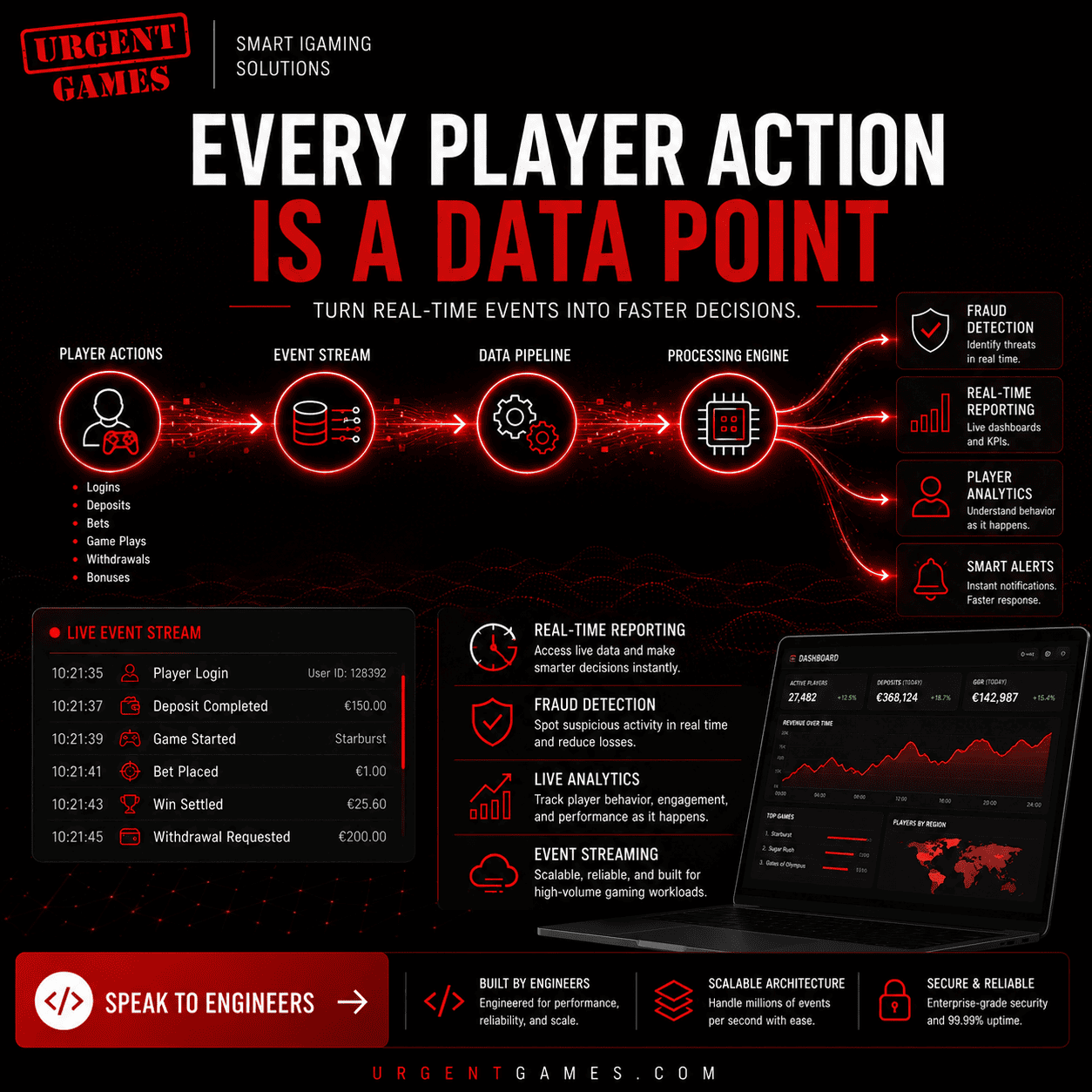
A real-time data pipeline continuously captures, processes, and distributes events the moment they occur.
Examples include:
- Player logins
- Deposits
- Withdrawals
- Bet placements
- Game launches
- Bonus activations
- Session terminations
Instead of waiting for scheduled reports, data becomes available immediately across the organization.
This capability forms the foundation of modern real time gaming analytics platforms.
How Event Streaming Powers Real Time Gaming Analytics
Traditional systems are built around databases.
Modern architectures are increasingly built around events.
Every action performed by a player or system becomes a streamable event.
Examples include:
- Player Registered
- Deposit Completed
- Game Started
- Bet Placed
- Win Settled
- Withdrawal Requested
These events can be consumed simultaneously by multiple systems, enabling instant analysis and decision-making.
The Event-Driven Advantage for Gaming Operators
A single event can support multiple business functions in real time.
For example:
Deposit Completed
Can immediately trigger:
- Wallet updates
- Fraud detection workflows
- Revenue dashboards
- CRM automation
- Marketing campaigns
- Analytics systems
This eliminates delays and creates a highly responsive gaming ecosystem.
Real-Time Reporting Improves Decision Making
With real time gaming analytics, operators no longer need to wait for overnight reports.
They can monitor:
- Revenue performance
- Active player counts
- Payment activity
- Provider performance
- Regional traffic patterns
- Conversion metrics
As events happen.
Faster visibility enables faster decisions and more effective operations.
Real-Time Fraud Detection Reduces Risk
One of the most valuable applications of real time gaming analytics is fraud prevention.
Traditional fraud systems often identify suspicious activity after losses have occurred.
Event-driven systems can detect anomalies instantly.
Examples include:
- Deposit velocity spikes
- Multi-account behavior
- Device fingerprint anomalies
- Withdrawal abuse
- Bonus exploitation
- Geographic inconsistencies
Earlier detection significantly reduces fraud exposure and operational losses.
Gameplay Analytics Become More Valuable
Gaming operators require deeper insight into player behavior than ever before.
Event streaming continuously captures:
- Session duration
- Game popularity
- Player journeys
- Feature engagement
- Retention behavior
- Churn indicators
This creates richer product intelligence and supports data-driven decision-making.
Understanding Player Behavior in Real Time
Imagine knowing:
- Which games are trending right now
- Which regions are generating the highest activity
- Which features increase engagement
- Which player segments are most valuable
Not tomorrow.
Immediately.
This level of visibility creates a significant competitive advantage for gaming platforms.
Real-Time Personalization Improves Player Engagement
Modern players expect personalized experiences.
Real time gaming analytics enables:
- Dynamic game recommendations
- Personalized promotions
- Loyalty rewards
- Intelligent player segmentation
- Context-aware messaging
Because decisions are based on current player behavior rather than historical reports, engagement and retention improve substantially.
Operational Monitoring Becomes Proactive
Infrastructure systems also generate valuable events.
Examples include:
- API failures
- Provider latency spikes
- Database slowdowns
- Session errors
- Payment gateway disruptions
Streaming architectures provide immediate visibility into operational health, allowing teams to resolve issues before players are affected.
Real-Time Data Pipelines Reduce Reporting Bottlenecks
Traditional reporting often places heavy load on production databases.
Large analytical queries can negatively impact:
- Platform performance
- User experience
- Scalability
- System reliability
Modern streaming architectures separate:
Operational Workloads
From
Analytical Workloads
The result is better platform performance and improved scalability.
Why Event Streaming Scales Better
As gaming businesses grow, transaction volumes increase dramatically.
Growth introduces:
- More players
- More games
- More payment methods
- More providers
- More regions
Traditional reporting systems often struggle under these conditions.
Event-driven architectures are designed to handle high-volume environments efficiently while maintaining performance.
Popular Technologies Behind Real Time Gaming Analytics
Many modern gaming platforms utilize streaming technologies such as:
- Apache Kafka
- Redis Streams
- RabbitMQ
- Apache Pulsar
These platforms enable reliable real-time event distribution across the entire gaming ecosystem.
The goal is simple:
Reliable, scalable, and low-latency data movement.
How Fraud Teams Benefit from Real-Time Analytics
Fraud analysts gain the ability to monitor risk as activity unfolds.
They can track:
- High-risk accounts
- Withdrawal anomalies
- Device clusters
- Suspicious transaction patterns
- Geo-location inconsistencies
This proactive approach significantly reduces fraud losses.
Real-Time Alerts Improve Response Times
Streaming platforms support automated alerting systems.
Examples include:
- Deposit failure spikes
- Provider outages
- Session drops
- Payment disruptions
- Revenue anomalies
Rather than discovering problems hours later, teams receive immediate notifications and can respond faster.
Better Provider and Partner Monitoring
Gaming operators often manage:
- Multiple game providers
- Payment processors
- Sportsbook feeds
- Third-party integrations
Real-time analytics reveals:
- Performance degradation
- Latency spikes
- Service interruptions
- Session failures
Before they become critical incidents.
Marketing Teams Also Benefit from Real Time Gaming Analytics
Real-time data is not just valuable for engineering and operations teams.
Marketing departments can monitor:
- Campaign performance
- Registration velocity
- Deposit conversion rates
- Regional engagement
- Player acquisition effectiveness
This enables faster optimization and improved ROI.
The Role of Data Warehouses in Modern Gaming Analytics
Real-time pipelines often feed:
- Data lakes
- Data warehouses
- Business intelligence platforms
This creates a hybrid analytics model:
Real-Time Analytics
Supports immediate operational decisions.
Historical Analytics
Supports long-term strategic planning and forecasting.
Together, they provide a complete view of business performance.
Why Scalability Matters in Modern Gaming Platforms
Today’s operators may process:
- Millions of daily events
- Multiple brands
- Multiple currencies
- Global player traffic
Without a scalable analytics architecture:
- Costs increase
- Visibility decreases
- Operational risk grows
- Innovation slows
Scalability is no longer optional.
Multi-Tenant Analytics Creates Operational Efficiency
Multi-tenant gaming platforms can analyze:
- Brand performance
- Regional performance
- Provider performance
- Market trends
Across an entire ecosystem.
Shared intelligence enables better decision-making and operational efficiency.
Common Mistakes Gaming Operators Make
Relying Solely on Daily Reports
Delayed visibility limits responsiveness and increases risk.
Treating Analytics as a Reporting Function
Modern analytics should drive operational decisions, not simply generate reports.
Overloading Production Databases
Reporting workloads should never impact player experience.
Ignoring Event-Driven Architecture
Events provide the flexibility, scalability, and speed required by modern gaming businesses.
The Future of Real Time Gaming Analytics
The next generation of gaming platforms will increasingly rely on:
- Event streaming
- AI-powered insights
- Automated anomaly detection
- Real-time personalization
- Predictive analytics
- Machine learning models
Why?
Because operators need decision-making capabilities that match the speed of gameplay.
Organizations that leverage real time gaming analytics effectively will gain significant advantages in player engagement, operational efficiency, and revenue growth.
Final Thoughts
Data has become one of the most valuable assets in modern gaming.
However, data only creates value when it arrives in time to influence decisions.
Modern real time gaming analytics enables operators to:
- Detect fraud faster
- Improve reporting accuracy
- Monitor infrastructure proactively
- Personalize player experiences
- Scale operations intelligently
The future belongs to gaming platforms that can transform events into actionable insights instantly.
Because in modern iGaming, the operator that sees first usually wins first.