
 English
  简体中文
简体中文  Español
  Русский
  Türkçe
  Tiếng Việt
  Українська
  Български
  Suomi
Suomi  Ελληνικά
  Čeština
  اردو
اردو  Svenska
  עִבְרִית
  हिन्दी
  Français
  Հայերեն
  Italiano
  日本語
日本語  Română
  Polski
  Српски језик
  Latviešu valoda
  Deutsch (Sie)
  Português do Brasil
  한국어
한국어 
Introduction: Why Architecture Beats Speed
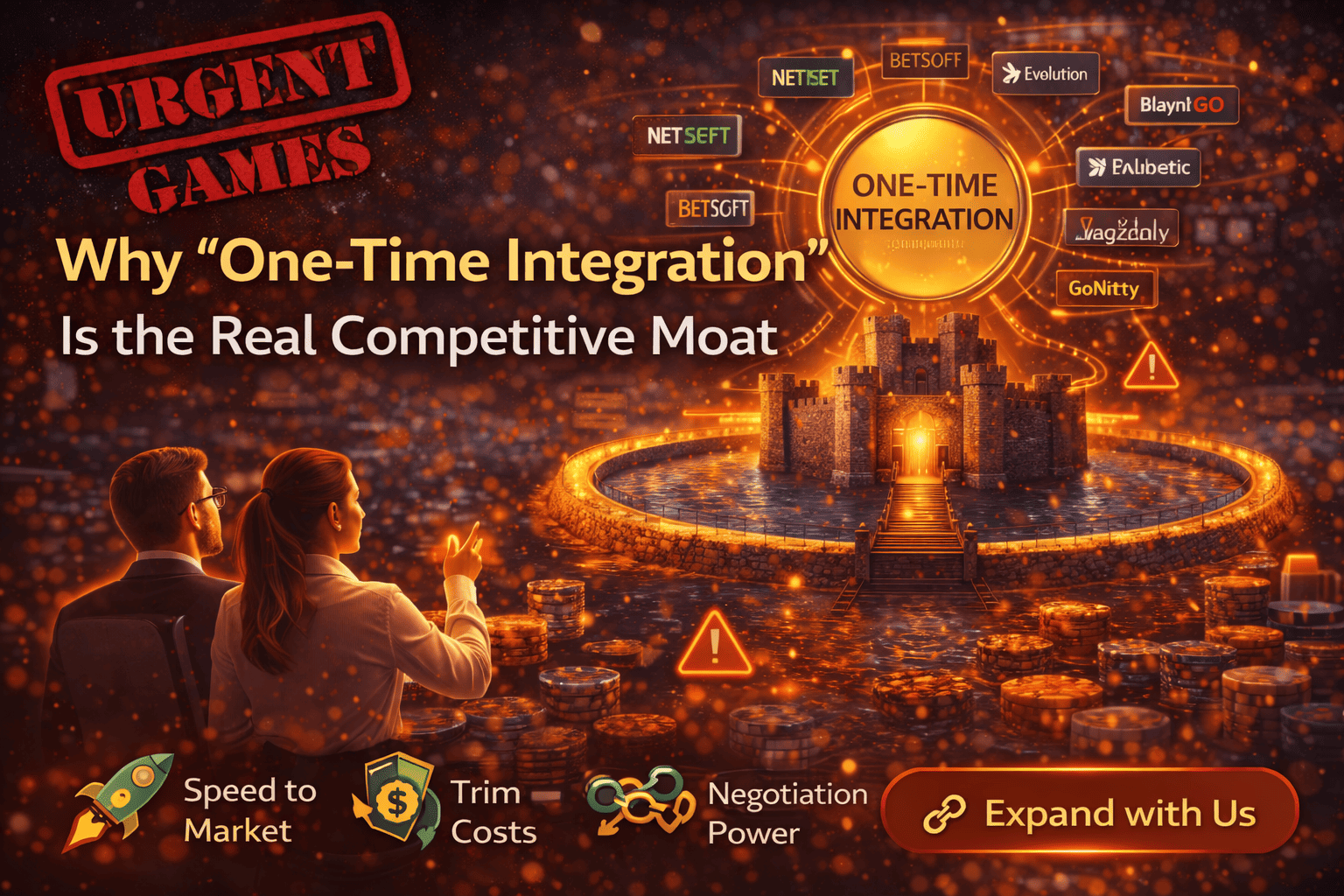
In competitive iGaming markets, long-term advantage doesn’t come from launching quickly — it comes from building infrastructure that scales cleanly.
A one time integration casino model allows operators to integrate once and expand continuously without repeated engineering cycles. Instead of rebuilding connections for every provider, the platform grows through configuration, not reconstruction.
That structural efficiency becomes a true competitive edge.
What a One-Time Integration Model Actually Means
A proper architecture includes:
One API connection
Unified wallet logic
Centralized reporting
Access to thousands of games through aggregation
Rather than re-integrating every new supplier, the operator connects once and scales from there.
This reduces technical repetition and prevents operational drag.
The Cost of Repeated Integrations
Without aggregation or unified APIs, each new provider introduces:
Custom wallet handling
Unique error logic
Separate certification processes
QA duplication
Over time, this creates technical debt and slows innovation.
Operators using a one time integration casino framework avoid this accumulation entirely.
Efficiency Compounds Over Time
Repeated integrations increase system complexity.
Unified architecture reduces it.
With a one-time model, operators benefit from:
Stable transaction flows
Predictable reporting outputs
Lower maintenance overhead
Faster provider onboarding
As scale increases, operational clarity improves rather than deteriorates.
Competitive Expansion Speed
When new game categories trend, operators with unified infrastructure can deploy immediately.
Those relying on direct integrations must negotiate specs, build new logic, and pass certification — costing weeks.
A one time integration casino approach converts expansion speed into a structural advantage.
Financial Impact
Repeated integrations inflate cost per provider.
A unified integration model drives marginal cost toward zero.
Over time, this improves:
ROI per provider
Break-even speed
Scalability economics
Technical leverage becomes financial leverage.
How Aggregation Supports This Model
A strong casino game aggregator standardizes provider APIs, wallet interactions, and reporting frameworks.
If you’re exploring scalable content strategies, review our guide on game provider integration and how structured onboarding reduces long-term friction.
For operators focused on reporting resilience, our article on casino transaction logs explains how centralized data protects margins.
Industry & Regulatory Context
Regulators such as the UK Gambling Commission and the Malta Gaming Authority emphasize auditability and operational control. Clean architecture simplifies compliance reporting and transaction traceability.
Market research firms like H2 Gambling Capital consistently show expanding provider ecosystems — making scalable integration increasingly critical.
Why Architecture Is Hard to Copy
Competitors can replicate:
Bonuses
Campaign structures
UI layouts
They cannot easily replicate:
Unified reporting
Stable wallet systems
Clean onboarding pipelines
Low-friction scaling
This is why a one time integration casino strategy becomes a durable moat rather than a temporary advantage.
Conclusion
Speed helps you launch.
Architecture helps you win.
A properly implemented one-time integration approach enables:
Faster provider expansion
Lower operational overhead
Stronger negotiation leverage
Higher long-term ROI