
 日本語
日本語  English
  简体中文
简体中文  Español
  Русский
  Türkçe
  Tiếng Việt
  Українська
  Български
  Suomi
Suomi  Ελληνικά
  Čeština
  اردو
اردو  Svenska
  עִבְרִית
  हिन्दी
  Français
  Հայերեն
  Italiano
  Română
  Polski
  Српски језик
  Latviešu valoda
  Deutsch (Sie)
  Português do Brasil
  한국어
한국어 
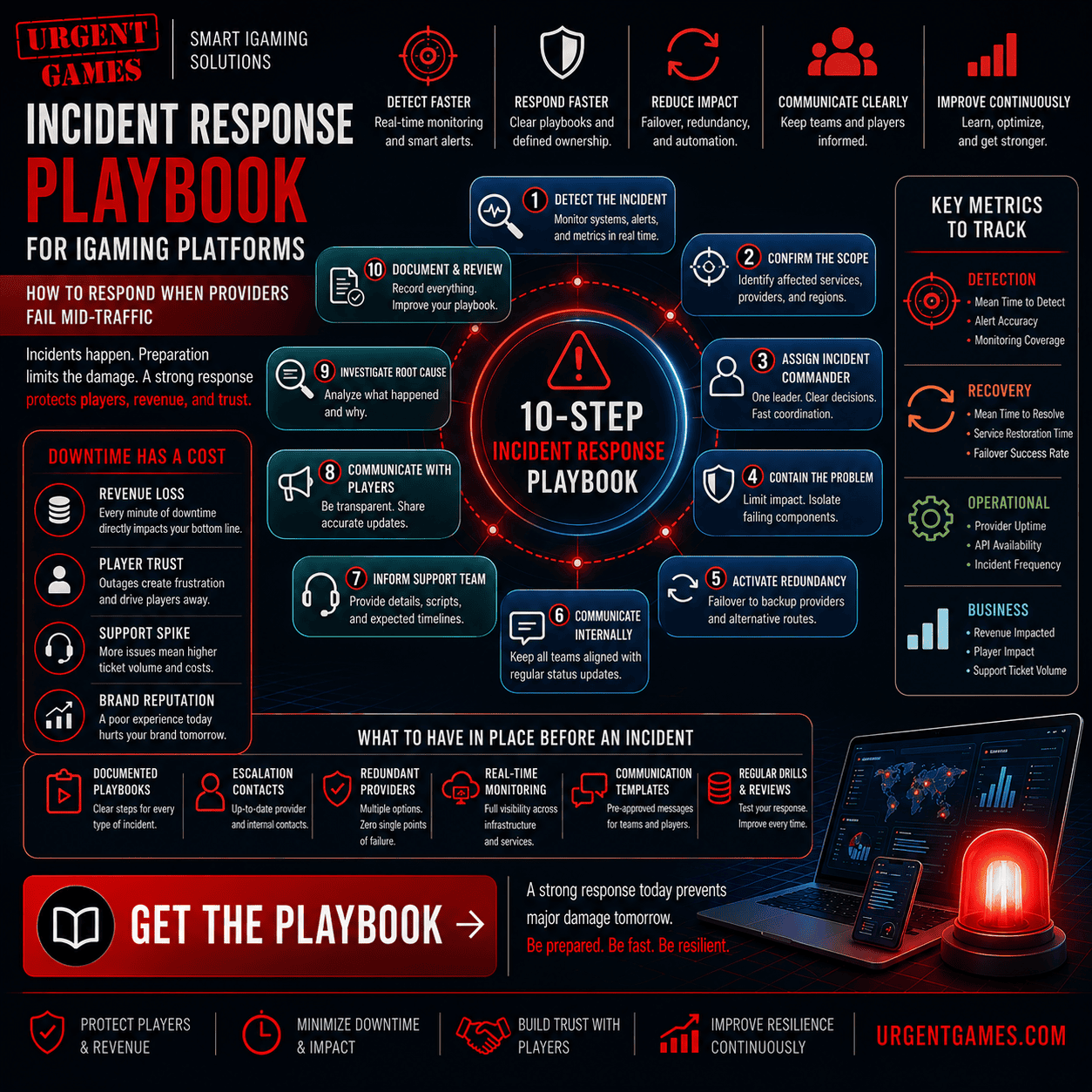
Incident Response Playbook for iGaming Platforms
In online gaming, incidents don’t happen at convenient times.
They happen:
- During peak traffic
- During major sporting events
- During high-value tournaments
- During marketing campaigns
- During record-breaking player activity
The real question isn’t もし something will fail.
It’s how quickly your team can respond when it does.
Whether it’s a casino provider outage, payment gateway failure, API latency spike, or wallet synchronization issue, every minute of downtime affects revenue, player trust, and operational efficiency.
This is why every operator should have a well-defined カジノでの事件対応 playbook.
The goal isn’t simply recovering from incidents.
It’s minimizing business impact while maintaining player confidence.
Why Incident Response Matters
Modern gaming platforms rely on dozens of interconnected systems.
例:
- カジノプロバイダー
- Sportsbook APIs
- ウォレットサービス
- 決済ゲートウェイ
- Identity verification
- CRMプラットフォーム
- 分析システム
A failure in one component can quickly cascade across the platform.
Without structured response procedures, even minor issues can become major outages.
Every Minute Has a Cost
When a provider fails, operators may experience:
- Failed game launches
- Interrupted sessions
- Deposit failures
- 引き出しの遅延
- サポートチケットの増加
- Lost wagers
Fast detection and coordinated response directly reduce financial impact.
Preparation Begins Before the Incident
The best incident response starts long before production issues occur.
Every operator should document:
- Critical services
- System dependencies
- Escalation contacts
- Recovery procedures
- Communication plans
Preparation reduces confusion during high-pressure situations.
Step 1: Detect the Incident Quickly
The faster an issue is detected, the faster recovery begins.
Modern monitoring platforms should continuously track:
- API応答時間
- プロバイダーの空き状況
- ウォレット同期
- 支払い成功率
- エラー率
Automated alerts reduce Mean Time to Detect (MTTD).
Step 2: Confirm the Scope
Not every alert requires the same response.
Determine:
- Which services are affected?
- Which providers are impacted?
- Are all players affected or only specific regions?
- Is the issue internal or external?
Understanding scope prevents unnecessary escalation.
Step 3: Assign an Incident Commander
Every major incident needs one decision-maker.
The Incident Commander coordinates:
- Engineering
- DevOps
- サポート
- Product
- Communications
Clear ownership eliminates confusion and accelerates recovery.
Step 4: Contain the Problem
The next priority is preventing further impact.
Possible actions include:
- Temporarily disabling a failing provider
- Activating failover routing
- Redirecting traffic
- Pausing specific features
- Limiting new sessions
Containment protects the remainder of the platform.
Step 5: Activate Redundancy
Modern gaming platforms should never rely on a single provider.
Provider redundancy enables operators to:
- Route players to alternative content
- Maintain gameplay
- Reduce downtime
Well-designed aggregation platforms significantly improve operational resilience.
Step 6: Communicate Internally
沈黙は不確実性を生む。.
Engineering teams should provide regular updates covering:
- Current status
- Root cause investigation
- Recovery progress
- Estimated resolution
Operations teams can then make informed business decisions.
Step 7: Keep Customer Support Informed
Support teams should never discover incidents through player complaints.
提供する:
- Internal status updates
- Approved messaging
- Expected timelines
- Workarounds
Prepared support teams improve player confidence.
Step 8: Communicate With Players
Transparency matters.
If players are affected:
Communicate clearly.
例:
- Provider maintenance
- 一時的なサービス中断
- Payment delays
Avoid speculation.
Provide accurate information and realistic expectations.
Step 9: Investigate Root Cause
Once stability returns, investigate:
- 何が失敗したのか?
- Why did it fail?
- Could it have been detected earlier?
- Did monitoring perform correctly?
- Were response procedures effective?
The goal is continuous improvement.
Step 10: Document Everything
Every incident should produce a detailed report including:
- Timeline
- Root cause
- Systems affected
- Resolution steps
- Lessons learned
Documentation improves future response efforts.
Automation Improves Response Speed
Modern platforms increasingly automate:
- Alert generation
- Provider failover
- Traffic routing
- Service restarts
- Health checks
Automation reduces recovery time while minimizing manual intervention.
High Availability Supports Incident Response
Well-designed infrastructure includes:
- ロードバランシング
- 複数地域への展開
- Redundant databases
- 自動スケーリング
- Provider failover
Strong architecture reduces both incident frequency and severity.
Monitoring Drives Faster Decisions
Real-time dashboards should provide visibility into:
- Active incidents
- 医療提供者の健康
- APIレイテンシ
- インフラ利用
- Wallet performance
Decision-makers require immediate operational awareness.
Incident Reviews Build Better Platforms
Every incident presents an opportunity.
Post-incident reviews should answer:
- What worked well?
- What slowed recovery?
- Which procedures should change?
- Which systems require improvement?
Continuous improvement strengthens resilience.
すべての事業者が追跡すべき主要指標
Detection Metrics
- Mean Time to Detect (MTTD)
- Alert accuracy
- Monitoring coverage
Recovery Metrics
- Mean Time to Resolve (MTTR)
- Service restoration time
- Failover success rate
運用指標
- プロバイダーの稼働時間
- API availability
- 発生頻度
ビジネス指標
- Revenue affected
- Player impact
- Support ticket volume
- Session recovery rate
Common Incident Response Mistakes
❌ No documented playbook
Creates confusion during outages.
❌ Delayed communication
Increases player frustration.
❌ No provider redundancy
Extends downtime.
❌ 監視体制が不十分
Problems remain undetected.
❌ Skipping postmortems
Prevents long-term improvement.
The Future of Casino Incident Response
The next generation of response strategies will increasingly leverage:
- AIを活用した異常検知
- Predictive incident analysis
- 自動フェイルオーバー
- 自己修復インフラ
- Intelligent traffic routing
なぜ?
Because players expect uninterrupted gaming experiences regardless of backend challenges.
最後に
Incidents are inevitable.
Extended downtime is not.
構造化された カジノでの事件対応 playbook enables operators to:
- Detect issues earlier
- より迅速に対応
- Reduce business disruption
- プレイヤーの信頼を守る
- Improve long-term platform resilience
The strongest gaming platforms aren’t the ones that never experience failures.
They’re the ones built to recover quickly, communicate clearly, and continuously improve.
現代のiGamingでは:
Resilience isn’t measured by avoiding incidents.