
 Italiano
  English
  简体中文
简体中文  Español
  Русский
  Türkçe
  Tiếng Việt
  Українська
  Български
  Suomi
Suomi  Ελληνικά
  Čeština
  اردو
اردو  Svenska
  עִבְרִית
  हिन्दी
  Français
  Հայերեն
  日本語
日本語  Română
  Polski
  Српски језик
  Latviešu valoda
  Deutsch (Sie)
  Português do Brasil
  한국어
한국어 
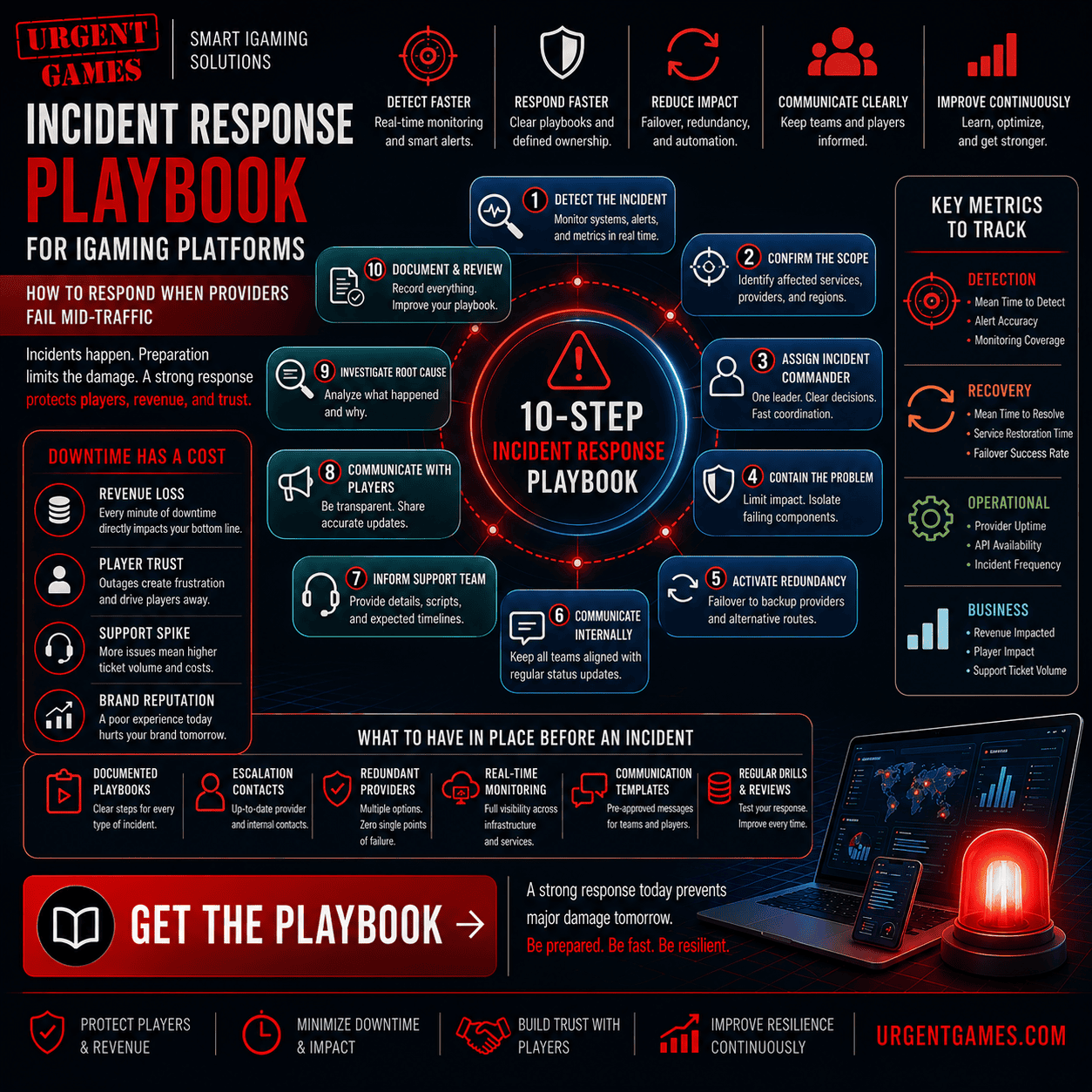
Incident Response Playbook for iGaming Platforms
In online gaming, incidents don’t happen at convenient times.
They happen:
- During peak traffic
- During major sporting events
- During high-value tournaments
- During marketing campaigns
- During record-breaking player activity
The real question isn’t Se something will fail.
It’s how quickly your team can respond when it does.
Whether it’s a casino provider outage, payment gateway failure, API latency spike, or wallet synchronization issue, every minute of downtime affects revenue, player trust, and operational efficiency.
This is why every operator should have a well-defined risposta agli incidenti nei casinò playbook.
The goal isn’t simply recovering from incidents.
It’s minimizing business impact while maintaining player confidence.
Why Incident Response Matters
Modern gaming platforms rely on dozens of interconnected systems.
Alcuni esempi:
- Fornitori di casinò
- Sportsbook APIs
- Servizi di portafoglio
- Gateway di pagamento
- Identity verification
- piattaforme CRM
- Sistemi di analisi
A failure in one component can quickly cascade across the platform.
Without structured response procedures, even minor issues can become major outages.
Every Minute Has a Cost
When a provider fails, operators may experience:
- Failed game launches
- Interrupted sessions
- Deposit failures
- Ritardi nel prelievo
- Ticket di supporto aumentati
- Lost wagers
Fast detection and coordinated response directly reduce financial impact.
Preparation Begins Before the Incident
The best incident response starts long before production issues occur.
Every operator should document:
- Critical services
- System dependencies
- Escalation contacts
- Recovery procedures
- Communication plans
Preparation reduces confusion during high-pressure situations.
Step 1: Detect the Incident Quickly
The faster an issue is detected, the faster recovery begins.
Modern monitoring platforms should continuously track:
- Tempi di risposta dell'API
- Disponibilità del fornitore
- Sincronizzazione del portafoglio
- Tassi di successo dei pagamenti
- tassi di errore
Automated alerts reduce Mean Time to Detect (MTTD).
Step 2: Confirm the Scope
Not every alert requires the same response.
Determine:
- Which services are affected?
- Which providers are impacted?
- Are all players affected or only specific regions?
- Is the issue internal or external?
Understanding scope prevents unnecessary escalation.
Step 3: Assign an Incident Commander
Every major incident needs one decision-maker.
The Incident Commander coordinates:
- Engineering
- DevOps
- Supporto
- Product
- Communications
Clear ownership eliminates confusion and accelerates recovery.
Step 4: Contain the Problem
The next priority is preventing further impact.
Possible actions include:
- Temporarily disabling a failing provider
- Activating failover routing
- Redirecting traffic
- Pausing specific features
- Limiting new sessions
Containment protects the remainder of the platform.
Step 5: Activate Redundancy
Modern gaming platforms should never rely on a single provider.
Provider redundancy enables operators to:
- Route players to alternative content
- Maintain gameplay
- Reduce downtime
Well-designed aggregation platforms significantly improve operational resilience.
Step 6: Communicate Internally
Il silenzio genera incertezza.
Engineering teams should provide regular updates covering:
- Current status
- Root cause investigation
- Recovery progress
- Estimated resolution
Operations teams can then make informed business decisions.
Step 7: Keep Customer Support Informed
Support teams should never discover incidents through player complaints.
Fornire:
- Internal status updates
- Approved messaging
- Expected timelines
- Workarounds
Prepared support teams improve player confidence.
Step 8: Communicate With Players
Transparency matters.
If players are affected:
Communicate clearly.
Alcuni esempi:
- Provider maintenance
- Interruzioni temporanee del servizio
- Payment delays
Avoid speculation.
Provide accurate information and realistic expectations.
Step 9: Investigate Root Cause
Once stability returns, investigate:
- Cosa non ha funzionato?
- Why did it fail?
- Could it have been detected earlier?
- Did monitoring perform correctly?
- Were response procedures effective?
The goal is continuous improvement.
Step 10: Document Everything
Every incident should produce a detailed report including:
- Timeline
- Root cause
- Systems affected
- Resolution steps
- Lessons learned
Documentation improves future response efforts.
Automation Improves Response Speed
Modern platforms increasingly automate:
- Alert generation
- Provider failover
- Traffic routing
- Service restarts
- Health checks
Automation reduces recovery time while minimizing manual intervention.
High Availability Supports Incident Response
Well-designed infrastructure includes:
- Bilanciamento del carico
- Implementazione multiregionale
- Redundant databases
- Ridimensionamento automatico
- Provider failover
Strong architecture reduces both incident frequency and severity.
Monitoring Drives Faster Decisions
Real-time dashboards should provide visibility into:
- Active incidents
- Salute del fornitore
- latenza API
- Utilizzo delle infrastrutture
- Wallet performance
Decision-makers require immediate operational awareness.
Incident Reviews Build Better Platforms
Every incident presents an opportunity.
Post-incident reviews should answer:
- What worked well?
- What slowed recovery?
- Which procedures should change?
- Which systems require improvement?
Continuous improvement strengthens resilience.
Indicatori chiave che ogni operatore dovrebbe monitorare
Detection Metrics
- Mean Time to Detect (MTTD)
- Alert accuracy
- Monitoring coverage
Recovery Metrics
- Mean Time to Resolve (MTTR)
- Service restoration time
- Failover success rate
Metriche operative
- Tempo di attività del fornitore
- API availability
- Frequenza degli incidenti
Metriche aziendali
- Revenue affected
- Player impact
- Support ticket volume
- Session recovery rate
Common Incident Response Mistakes
❌ No documented playbook
Creates confusion during outages.
❌ Delayed communication
Increases player frustration.
❌ No provider redundancy
Extends downtime.
❌ Monitoraggio insufficiente
Problems remain undetected.
❌ Skipping postmortems
Prevents long-term improvement.
The Future of Casino Incident Response
The next generation of response strategies will increasingly leverage:
- Rilevamento delle anomalie basato sull'intelligenza artificiale
- Predictive incident analysis
- Failover automatico
- Infrastruttura autoriparante
- Intelligent traffic routing
Perché?
Because players expect uninterrupted gaming experiences regardless of backend challenges.
Considerazioni finali
Incidents are inevitable.
Extended downtime is not.
Una struttura risposta agli incidenti nei casinò playbook enables operators to:
- Detect issues earlier
- Rispondere più velocemente
- Reduce business disruption
- Tutelare la fiducia dei giocatori
- Improve long-term platform resilience
The strongest gaming platforms aren’t the ones that never experience failures.
They’re the ones built to recover quickly, communicate clearly, and continuously improve.
Perché nel moderno iGaming:
Resilience isn’t measured by avoiding incidents.