
 English
  简体中文
简体中文  Español
  Русский
  Türkçe
  Tiếng Việt
  Українська
  Български
  Suomi
Suomi  Ελληνικά
  Čeština
  اردو
اردو  Svenska
  עִבְרִית
  हिन्दी
  Français
  Հայերեն
  Italiano
  日本語
日本語  Română
  Polski
  Српски језик
  Latviešu valoda
  Deutsch (Sie)
  Português do Brasil
  한국어
한국어 
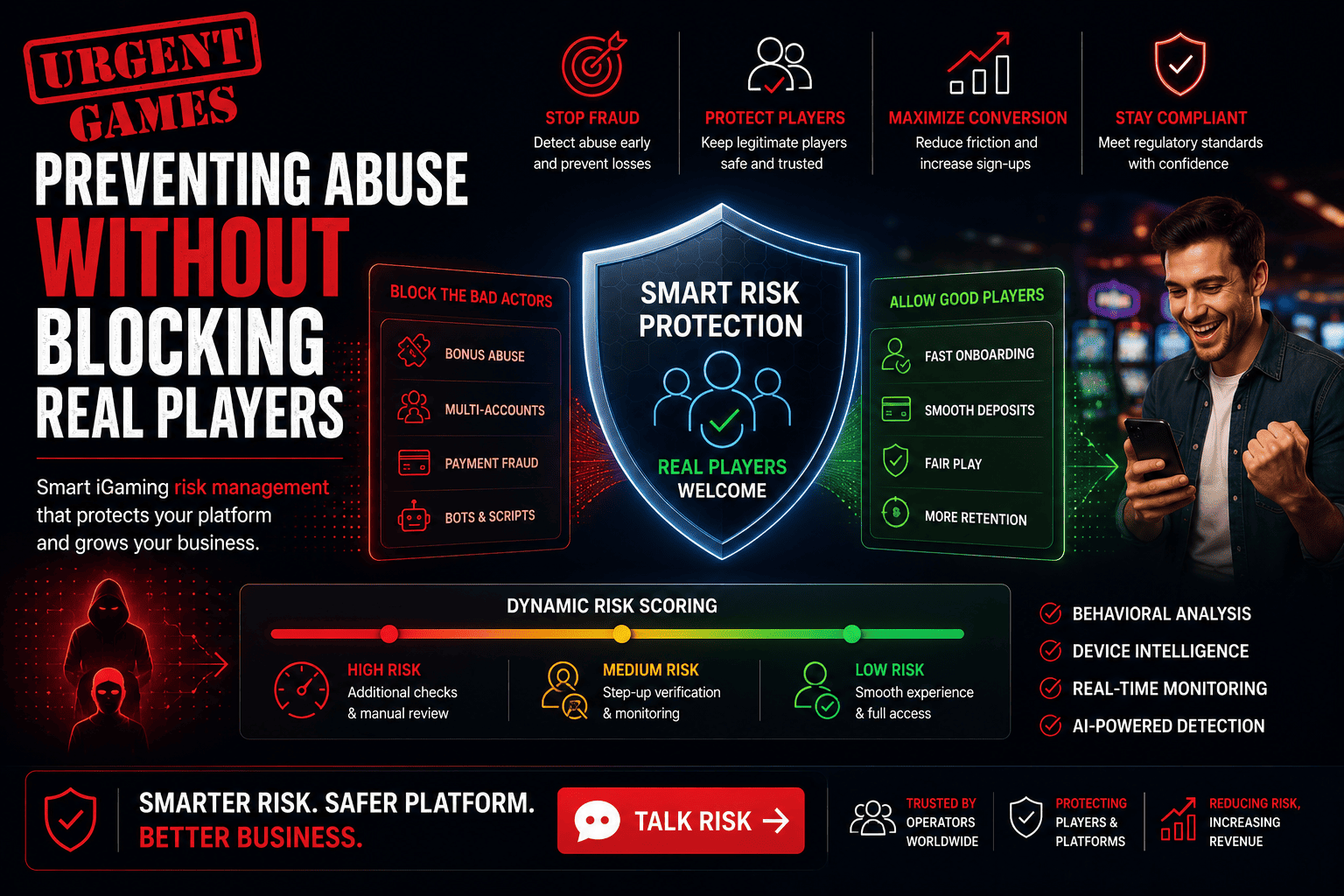
iGaming risk management has become one of the most critical challenges for modern operators.
Every platform needs protection against fraud, bonus abuse, chargebacks, and multi-accounting. But stricter controls often come at a cost: legitimate players getting blocked or frustrated.
That’s the real balancing act.
How do you stop bad actors without damaging the experience for real users?
In 2026, leading operators understand something important:
Security alone doesn’t drive growth—smart iGaming risk management does.
The Cost of Overblocking in iGaming Risk Management
Most operators focus heavily on fraud prevention.
But very few measure:
- Legitimate users blocked
- False-positive risk flags
- Conversion loss caused by friction
Reality:
A player wrongly flagged as suspicious may never return.
The Shift Toward Intelligent iGaming Risk Management
Modern systems are designed to:
- Detect abuse early
- Adapt dynamically
- Minimize friction for trusted users
This is where intelligent iGaming risk management becomes essential.
Key Abuse Types in iGaming Risk Management
Bonus Abuse
Still one of the biggest threats.
Common tactics:
- Multi-accounting
- Referral farming
- Arbitrage betting
Mistake operators make:
Applying aggressive restrictions to everyone.
Better approach:
Use behavioral scoring instead of blanket blocks.
Payment Fraud
This includes:
- Stolen cards
- Chargeback abuse
- Payment cycling
Key signals:
- Velocity spikes
- Geolocation mismatches
- Unusual deposit patterns
Account Takeovers
Attackers increasingly target player accounts directly.
Indicators:
- Device changes
- IP anomalies
- Unusual session behavior
Problem:
Overreacting creates unnecessary login friction.
Bot & Script Abuse
Bots target:
- Bonuses
- Promotions
- Automated gameplay exploits
Challenge:
Many anti-bot systems accidentally punish real users.
Why Traditional iGaming Risk Management Systems Fail
Older systems rely on:
- Static rules
- Hard blocks
- Generic thresholds
Example:
“Block all users with multiple accounts from one IP.”
Sounds logical…
Until you realize:
- Families share devices
- Public networks exist
- Mobile carriers rotate IPs
Result:
Real users get blocked.
Risk Scoring vs Hard Blocking in iGaming Risk Management
Modern platforms use dynamic risk scoring instead of instant denial.
How Smart Risk Scoring Works
Every player action contributes to a score.
Signals include:
- Device reputation
- Transaction history
- Session patterns
- Geographic consistency
- Betting behavior
Outcome:
- Low-risk users move smoothly
- High-risk users trigger additional verification
Progressive Friction Strategy
The best operators don’t block immediately.
They increase friction gradually.
Example flow:
Low Risk
- Instant login
- Fast deposits
Medium Risk
- Email verification
- Deposit limits
High Risk
- Manual review
- Enhanced KYC
The Psychology of Friction in iGaming
Players tolerate:
- Security
They do NOT tolerate:
- Confusion
- Delays
- Constant verification
Important:
Every extra step reduces conversion.
Metrics That Matter in iGaming Risk Management
Most teams monitor fraud losses.
But forget conversion impact.
Track:
- False positive rate
- Verification completion rate
- Deposit abandonment rate
- KYC drop-off rate
Behavioral Analysis & Device Intelligence
Modern iGaming risk management is increasingly behavioral.
Systems now analyze:
- Typing patterns
- Navigation behavior
- Session timing
- Betting consistency
Why it works:
Real users behave differently from bots and fraud rings.
Real-Time Risk Decisions Matter
Fraud systems must operate instantly.
Delayed risk systems create:
- Financial exposure
- Poor user experience
Ideal flow:
Risk checks happen invisibly in milliseconds.
Multi-Tenant iGaming Risk Management
If you operate multiple brands:
Risk systems must adapt per tenant.
Example:
- One market may require stricter KYC
- Another may prioritize conversion speed
Smart platforms support:
- Tenant-level risk policies
- Region-specific controls
- Currency-based monitoring
Compliance vs User Experience
Regulators demand stronger controls.
But operators still need:
- Fast onboarding
- High retention
- Smooth deposits
Winning strategy:
Automate intelligently instead of adding blanket friction.
AI & Machine Learning in iGaming Risk Management
Modern platforms increasingly use AI for:
- Anomaly detection
- Pattern recognition
- Predictive fraud scoring
Benefits:
- Fewer false positives
- Faster adaptation
- Better scalability
But AI should assist human teams—not replace them entirely.
Common Mistakes in iGaming Risk Management
❌ Blocking too aggressively
❌ Treating every player equally
❌ Using only rule-based systems
❌ Ignoring player experience
The Future of iGaming Risk Management
The future is:
- Adaptive
- Behavioral
- Invisible
Players increasingly expect:
- Instant onboarding
- Fast withdrawals
- Minimal interruptions
Risk systems that create heavy friction will lose market share.
Final Thoughts
The best iGaming risk management systems don’t just stop fraud.
They protect:
- Revenue
- Player trust
- Conversion rates
Great operators understand:
The goal isn’t maximum restriction.
The goal is intelligent protection.
Because in modern iGaming:
- Trust drives retention
- Experience drives growth
- Smart risk management protects both
🛡️ Talk to Risk Experts
Want to build smarter iGaming risk management systems without hurting conversion?