
 English
  简体中文
简体中文  Español
  Русский
  Türkçe
  Tiếng Việt
  Українська
  Български
  Suomi
Suomi  Ελληνικά
  Čeština
  اردو
اردو  Svenska
  עִבְרִית
  हिन्दी
  Français
  Հայերեն
  Italiano
  日本語
日本語  Română
  Polski
  Српски језик
  Latviešu valoda
  Deutsch (Sie)
  Português do Brasil
  한국어
한국어 
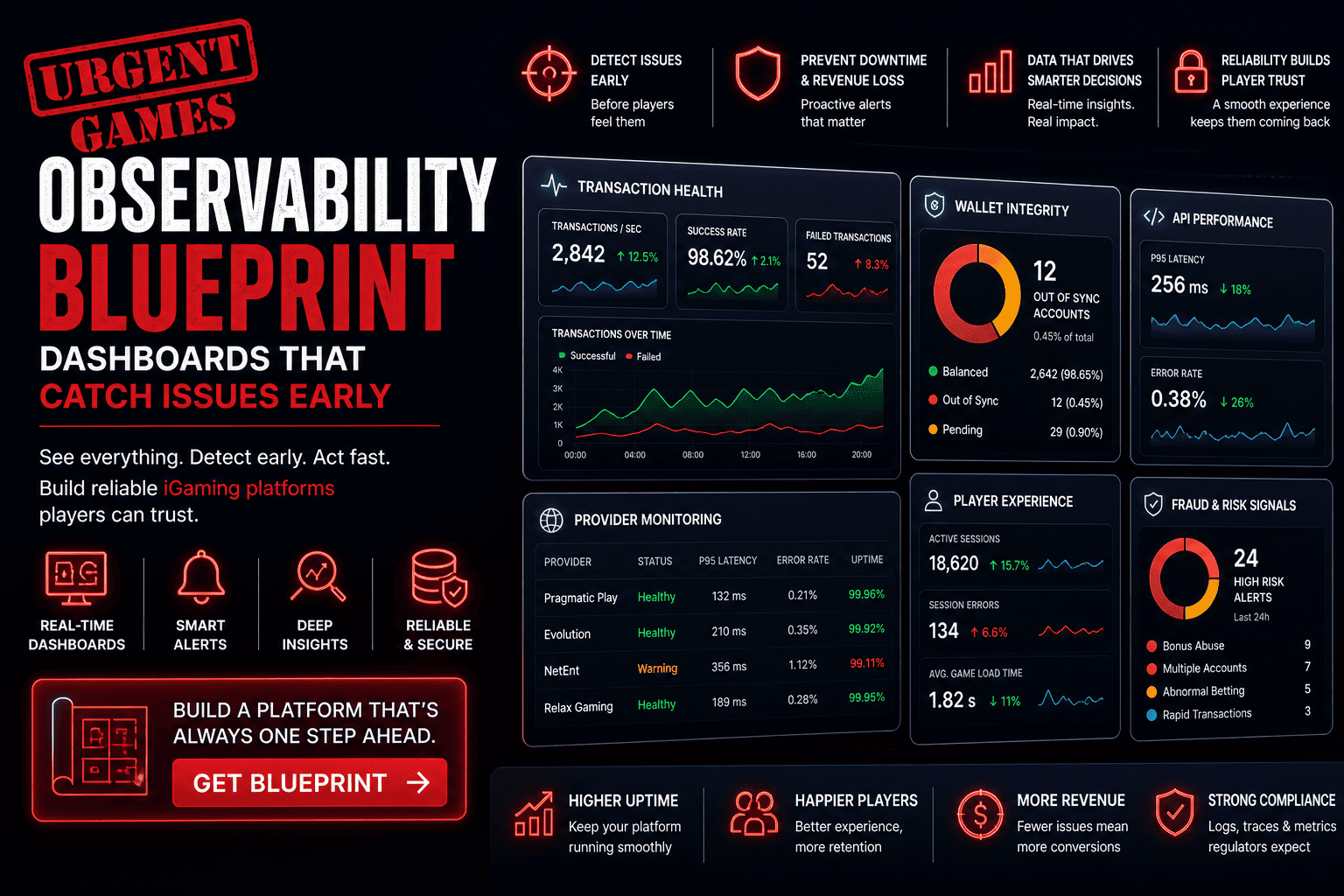
In modern platforms, iGaming observability is what separates reactive teams from proactive operators.
Small issues don’t start big. Instead, they begin quietly:
- A slight API delay
- A few failed transactions
- A small wallet mismatch
However, these quickly grow into player complaints, failed payments, and revenue loss.
👉 The best operators don’t wait—they detect issues before players feel them.
What Is iGaming Observability (and Why It Matters)
Many teams think they have observability. In reality, they only have monitoring.
Monitoring shows:
- CPU usage
- Uptime
- Basic alerts
In contrast, iGaming observability explains:
- What broke
- Why it broke
- Where to fix it
Because of this, observability is essential for modern platforms.
The Goal of iGaming Observability Dashboards
Your dashboards should instantly answer:
- Are transactions failing right now?
- Are providers slowing down?
- Is any region affected?
- Are balances out of sync?
If you cannot answer these quickly, then visibility is limited.
Core iGaming Observability Dashboards
1. Transaction Health Dashboard
This is the most critical dashboard.
Track:
- Transactions per second
- Success vs failure rates
- Pending transactions
- Retry attempts
Also break data down by:
- Provider
- Game
- Tenant
- Currency
👉 A spike in failures directly impacts revenue.
2. Wallet Monitoring Dashboard
This dashboard protects financial integrity.
Monitor:
- Balance mismatches
- Failed updates
- Duplicate transactions
- Ledger vs actual balance
Key metric:
- Out-of-sync accounts
3. API Performance Dashboard
Since platforms are API-driven, this is essential.
Track:
- Latency per endpoint
- Error rates
- Timeout frequency
- Request volume
Split data between internal and external APIs.
4. Provider Performance Dashboard
External providers can fail without warning.
Track:
- Response time
- Error rates
- Downtime
- Game-level issues
👉 Even small delays can hurt player experience.
5. Player Experience Dashboard
This reflects real user impact.
Track:
- Login failures
- Session errors
- Game load time
- Abandoned sessions
Also segment by device and region.
6. Fraud & Risk Dashboard
Patterns often reveal threats.
Monitor:
- Unusual betting behavior
- Rapid transactions
- Multiple accounts per IP
- Bonus abuse signals
7. Infrastructure Dashboard
Although basic, this still matters.
Track:
- CPU and memory
- Database performance
- Queue delays
- Service uptime
However, this should support—not replace—business dashboards.
Key Metrics in iGaming Observability
Focus on impact-driven metrics:
- Transaction success rate
- Wallet consistency
- API latency (p95, p99)
- Provider uptime
- Error spikes
These metrics directly affect revenue and trust.
Real-Time Alerts in iGaming Observability
Dashboards alone are not enough.
Set alerts for:
- Transaction failure spikes
- Wallet inconsistencies
- API latency thresholds
- Provider downtime
- Traffic anomalies
👉 Alerts must trigger before players notice problems.
Multi-Tenant Observability
If you run multiple brands, this becomes critical.
You need:
- Tenant-level filtering
- Region-level visibility
- Currency segmentation
Because one tenant may fail while others remain stable.
Logs, Metrics, and Traces Together
Strong iGaming observability combines:
Metrics
Numbers like latency and error rates
Logs
Detailed event records
Traces
End-to-end request tracking
For example, a single bet can be traced across:
- API request
- Wallet validation
- Provider response
- Final outcome
Common Observability Mistakes
Avoid:
- Too many dashboards
- No prioritization
- Delayed data
- No alert ownership
Because of this, teams often miss critical issues.
Observability Tools for iGaming Platforms
Common tools include:
- Prometheus + Grafana
- Datadog
- New Relic
- OpenTelemetry
👉 The tools matter less than what you measure.
Internal Resources
- iGaming audit logs guide
- Fraud detection systems in iGaming
- Payment reconciliation best practices
External Resources
Final Thoughts
iGaming observability is not optional—it’s a competitive advantage.
Operators who invest in the right dashboards:
- Detect issues early
- Respond faster
- Prevent escalation
As a result, they improve uptime, player trust, and revenue.
Get the Observability Blueprint
Want to build dashboards that actually protect your platform?
👉 Get the observability blueprint and start scaling with confidence.