
 English
  简体中文
简体中文  Español
  Русский
  Türkçe
  Tiếng Việt
  Українська
  Български
  Suomi
Suomi  Ελληνικά
  Čeština
  اردو
اردو  Svenska
  עִבְרִית
  हिन्दी
  Français
  Հայերեն
  Italiano
  日本語
日本語  Română
  Polski
  Српски језик
  Latviešu valoda
  Deutsch (Sie)
  Português do Brasil
  한국어
한국어 
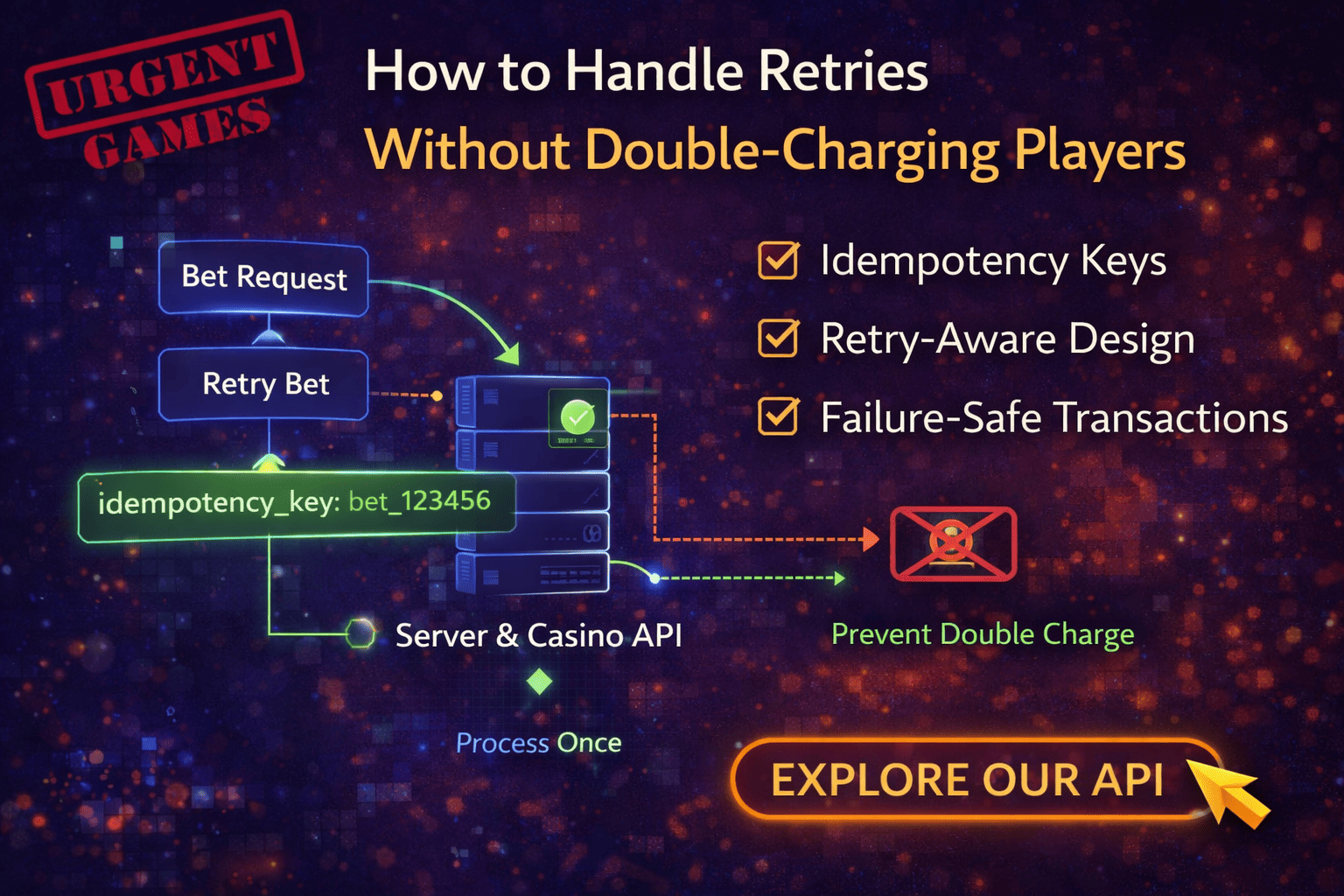
An idempotency casino API is critical for protecting player trust and ensuring transaction reliability. Every casino platform depends on APIs for bets, settlements, and balance updates—but when retries are not handled correctly, systems can accidentally process the same request multiple times.
This leads to one of the most serious risks in iGaming:
👉 double charging players
The Hidden Risk in Every API Call
Casino platforms rely on APIs for:
- placing bets
- settling wins
- processing rollbacks
- updating balances
However, APIs are not perfect.
Requests fail. Connections drop. Providers retry.
Without proper safeguards, duplicate execution becomes inevitable.
As a result, operators may face:
- player trust issues
- financial discrepancies
- increased support tickets
- brand damage
Why Retries Are Necessary
Retries are not the problem—they are essential.
Systems retry due to:
- network timeouts
- delayed provider responses
- temporary outages
- packet loss
Without retries:
- transactions would fail permanently
- gameplay would break
- revenue would drop
👉 The real issue is uncontrolled retries.
What Is an Idempotency Casino API?
An idempotency casino API ensures that the same request can be processed multiple times without changing the result after the first execution.
Simple logic:
- first request → processed
- repeated request → ignored or returns same result
Why it matters:
- prevents duplicate bets
- avoids double settlements
- ensures consistent balances
This is the foundation of safe transaction handling.
Where Double Charging Happens Most
Bet Placement
Duplicate bets are the most critical issue.
Win Settlements
Repeated payouts lead to financial loss.
Rollbacks
Incorrect handling can over-credit players.
Bonuses
Duplicate triggers distort balances.
Core Principles of an Idempotency Casino API
Unique Transaction IDs
Each transaction must have a unique identifier.
How it works:
- client generates ID
- server stores it
- retries reuse the same ID
If the ID already exists, the system returns the original result.
Idempotency Keys
Idempotency keys take this further by identifying each request uniquely.
Best practices:
- require a key for every critical request
- store responses against the key
- return the same response on retries
👉 This makes retries safe by design.
Atomic Transactions
Every operation must be fully completed or fully rolled back.
Without this:
- balances may update incorrectly
- bets may not be recorded
Use database transactions to guarantee consistency.
State Validation
Always validate state before processing.
For example:
If a bet is already settled → ignore duplicate settlement requests.
Checks should include:
- transaction status
- session state
- balance integrity
Retry-Aware API Design
APIs should guide retry behavior clearly.
Instead of vague errors, return:
- success (if already processed)
- clear failure messages
👉 This prevents unnecessary retries.
Handling Timeouts Safely
Timeouts are a major cause of duplicate execution.
Correct approach:
- do NOT assume failure
- check transaction status first
Flow:
- request times out
- client checks status
- system confirms result
This eliminates unnecessary duplicate processing.
Logging and Traceability
Every transaction must be traceable.
Required logs:
- transaction ID
- idempotency key
- timestamps
- request and response data
This is essential for:
- debugging
- dispute resolution
- financial audits
Real-World Impact of Idempotency
Without Idempotency
- duplicate bets
- incorrect balances
- player complaints
With Idempotency
- safe retries
- consistent balances
- stable systems
👉 The difference is trust.
The Role of Reconciliation
Even strong systems need validation.
Reconciliation ensures:
- all records match across systems
- no discrepancies remain
Combined approach:
- idempotency prevents errors
- reconciliation detects edge cases
Business Impact
A strong idempotency casino API leads to:
- higher player trust
- fewer disputes
- cleaner financial data
- smoother operations
Without it, operators face constant issues and revenue leakage.
The Future of API Reliability
Modern platforms are evolving toward:
- fully idempotent APIs
- event-driven systems
- automated retry handling
- real-time validation
The goal is simple:
👉 systems that expect failure and handle it gracefully.
Internal Resources
- Scalable Casino Platform → /scalable-casino-platform
- Casino Growth Stack → /casino-growth-stack-tech-layers
- Instant Game Launch UX → /instant-game-launch-ux
External Resources
Learn more about API reliability and idempotency:
- https://stripe.com/docs/idempotency
- https://aws.amazon.com/builders-library/making-retries-safe-with-idempotent-APIs/
Final Thought
Retries are inevitable. Failures are normal.
But double charging players is not.
A strong idempotency casino API ensures that no matter how many times a request is sent—it only counts once.
That’s not just good engineering.
That’s essential trust.
🚀 Explore Our API
If you’re building a platform with a reliable idempotency casino API, failure-safe transactions, and scalable infrastructure—
👉 Protect your players—and your revenue.