
 English
  简体中文
简体中文  Español
  Русский
  Türkçe
  Tiếng Việt
  Українська
  Български
  Suomi
Suomi  Ελληνικά
  Čeština
  اردو
اردو  Svenska
  עִבְרִית
  हिन्दी
  Français
  Հայերեն
  Italiano
  日本語
日本語  Română
  Polski
  Српски језик
  Latviešu valoda
  Deutsch (Sie)
  Português do Brasil
  한국어
한국어 
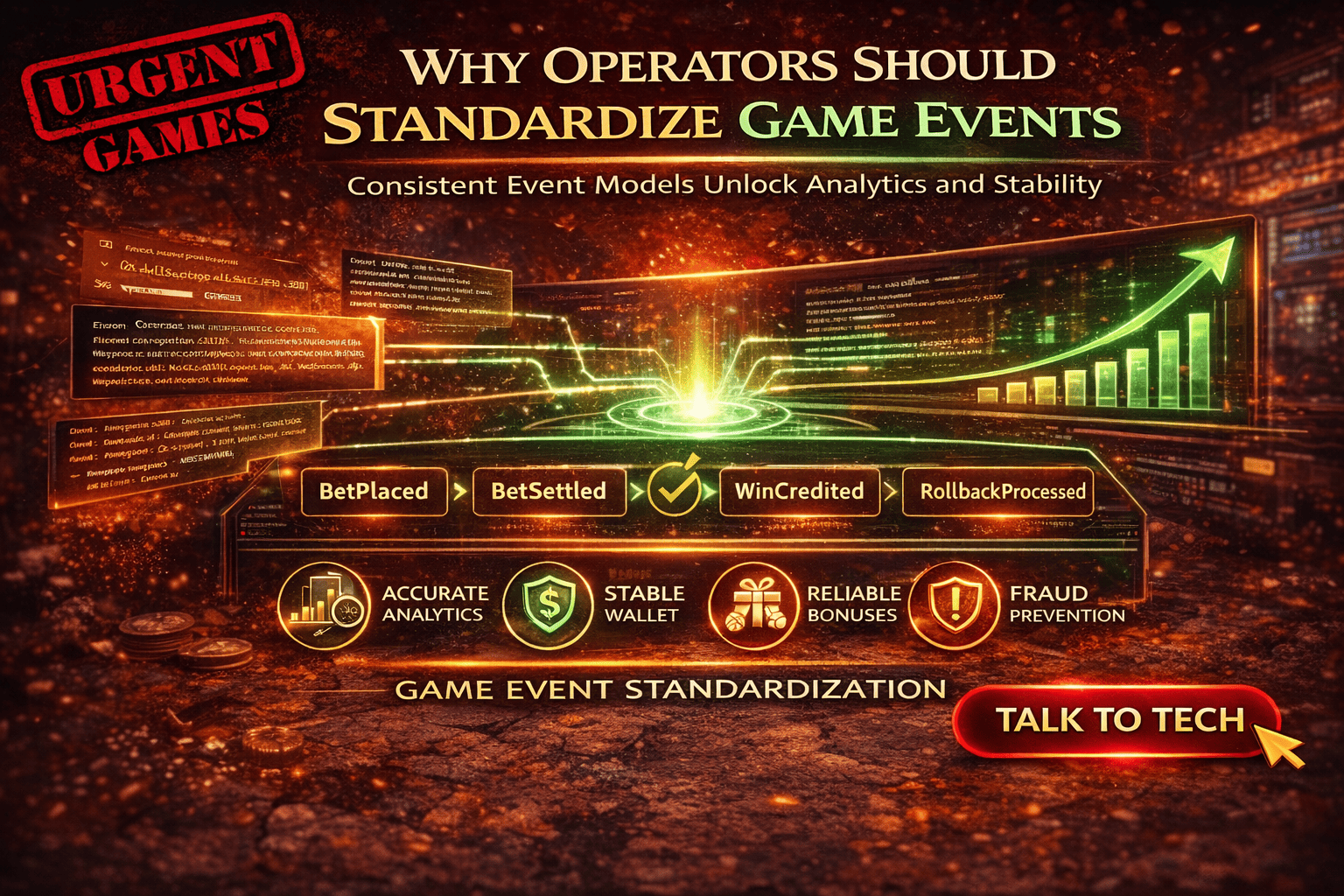
Game Event Standardization for Casino Platforms
Game event standardization is the backbone of any scalable and reliable casino platform. Without it, platforms often face errors in reporting, wallet balances, and bonus calculations.
Many operators focus on adding more providers or expanding game catalogs. However, the real challenge lies in how each provider sends event data. If events are inconsistent, platforms accumulate hidden technical debt that grows with every integration.
Fortunately, game event standardization solves this problem. By unifying all provider events into a single internal format, platforms can operate smoothly, scale efficiently, and reduce operational risks.
The Hidden Chaos in Casino Platforms
Modern operators often integrate:
15–30 game providers
Slots, live casino, crash, and table games
Multiple wallet systems
Fraud detection tools
CRM and analytics platforms
Each provider sends data differently. Some use stake, others use bet_amount, and a few nest bets inside JSON arrays. Additionally, timestamp formats, rollback procedures, and settlement logic vary widely.
As a result, platforms spend a lot of time reconciling inconsistent data. This can lead to reporting errors, bonus miscalculations, and wallet mismatches. Over time, these small errors compound and slow growth.
What Is Game Event Standardization?
Game event standardization converts all provider-specific events into a single, consistent format. This format is then used by:
Wallet systems
Bonus engines
Fraud detection tools
Analytics dashboards
Instead of adapting each core system to every provider, the flow becomes:
Provider → Mapping Adapter → Standard Event → Core Platform
This approach isolates provider differences, reduces errors, and simplifies maintenance. Consequently, platforms can scale without adding complexity to their core architecture.
How Standardized Events Improve Analytics
Accurate analytics require structured data. Without standardization, issues arise:
Different field names for bet amounts
Inconsistent timestamps
Partial settlements reported differently
These inconsistencies make reporting difficult and dashboards unreliable.
Standardized events solve these problems by ensuring:
Consistent field names
Normalized currency handling
Unified timestamps
Predictable transaction statuses
As a result, operators can track key metrics accurately, compare provider performance, and generate real-time dashboards to guide strategic decisions.
Internal Resources:
Keeping Wallets Stable
The wallet is the financial heart of any casino platform. Each event affects:
Cash balances
Bonus balances
Locked wagering
Withdrawal eligibility
When events are inconsistent, platforms risk:
Duplicate transactions
Missed rollbacks
Partial settlement errors
Desynchronized balances
With standardization, platforms can enforce:
Idempotency keys
Unique transaction verification
Duplicate protection
Status transition validation
Consequently, wallets remain accurate, reconciliations are simpler, and auditing is easier.
Recommended Reading:
Ensuring Consistent Bonuses
Bonus engines rely on event triggers. For example:
Slots may contribute 100% to wagering
Live games may contribute 10%
Free spins may contribute 0%
If provider events differ, bonus calculations become unreliable. Standardized events ensure that bonuses are applied correctly, leaderboards remain accurate, and promotions are fair.
Internal Resources:
Strengthening Fraud Prevention
Fraud detection relies on patterns such as:
Bet timing
Win-to-bet ratios
Session behavior
Rapid withdrawal attempts
Inconsistent events weaken fraud signals. Standardization solves this by:
Normalizing timestamps (UTC)
Maintaining consistent session IDs
Categorizing transactions uniformly
Preserving event order
As a result, anomaly detection improves, reducing bonus abuse, collusion, and multi-account exploitation.
Recommended Reading:
Faster Provider Integrations
Integrating new providers without standardization requires custom mappings for wallets, bonuses, analytics, and reporting. Each integration becomes time-consuming and error-prone.
With standardized events, the flow is consistent:
Provider → Mapper → Standard Event → Core Platform
This reduces development time, simplifies testing, and lowers production risk. Engineers can focus on improving the platform instead of creating repetitive custom mappings.
Key Components of a Standardized Event Model
Core Event Fields
event_id
event_type
player_id
provider_id
game_id
session_id
currency
amount
bonus_amount
transaction_reference
status
timestamp
processed_at
Event Categories
BetPlaced
BetSettled
WinCredited
RollbackProcessed
BonusApplied
BonusReleased
SessionStarted
SessionEnded
JackpotTriggered
Validation Controls
Idempotency enforcement
Duplicate protection
Status transition validation
Timestamp normalization
Currency precision enforcement
The principle is simple: provider logic stays external, while internal systems remain unified, reliable, and scalable.
Common Mistakes to Avoid
Passing provider events directly to core systems, causing tight coupling.
Standardizing only wallets, leaving analytics, bonus engines, and fraud detection inconsistent.
Ignoring edge cases, such as free spins, partial settlements, jackpots, game restarts, retry callbacks, or timeouts.
Failure to address these issues can break the platform as provider numbers grow.
Strategic Advantages
Operators who implement standardization gain:
Accurate reporting
Stable wallets
Predictable bonus execution
Faster provider integrations
Stronger fraud prevention
Scalable architecture
In contrast, operators who ignore standardization accumulate technical debt, which slows growth over time.