
 Suomi
Suomi  English
  简体中文
简体中文  Español
  Русский
  Türkçe
  Tiếng Việt
  Українська
  Български
  Ελληνικά
  Čeština
  اردو
اردو  Svenska
  עִבְרִית
  हिन्दी
  Français
  Հայերեն
  Italiano
  日本語
日本語  Română
  Polski
  Српски језик
  Latviešu valoda
  Deutsch (Sie)
  Português do Brasil
  한국어
한국어 
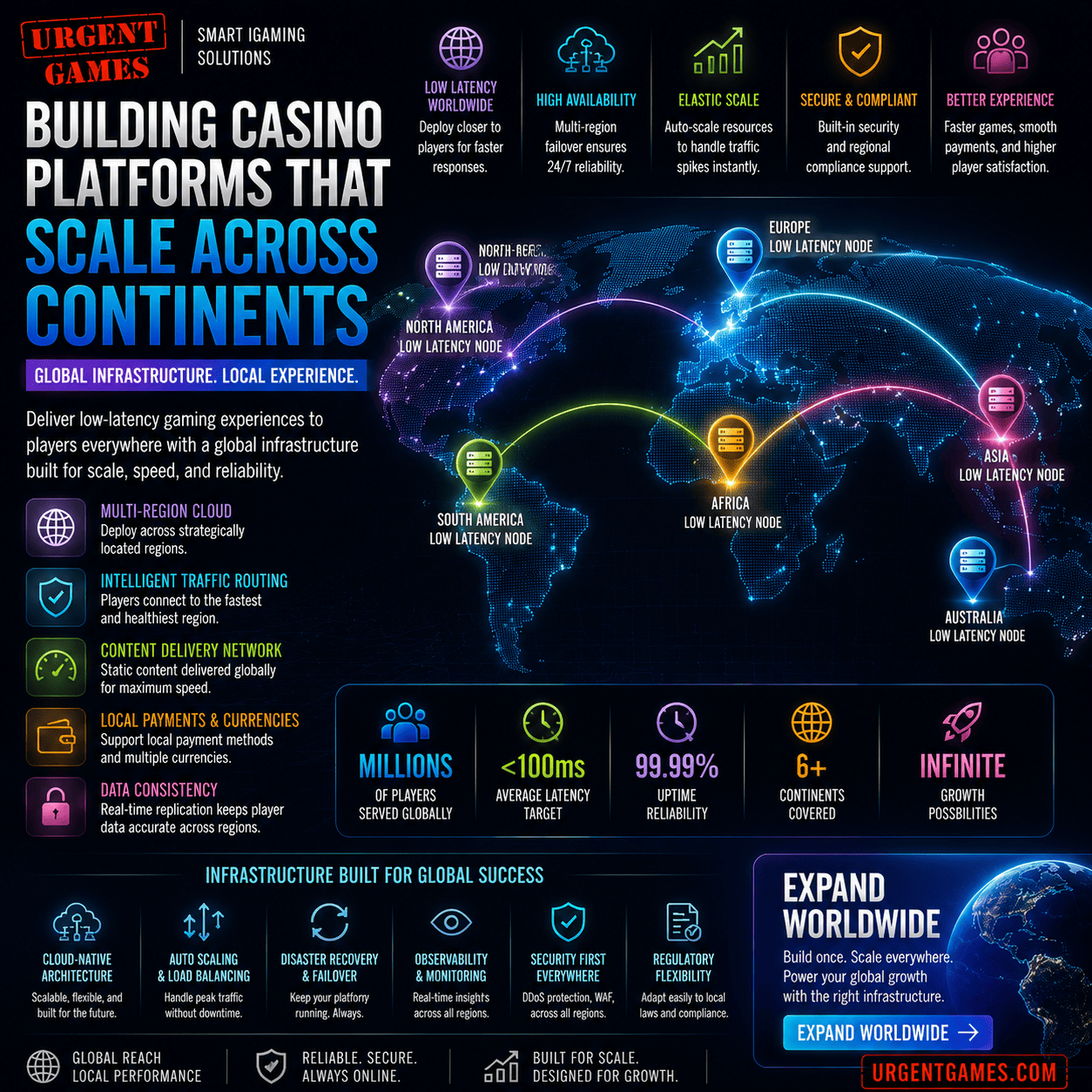
Global Casino Infrastructure: Building Platforms That Scale Across Continents
Building a resilient global casino infrastructure is essential because online gaming is no longer limited by geography. Today’s operators launch in multiple regions simultaneously, support players across dozens of countries, and process millions of transactions around the clock. Consequently, players expect instant game launches, fast deposits, and uninterrupted gameplay regardless of where they are located.
Meeting those expectations requires far more than translating a website or accepting multiple currencies. Indeed, it demands a specialized global casino infrastructure designed for low latency, high availability, regulatory flexibility, and continuous scalability. For operators planning international expansion, infrastructure is one of the biggest competitive advantages.
Why Global Scale Matters for iGaming Platforms
A player connecting from Singapore should have the exact same smooth experience as a player in London or São Paulo. However, when infrastructure is poorly architected, platforms experience significant operational drop-offs.
Specifically, weak global architecture leads to:
Longer game load times
Higher payment processing failures
Interrupted live gaming sessions
Lower player retention rates
Substantial loss of operator revenue
Therefore, deploying infrastructure that serves players close to where they live dramatically improves the overall user experience.
Core Pillars of a Low-Latency Global Casino Infrastructure
1. Reduce Latency with Regional Deployments
Latency is the time it takes for data to travel between a player’s device and the core platform. Even small delays can negatively impact live casino streams, sportsbook odds updates, wallet balance changes, and authentication requests. Deploying application instances across multiple edge regions ensures requests are processed closer to the player, which dramatically lowers response times.
2. Multi-Region Cloud Architecture
Leading operators rely on global cloud platforms—such as AWS Global Infrastructure—that offer robust data centers across multiple geographic zones. As a result, operators achieve faster local performance, automated multi-region failover, simplified scaling, and robust disaster recovery capabilities.
3. Content Delivery Networks (CDNs) for Faster Media Speed
Static assets—such as game thumbnails, promotional banners, JavaScript bundles, and CSS stylesheets—should always be delivered via a Content Delivery Network (CDN). CDNs cache static media assets at edge locations globally, which reduces server load and speeds up page rendering worldwide.
Technical Strategies for Scaling Global Casino Infrastructure
To maintain high availability and performance across continents, engineering teams must implement scalable software architecture patterns.
| Scaling Strategy | Technical Implementation | Operational Benefit |
| Horizontal Scaling | Auto-scaling groups and container orchestration | Handles sudden traffic spikes during major sporting events without downtime. |
| Intelligent Traffic Routing | Global load balancing based on geolocation and latency | Automatically routes players to the nearest and healthiest server node. |
| Distributed Data Replication | Event-driven data synchronization and replication | Keeps critical player wallets, balances, and bonus statuses synced globally. |
| Modular Microservices | Decoupled services (Wallets, Payments, CRM, Fraud) | Enables teams to scale high-traffic components independently without bottlenecks. |
Regulatory Compliance and Payment Localization
Operating a global casino infrastructure requires navigating diverse regional laws and financial preferences.
Localized Payment Infrastructure
Payment preferences vary significantly around the world. Therefore, operators should integrate local payment gateways, regional banking networks, digital wallets, and popular cryptocurrencies alongside traditional credit card options. Supporting local financial methods directly increases deposit conversion rates.
Building for Multi-Jurisdiction Regulatory Flexibility
Different markets enforce distinct compliance standards. Thus, your infrastructure must support regional data residency requirements, local taxation reporting, responsible gaming limits, and localized identity verification (KYC). A modular architecture makes adapting to new gaming jurisdictions significantly faster and easier.
Ensuring High Availability, Security, and Observability
Operating a 24/7 gaming platform across time zones leaves zero room for unexpected outages.
To explore advanced monitoring techniques across microservice platforms, read our comprehensive guide on implementing gaming observability.
Key Metrics Every Global Operator Should Track
Infrastructure Tip: Never assume your disaster recovery works—test multi-region failover scenarios regularly in staging environments.
Performance Metrics: Average API response time, game launch latency, static asset load speed, CDN cache hit ratio.
Reliability Metrics: Regional service uptime, multi-region failover success rate, database replication lag, incident recovery duration.
Business Metrics: Active player volume by country, deposit success rate by region, market revenue generation, retention rates.
Infrastructure Metrics: CPU and memory utilization per region, network throughput, queue processing times.
Common Mistakes in Global Casino Infrastructure Scaling
Expanding Before Infrastructure Is Ready: Launching into new international markets without edge deployments leads to immediate server crashes and lost revenue.
Ignoring Regional Network Latency: Hosting a platform in a single central data center guarantees slow load times for international players.
Weak Disaster Recovery Protocols: Failover mechanisms must be tested regularly rather than assuming cloud providers will handle failures automatically.
Treating Every Region Identically: Failing to localize payment gateways, regulatory compliance rules, and language support harms market penetration.
Operating Without Centralized Observability: Lacking multi-region visibility makes diagnosing distributed microservice errors slow and complex.
The Future of Global Casino Infrastructure
Next-generation iGaming platforms are moving rapidly toward edge computing and automated orchestration. Future architectures will increasingly depend on:
Multi-cloud deployments to avoid vendor lock-in
Edge-based serverless execution for near-instant game responses
AI-driven traffic routing to route requests dynamically around network congestion
Fully automated cloud-native microservices and infrastructure scaling
By leveraging modern telemetry standards like OpenTelemetry, operators can maintain full control over complex multi-region ecosystems.
Loppuajatukset
Expand Your Platform Worldwide
Ready to deploy a high-availability global casino infrastructure engineered for enterprise scalability and low latency?
Explore our guide on monthly content planning for marketing operations or contact our cloud architecture team today to audit your multi-region deployment stack!