
 Deutsch (Sie)
  English
  简体中文
简体中文  Español
  Русский
  Türkçe
  Tiếng Việt
  Українська
  Български
  Suomi
Suomi  Ελληνικά
  Čeština
  اردو
اردو  Svenska
  עִבְרִית
  हिन्दी
  Français
  Հայերեն
  Italiano
  日本語
日本語  Română
  Polski
  Српски језик
  Latviešu valoda
  Português do Brasil
  한국어
한국어 
Feature Flags Gaming: How to Accelerate Platform Releases Safely
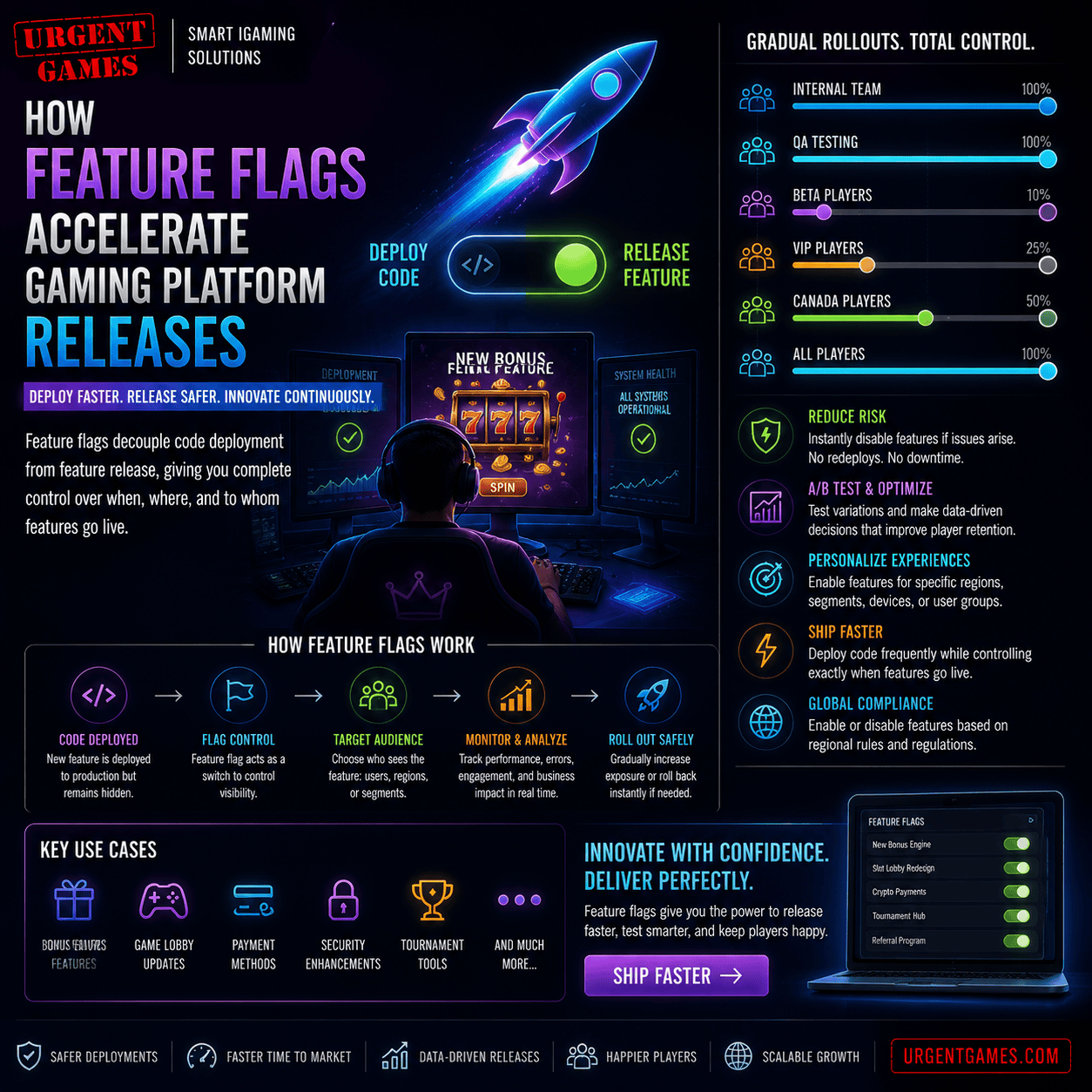
Adopting feature flags gaming strategies allows modern platform operators to solve one of the biggest challenges in software engineering: releasing new features without introducing production risk. Every code deployment carries inherent risk. Specifically, a single unexpected bug can impact live player sessions, disrupt payment processing, break wallet synchronization, or crash game servers—potentially affecting thousands of active players and damaging brand trust.
To mitigate these risks, engineering teams rely on feature flags. Instead of deploying code and immediately exposing it to every player, feature flags gaming workflows allow operators to release functionality gradually, test safely in production environments, and instantly disable problematic features without rolling back entire deployments.
What Are Feature Flags in Gaming Platforms?
Feature flags (also known as feature toggles or feature switches) separate software deployment from feature release. Rather than enabling a new capability for every player simultaneously, developers deploy dark code in a disabled state.
Consequently, operators can selectively activate functionality for specific cohorts:
Internal QA and engineering teams
Closed beta test groups
VIP player segments
Specific countries or licensing jurisdictions
Individual B2B white-label operators
Percentage-based user audiences (e.g., 1%, 5%, 25%)
This architectural decoupling provides immense operational flexibility while dramatically lowering deployment stress. To explore the foundational software patterns behind feature toggles, read Martin Fowler’s Feature Toggles Guide.
Why Traditional Gaming Platform Releases Are Risky
In a traditional monolithic release process, new code goes live to 100% of your audience at once. If an unexpected error occurs, every single player experiences the disruption immediately.
Furthermore, resolving critical issues typically requires an emergency rollback, which is both time-consuming and disruptive to database stability. By contrast, a feature flags gaming implementation eliminates this all-or-nothing vulnerability by allowing releases to be managed independently of underlying code deployments.
Core Benefits of Feature Flags Gaming Deployments
1. Safer Rollouts Through Phased Deployments
Instead of exposing a major feature to all players at once, operators can follow a controlled, phased rollout pipeline:
[Deploy Code (Hidden)] ──> [1% Beta Testers] ──> [10% VIP Cohort] ──> [50% Regional] ──> [100% Global]
                                 │
                   (If Error Detected ──> Instant Flip Switch Off)
If performance metrics remain stable at each stage, the rollout continues. However, if latency spikes or errors occur, the feature can be toggled off instantly in real time—without redeploying code or scheduling emergency maintenance window downtime.
2. A/B Testing and Data-Driven Personalization
Experimentation becomes seamless when functionality is wrapped in feature toggles. For instance, product teams can split traffic to compare:
| Feature Area | Experimentation Focus | Data-Driven Impact |
| Lobby Layouts | Grid vs. Carousel game displays | Higher player game discovery |
| Bonus Engines | Instant cashbacks vs. Spin rewards | Improved retention rates |
| Registration Flows | Single-page vs. Multi-step onboarding | Higher deposit conversion rates |
| Payment Gateways | Dynamic local payment sorting | Reduced checkout friction |
In addition, feature flags enable localized player experiences based on geography, device type, VIP status, or active marketing campaigns without forcing developers to maintain multiple codebase branches.
Operational Execution Strategy
Implementing feature toggles empowers non-engineering teams—including product managers, QA specialists, customer support leads, and compliance managers—to manage feature availability independently.
For actionable guidance on establishing real-time telemetry across distributed systems, explore our guide on implementing gaming observability.
Enhancing Regulatory Compliance and Peak Event Performance
Major sporting events, global tournaments, and promotional jackpots are high-risk periods for platform updates. Deploying code behind feature flags gaming tools allows teams to freeze codebase deployments while retaining the ability to activate pre-tested promotional features during peak traffic safely.
Furthermore, because online gaming regulations vary across international borders, feature flags simplify multi-jurisdiction operations. Teams can dynamically enable or disable specific deposit methods, responsible gaming tools, or marketing banners based on local country licenses.
To learn more about structuring resilient architecture across international markets, read our playbook on building global casino infrastructure.
Best Practices and Common Mistakes to Avoid
DevOps Tip: Feature flags are powerful, but temporary flags must be removed once a feature is fully rolled out. Accumulating stale flags creates unnecessary technical debt and code complexity.
Best Practices:
Document flag ownership and expiry dates clearly within your repository.
Integrate flag management directly into your CI/CD delivery pipelines.
Automate rollback triggers based on error rate thresholds.
Combine feature toggles with real-time application monitoring tools.
Common Pitfalls:
❌ Leaving Retired Flags in Production: Forgotten flags bloat codebase logic over time.
❌ Releasing Without Real-Time Observability: Gradual rollouts require continuous monitoring of server health and API latency.
❌ Testing Only in Production: Feature flags complement thorough QA and staging testing—they do not replace them.
The Future of Feature Flags in Gaming
As cloud-native iGaming platforms evolve, feature flagging tools are incorporating advanced automation. Future release pipelines will increasingly utilize:
AI-driven dynamic rollout recommendations
Automated rollback triggers based on automated anomaly detection
Predictive risk scoring prior to flag activation
Self-healing deployment infrastructure
Schlussbetrachtung
Modernize Your Platform Release Engine
Explore our technical guides on monthly content planning or contact our DevOps architecture team today to audit your platform deployment stack!