
 English
  简体中文
简体中文  Español
  Русский
  Türkçe
  Tiếng Việt
  Українська
  Български
  Suomi
Suomi  Ελληνικά
  Čeština
  اردو
اردو  Svenska
  עִבְרִית
  हिन्दी
  Français
  Հայերեն
  Italiano
  日本語
日本語  Română
  Polski
  Српски језик
  Latviešu valoda
  Deutsch (Sie)
  Português do Brasil
  한국어
한국어 
Introduction
The modern crypto casino platform has evolved from a niche innovation into a serious business strategy. While the gaming industry has spent years optimizing payments, player acquisition, mobile experiences, and global expansion, financial friction remains a major challenge.
Slow deposits, delayed withdrawals, cross-border payment limitations, currency conversion costs, and banking restrictions continue to impact operators worldwide.
As a result, many gaming businesses are exploring crypto-native infrastructure not because it is trendy, but because it solves real operational problems. In many cases, it also provides competitive advantages that traditional payment systems struggle to match.
What Is a Crypto Casino Platform?
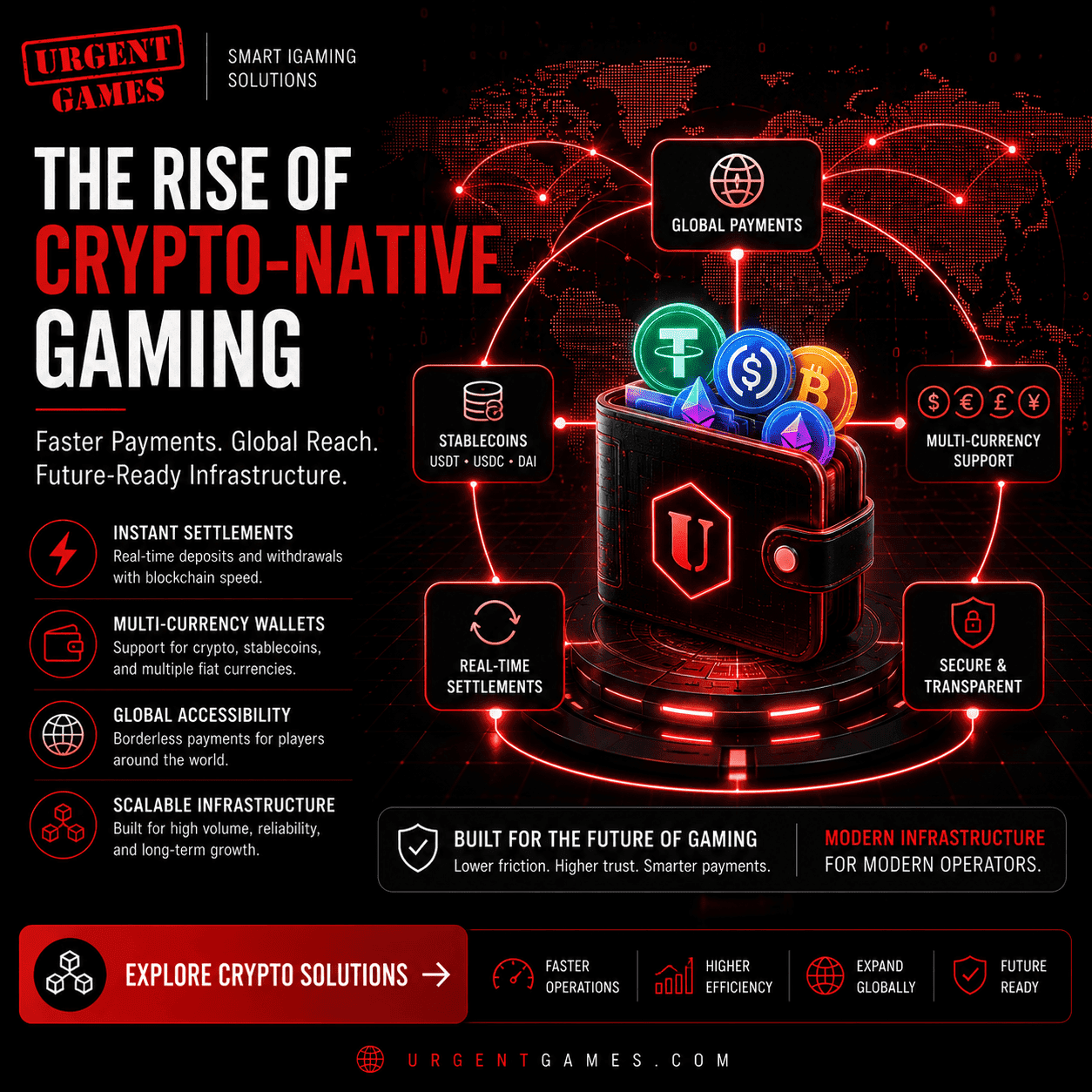
A crypto casino platform is much more than a traditional casino that simply accepts cryptocurrency payments.
There are two distinct approaches:
Crypto-Friendly Platform
Traditional infrastructure with cryptocurrency added as an additional payment option.
Crypto-Native Platform
Infrastructure designed from the ground up around:
- Digital assets
- Blockchain settlements
- Multi-currency wallets
- Real-time transactions
- Global accessibility
This distinction matters because platform architecture directly impacts scalability, efficiency, and user experience.
Why Operators Are Exploring Crypto Casino Platform Infrastructure
The primary driver behind crypto adoption is operational efficiency.
Traditional payment ecosystems often depend on:
- Banks
- Payment service providers
- Multiple intermediaries
- Settlement networks
Each layer introduces:
- Additional costs
- Increased friction
- Operational complexity
Crypto-native infrastructure reduces reliance on these intermediaries and streamlines financial operations.
How a Crypto Casino Platform Improves Deposit Conversion
Modern players expect instant experiences.
Waiting for deposits to clear creates unnecessary friction during onboarding.
Crypto transactions can provide:
- Near-instant confirmations
- Global accessibility
- 24/7 availability
- Faster account funding
As a result, operators can improve player acquisition and conversion rates.
Why Faster Withdrawals Create Competitive Advantage
Players often remember withdrawals more than deposits.
Fast payouts improve:
- Trust
- Retention
- Brand reputation
- Player satisfaction
Traditional withdrawal systems may involve:
- Manual reviews
- Banking delays
- Settlement windows
Crypto-native infrastructure can significantly reduce payout friction and improve the overall player experience.
Crypto Casino Platform Benefits for Global Expansion
One of the biggest challenges for operators is cross-border payments.
Different markets often require:
- Different banking partners
- Local payment methods
- Multiple currencies
Crypto provides a globally accessible transaction layer that simplifies international growth.
For additional insights, see our Global Gaming Platform Expansion Guide.
Multi-Currency Wallet Infrastructure Is Becoming Essential
Modern gaming businesses increasingly support:
- USD
- EUR
- BRL
- MXN
- Stablecoins
- Digital assets
Therefore, many operators are building around multi-currency wallet architecture.
Benefits include:
- Greater flexibility
- Improved player choice
- Simplified treasury management
How Stablecoins Are Accelerating Adoption
One of the fastest-growing areas of crypto gaming infrastructure is stablecoin adoption.
Popular examples include:
- USDT
- USDC
Stablecoins provide many blockchain benefits while reducing volatility concerns.
Advantages include:
- Faster settlement
- Predictable value
- Easier accounting
- Improved liquidity management
For more information about stablecoins, visit Circle USDC.
Real-Time Settlements in a Crypto Casino Platform
Traditional payment systems often settle transactions in batches.
By contrast, blockchain-based systems increasingly support real-time settlement.
Benefits include:
- Faster financial visibility
- Reduced reconciliation delays
- Improved cash-flow management
- More efficient operations
Why Wallet Architecture Matters
The wallet is becoming the foundation of modern gaming infrastructure.
Crypto-native wallets support:
- Multiple assets
- Instant transfers
- Unified balances
- Real-time transaction monitoring
As platforms evolve, the wallet increasingly becomes the center of the player experience.
Can Crypto Infrastructure Reduce Operational Costs?
Traditional payment systems often involve:
- Processing fees
- Intermediary costs
- Settlement charges
Crypto infrastructure can reduce dependency on multiple payment layers.
As a result, operators may lower transaction costs while simplifying operations.
Blockchain Transparency Improves Financial Visibility
Blockchain systems create transparent transaction histories.
This enables:
- Easier auditing
- Better reconciliation
- Improved traceability
- Enhanced reporting
For blockchain technology insights, visit Ethereum Foundation.
Fraud Prevention in Crypto Gaming Ecosystems
Crypto changes fraud dynamics.
Some traditional fraud vectors become less common, including:
- Chargebacks
- Payment reversals
However, new challenges emerge:
- Wallet security
- Transaction monitoring
- Asset movement analysis
For this reason, robust risk management remains essential.
Learn more in our Gaming Fraud Detection Framework guide.
Why Player Demand for Crypto Payments Is Growing
A growing segment of players expects:
- Crypto deposits
- Crypto withdrawals
- Multi-asset wallets
Demand is particularly strong among:
- Emerging markets
- Technology-focused communities
- Digital-native demographics
Consequently, operators are increasingly evaluating crypto-enabled payment ecosystems.
Infrastructure Matters More Than Token Support
Many operators focus primarily on which cryptocurrencies to accept.
However, a more important question is whether the infrastructure can support digital assets efficiently.
Key considerations include:
- Wallet architecture
- Settlement systems
- Compliance workflows
- Reporting capabilities
The strongest platforms prioritize infrastructure before expanding token support.
Compliance Requirements for a Crypto Casino Platform
Crypto does not eliminate regulatory obligations.
Operators still require:
- KYC verification
- AML monitoring
- Transaction screening
- Responsible gaming controls
For guidance on AML best practices, see Financial Action Task Force (FATF).
Why Hybrid Payment Models Are Emerging
Many gaming businesses are adopting hybrid payment architectures.
These systems support both:
- Traditional payments
- Cryptocurrency payments
Benefits include:
- Greater flexibility
- Wider player reach
- Market adaptability
- Reduced operational risk
Real-Time Analytics for Crypto Gaming Operations
Crypto-native ecosystems generate significant amounts of transaction data.
Operators increasingly use analytics for:
- Risk monitoring
- Fraud detection
- Transaction visibility
- Operational reporting
For a deeper dive, explore our Real-Time Gaming Analytics Guide.
The Competitive Advantage of Crypto-Native Infrastructure
Leading operators increasingly view crypto as infrastructure innovation rather than simply a payment feature.
Benefits include:
- Faster settlements
- Improved global reach
- Better wallet flexibility
- Reduced payment friction
- Enhanced scalability
These advantages help create stronger player experiences and more efficient operations.
Common Operator Mistakes
Focusing Only on Token Support
Infrastructure matters more than the number of supported assets.
Ignoring Compliance
Crypto does not remove regulatory requirements.
Underestimating Wallet Complexity
Multi-currency wallet systems require strong architecture.
Treating Crypto as a Trend
The long-term opportunity lies in operational efficiency.
The Future of Crypto Casino Platform Technology
The next generation of gaming infrastructure will likely include:
- Unified wallets
- Stablecoin settlements
- Multi-currency support
- Real-time financial visibility
- Hybrid payment ecosystems
Why?
Because operators increasingly prioritize:
- Speed
- Global reach
- Operational efficiency
- Scalability
Final Thoughts
Crypto adoption in gaming is no longer driven solely by innovation.
Instead, it is increasingly driven by business fundamentals.
Modern crypto-native infrastructure helps operators:
- Expand globally
- Reduce payment friction
- Improve withdrawal speed
- Enhance financial visibility
- Build flexible payment ecosystems
The future is unlikely to be purely traditional or purely crypto.
Instead, the strongest platforms will combine both worlds effectively.
Because in modern iGaming, the biggest advantage is not simply accepting cryptocurrency.
It is building infrastructure designed for the future of digital finance.