
 English
  简体中文
简体中文  Español
  Русский
  Türkçe
  Tiếng Việt
  Українська
  Български
  Suomi
Suomi  Ελληνικά
  Čeština
  اردو
اردو  Svenska
  עִבְרִית
  हिन्दी
  Français
  Հայերեն
  Italiano
  日本語
日本語  Română
  Polski
  Српски језик
  Latviešu valoda
  Deutsch (Sie)
  Português do Brasil
  한국어
한국어 
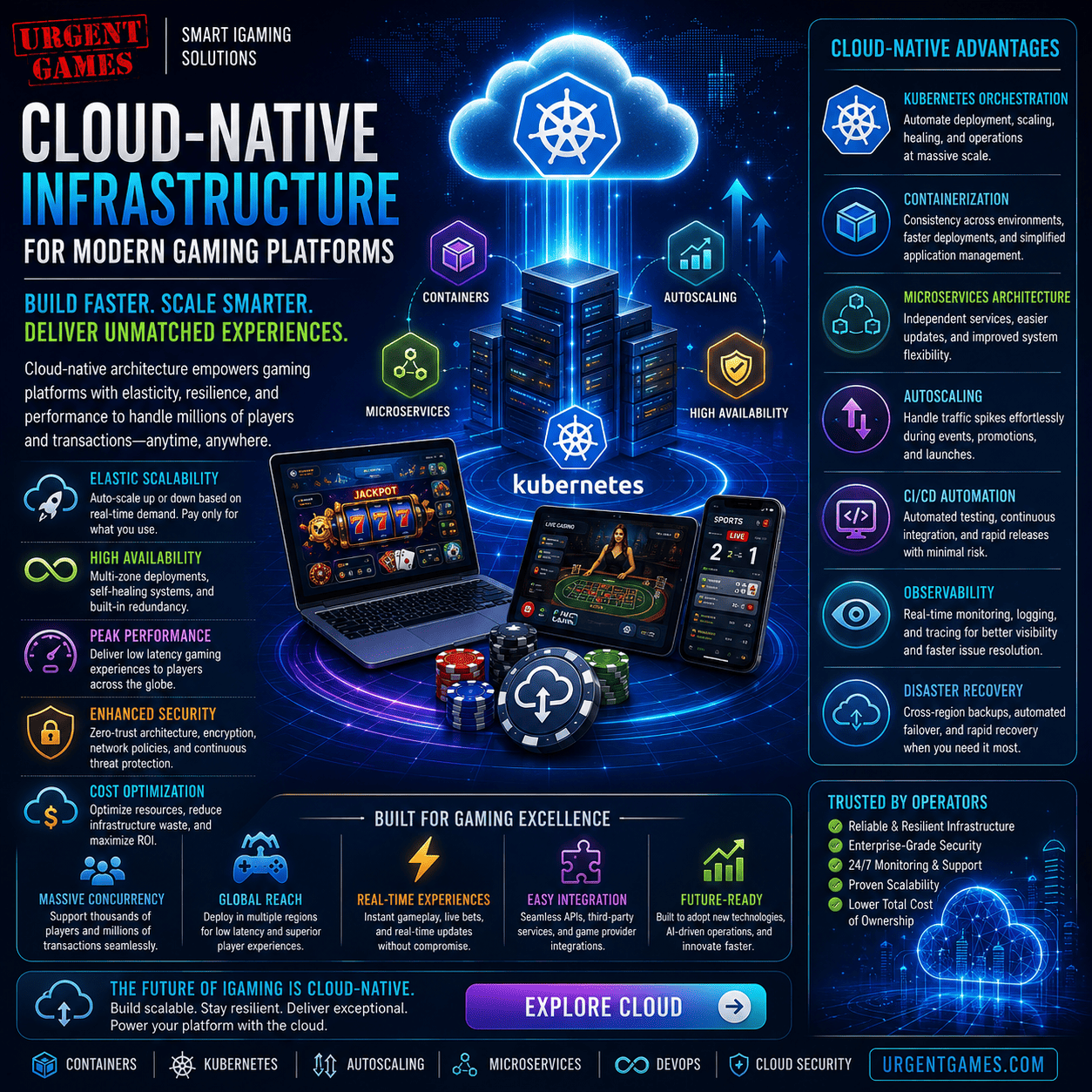
Cloud Native Casino Architecture: Scalable Gaming Infrastructure
Adopting a cloud native casino architecture is now essential for iGaming operators, as modern online platforms must process millions of daily transactions while supporting thousands of concurrent players. Consequently, traditional on-premises setups struggle to handle real-time payment processing, continuous game releases, and global traffic spikes without friction.
By transitioning from legacy monolithic deployments to modern cloud-native systems, operators can achieve near-zero downtime and seamless scalability. Leveraging containers, Kubernetes orchestration, and automated microservices ensures high availability while dramatically reducing operational overhead across global markets.
What Is Cloud Native Casino Architecture?
A cloud native casino architecture refers to an ecosystem engineered specifically for public, private, or hybrid cloud environments. Instead of lifting and shifting legacy code onto virtual machines, cloud-native gaming systems use decoupled microservices that scale independently based on demand.
Key technological components include:
Docker Containers: Packaging application services with their exact dependencies for consistent cross-environment deployment.
Kubernetes Orchestration: Automating container scheduling, self-healing, rolling updates, and cluster management.
Microservices Architecture: Splitting platform monoliths into specialized, independently deployable services (such as wallet, player, and game logic).
Infrastructure as Code (IaC): Managing infrastructure state through declarative scripts via Terraform or Ansible.
Automated CI/CD Pipelines: Executing continuous integration and zero-downtime blue/green or canary rollouts.
Core Operational Benefits for Gaming Operators
| Architecture Component | Traditional On-Premises | Cloud-Native Environment |
| Scaling Mechanism | Manual hardware provisioning (Days/Weeks) | Automated cluster autoscaling (Seconds) |
| Deployment Model | Monolithic maintenance windows | Zero-downtime rolling microservice updates |
| Fault Tolerance | Single point of failure risks | Multi-zone self-healing container pods |
| Cost Model | High fixed capital expenditure (CapEx) | Flexible elastic operational cost (OpEx) |
For deeper insights into automating real-time casino game deployment, review our guide on casino CI/CD continuous deployment.
Key Pillars of Modern Cloud Native Casino Architecture
1. Containerization and Kubernetes Orchestration
Containers eliminate configuration drifts between staging and production. By wrapping core gaming engines in lightweight containers, engineering teams achieve predictable behavior across all environments.
Furthermore, Kubernetes automates pod scheduling, load balancing, service discovery, and health checks. If an individual pod crashes, Kubernetes automatically replaces it without interrupting live player sessions.
2. Elastic Autoscaling for Peak Traffic
Player activity swings dramatically during major sporting events, high-jackpot campaigns, and new game launches.
[Traffic Spike Detected] ──> [Horizontal Pod Autoscaler Triggered] ──> [New Nodes Provisioned] ──> [Load Balanced Smoothly]
According to cloud performance research published by the CNCF (Cloud Native Computing Foundation), automated cluster autoscaling reduces infrastructure overhead by up to 40% while maintaining sub-100ms API response times during unexpected load surges.
3. Microservices Integration Framework
To explore how distributed wallet services handle instant game payouts, read our technical breakdown of real-time wallet reconciliation.
Observability, Security, and Disaster Recovery
Monitoring a distributed platform requires full visibility across logs, metrics, and distributed traces. Modern observability platforms allow engineering teams to detect API latency bottlenecks and container memory limits before they impact end users.
[Distributed Tracing / Logs] ──> [AIOps Anomaly Engine] ──> [Predictive Scale Trigger] ──> [SRE Incident Avoidance]
In addition, security must be built directly into the container lifecycle. Employing zero-trust network policies, role-based access control (RBAC), and automated container vulnerability scanning guarantees robust compliance across regulated markets.
For details on protecting player data across cloud environments, see our comprehensive casino data privacy guide.
Avoid Common Implementation Pitfalls
Architecture Warning: Treating the cloud as a static data center leads to overprovisioning and ballooning costs. True cloud-native efficiency requires dynamic autoscaling and automated container lifecycle management.
Watch out for these common operational mistakes:
❌ Ignoring CI/CD Automation: Manual updates eliminate the speed and safety benefits of container orchestration.
❌ Weak Pod Security Policies: Every container image must be regularly scanned for open vulnerabilities.
❌ Overlooking Multi-Region Failover: Always configure multi-zone or cross-region database replication for disaster recovery.
Future Trends in Cloud Native Casino Architecture
As cloud technologies mature, modern gaming platforms are increasingly integrating:
AIOps for Autonomous Scaling: Machine learning models predicting traffic surges and adjusting cluster capacity proactively.
Edge Computing for Low-Latency Play: Running game logic nodes closer to players globally to minimize latency.
GitOps Deployment Pipelines: Managing cluster configurations declaratively via Git repositories for full revision control.
Scale Your iGaming Platform Infrastructure
Upgrading your gaming infrastructure requires clear strategy and modern tools:
Learn How to Build Global Casino Infrastructure for Multi-Region Scale
Discover How Multiplayer Casino Fishing Games Scale on Cloud Infrastructure
Frequently Asked Questions
How does a cloud native casino architecture handle sudden traffic spikes?
Through Horizontal Pod Autoscaler (HPA) policies, cloud-native platforms detect resource utilization increases and spin up additional container instances automatically within seconds.
Why is Kubernetes preferred over traditional virtual machines for online gaming?
Kubernetes automates container scheduling, self-healing, rolling updates, and resource management, offering higher resource density and faster deployment speeds than traditional virtual machines.