
 English
  简体中文
简体中文  Español
  Русский
  Türkçe
  Tiếng Việt
  Українська
  Български
  Suomi
Suomi  Ελληνικά
  Čeština
  اردو
اردو  Svenska
  עִבְרִית
  हिन्दी
  Français
  Հայերեն
  Italiano
  日本語
日本語  Română
  Polski
  Српски језик
  Latviešu valoda
  Deutsch (Sie)
  Português do Brasil
  한국어
한국어 
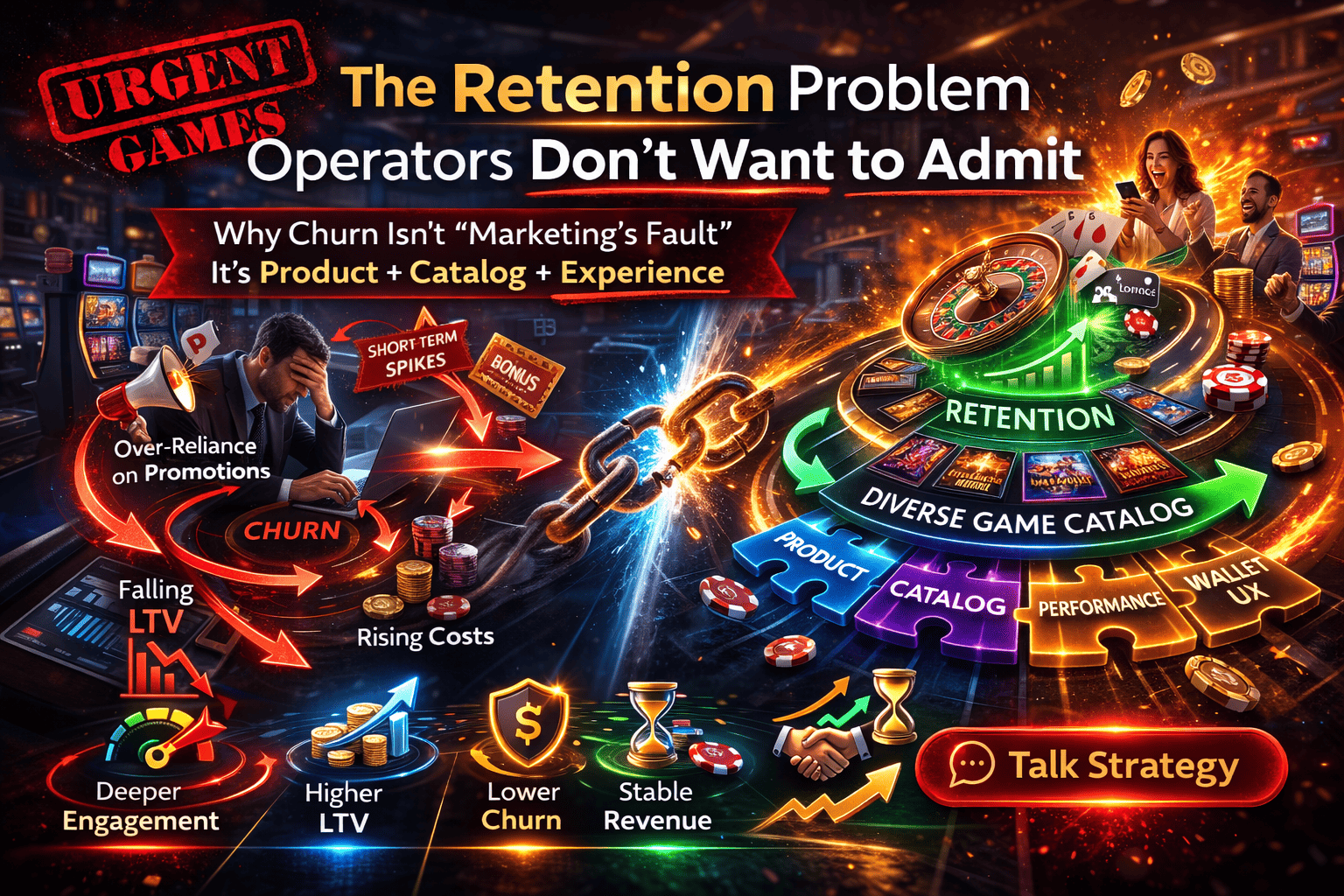
Introduction: It’s Easier to Blame Marketing
Casino retention is often treated as a marketing KPI.
When numbers fall, the reflex is predictable:
Campaigns weren’t optimized.
Bonuses weren’t strong enough.
CRM sequences underperformed.
But declining casino retention is rarely just a marketing issue.
More often, it reflects structural weaknesses in product depth, performance, and platform architecture.
Until operators address those foundations, churn continues — no matter how aggressive promotional spending becomes.
The Illusion of Retention Recovery


Temporary spikes can be misleading.
Large bonuses and reactivation campaigns inflate activity. Deposits rise. Dashboards look healthier.
But once incentives disappear, behavior often reverts.
Sustainable retention is habit-driven, not incentive-driven — a principle widely discussed in behavioral research published by Harvard Business Review.
True loyalty is measured by who returns organically.
Why Players Quietly Disengage


Churn is rarely dramatic.
It’s gradual.
Players disengage because of:
Limited content rotation
Repetitive lobby experience
Weak discovery tools
Subtle performance delays
Confusing wallet behavior
Industry data from Statista shows engagement across digital platforms strongly correlates with content refresh frequency.
Variety fuels engagement.
Stagnation fuels exits.
Content Depth vs. Content Volume
Many platforms assume “more games” automatically improves retention.
But long-term engagement depends on:
Volatility diversity
Multiple mechanics
New releases cadence
Cross-vertical exposure (live, crash, instant)
Depth creates replay value.
Surface-level volume creates noise.
Operators evaluating aggregation strategy can explore our internal resource:
Single-API Casino Integration Guide (/single-api-casino-integration)
Performance and Experience Quality

Even small technical friction impacts perceived quality.
Sub-second delays influence digital engagement — a finding consistently reported by Google in web performance research.
Slow game launches.
Delayed balance updates.
Interrupted session rhythm.
Players rarely complain.
They simply stop returning.
For a deeper technical breakdown, see:
iGaming API Latency: The Hidden Threat to Retention (/igaming-api-latency-retention)
The Promotion Dependency Trap
When engagement weakens, promotions expand.
The pattern is predictable:
Retention dips
Incentives increase
Short-term spike
Margin compression
Retention declines again
This creates dependency.
Research from McKinsey & Company emphasizes that long-term customer value improves when product strength — not discounts — drives engagement.
Habits outperform incentives.
Retention Is an Architectural Outcome
Retention does not live solely inside the marketing department.
It is influenced by:
Aggregation architecture
Wallet consistency
Transaction reliability
Personalization capability
Performance stability
These are structural decisions.
When architecture improves, retention strengthens naturally.
When architecture stagnates, acquisition costs rise.
Urgent Games: Strengthening the Foundation
Urgent Games supports operators through:
Access to 5,000+ games
Unified API integration
Standardized transaction logic
High-performance infrastructure
Centralized reporting
When platform friction decreases, engagement increases.
Marketing becomes more efficient because the product carries more weight.
Conclusion: Experience Drives Loyalty
Blaming campaigns is easy.
Strengthening product depth is harder.
But sustainable casino retention depends on:
Content evolution
Platform responsiveness
Architectural clarity
Churn rarely stems from creativity gaps.
It stems from experience gaps.
Operators who treat retention as a structural advantage — not just a marketing metric — build more resilient businesses.