
 English
  简体中文
简体中文  Español
  Русский
  Türkçe
  Tiếng Việt
  Українська
  Български
  Suomi
Suomi  Ελληνικά
  Čeština
  اردو
اردو  Svenska
  עִבְרִית
  हिन्दी
  Français
  Հայերեն
  Italiano
  日本語
日本語  Română
  Polski
  Српски језик
  Latviešu valoda
  Deutsch (Sie)
  Português do Brasil
  한국어
한국어 
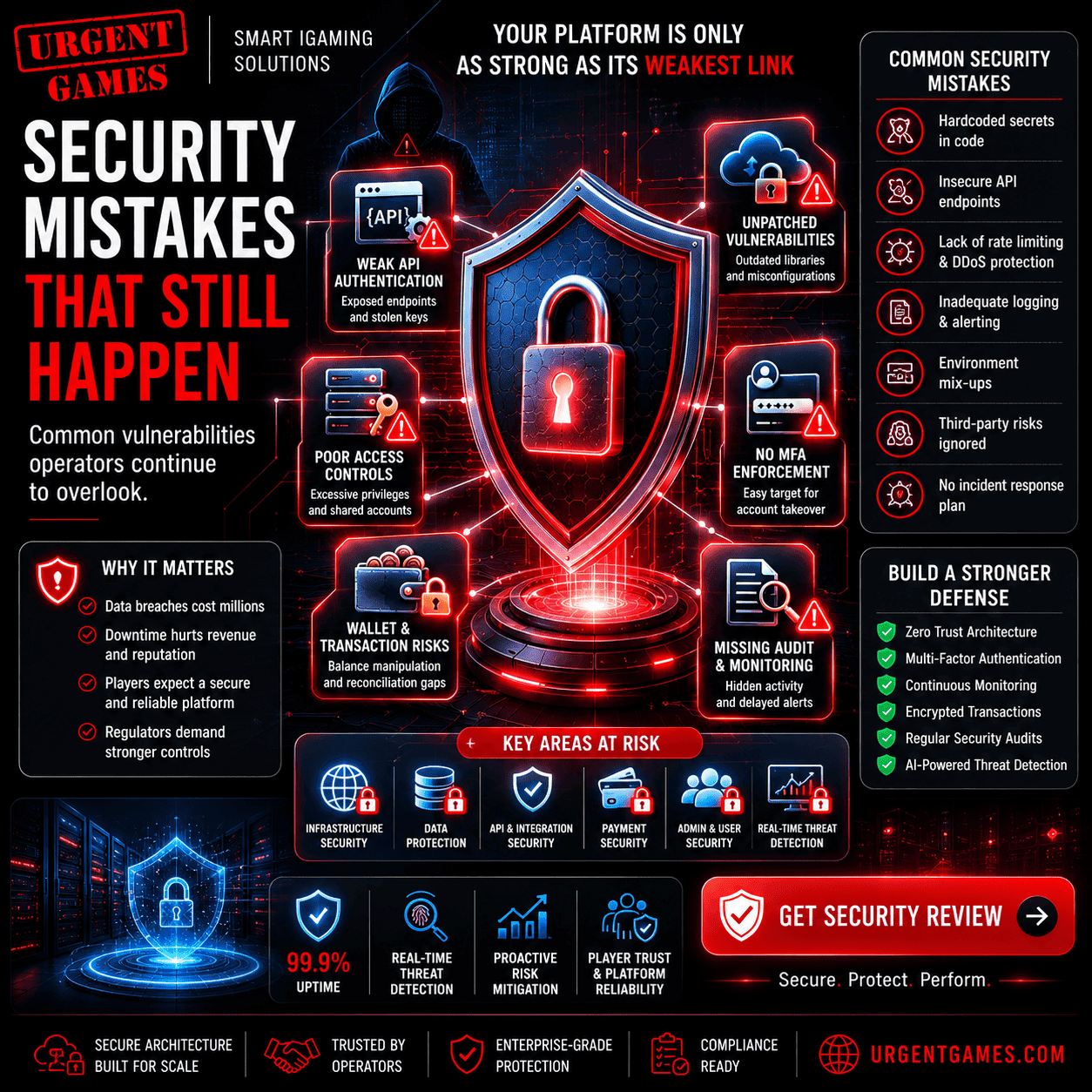
Introduction: Why Casino Platform Security Matters More Than Ever
Casino platform security has become one of the most important priorities for modern gaming operators. While the industry invests heavily in fraud prevention, compliance, payment protection, and infrastructure monitoring, many organizations continue to make avoidable security mistakes.
The issue is rarely a lack of security tools.
Instead, security incidents often result from misconfigured systems, weak operational processes, and overlooked vulnerabilities.
In today’s highly competitive and regulated environment, security failures can lead to:
- Revenue loss
- Regulatory penalties
- Reputational damage
- Player trust issues
- Operational disruption
As a result, casino platform security is no longer just an IT concern. It is a business-critical requirement that directly impacts growth, compliance, and customer retention.
The most successful operators understand that preventing incidents is significantly less expensive than recovering from them.
Why Casino Platform Security Challenges Continue to Grow
Modern gaming platforms are more complex than ever before.
Today, operators manage:
- Casino game integrations
- Sportsbook feeds
- Payment gateways
- Wallet systems
- CRM platforms
- Affiliate platforms
- Third-party APIs
Each new integration introduces additional risk.
Consequently, maintaining strong casino platform security becomes increasingly challenging as infrastructure grows.
Weak API Authentication Remains a Casino Platform Security Risk
One of the most common vulnerabilities continues to be poor API authentication.
Many systems still rely on:
- Static API keys
- Weak token management
- Long-lived credentials
- Poor access control policies
If compromised, attackers may gain access to:
- Player information
- Transaction systems
- Administrative functions
- Reporting environments
Therefore, strong authentication mechanisms are essential for modern casino platform security.
Excessive API Permissions Increase Security Exposure
Many integrations violate the principle of least privilege.
Applications frequently receive access to:
- More endpoints
- More data
- More permissions
Than they actually require.
As a result, attackers can potentially access larger portions of a platform if credentials are compromised.
Organizations should regularly review and limit permissions to only what is necessary.
Poor Secrets Management Creates Hidden Vulnerabilities
Surprisingly, many operators still store sensitive credentials in insecure locations.
Examples include:
- Configuration files
- Code repositories
- Shared documents
- Internal spreadsheets
These credentials often include:
- API keys
- Database passwords
- Authentication tokens
Modern casino platform security strategies should utilize dedicated secrets management solutions to protect sensitive information.
Weak Administrative Access Controls
Administrative systems are often among the most targeted attack surfaces.
Common mistakes include:
- Shared administrator accounts
- Weak password policies
- Excessive privileges
- Lack of account monitoring
Every administrative action should be tied to a specific individual.
This improves accountability and simplifies investigations when issues occur.
Missing Multi-Factor Authentication
Many security incidents begin with stolen credentials.
Multi-factor authentication (MFA) significantly reduces account takeover risks.
However, some operators still fail to enforce MFA consistently.
This is particularly dangerous for:
- Administrative users
- Finance departments
- Customer support teams
- Compliance personnel
Implementing MFA remains one of the most effective casino platform security improvements available.
Weak Wallet Security Controls
Wallet infrastructure is one of the most sensitive components of any gaming platform.
Common wallet security weaknesses include:
- Poor transaction validation
- Weak reconciliation processes
- Limited audit logging
- Inadequate access controls
Since financial transactions directly impact players and operators, wallet systems should meet the highest security standards.
Ignoring Internal Security Threats
Not every threat originates from external attackers.
Internal risks may include:
- Misuse of privileges
- Unauthorized data access
- Human error
- Insider threats
Therefore, operators should implement robust monitoring and auditing processes.
Strong visibility helps identify unusual behavior before it becomes a serious incident.
Missing Audit Trails Reduce Visibility
Every operator should be able to answer:
- Who made a change?
- What was changed?
- When was it changed?
- Why was it changed?
Without detailed audit logs, investigations become difficult and compliance obligations become harder to satisfy.
Comprehensive audit trails are a critical component of casino platform security.
Poor Infrastructure Segmentation
Many organizations place critical systems on the same network.
Examples include:
- Production databases
- Internal applications
- Administrative tools
- Development resources
Proper segmentation reduces the impact of security incidents.
Consequently, attackers have a harder time moving laterally through infrastructure.
Inadequate Security Monitoring
Security teams cannot protect systems they cannot see.
Operators should continuously monitor:
- Authentication attempts
- Permission changes
- Transaction anomalies
- API failures
- Network activity
Greater visibility enables faster detection and response.
Unpatched Dependencies Introduce Vulnerabilities
Modern gaming platforms rely heavily on:
- Frameworks
- Libraries
- Open-source components
- Third-party services
Outdated software often contains known vulnerabilities.
Therefore, patch management should remain a high priority within every casino platform security program.
Weak Rate Limiting on Public APIs
Internet-facing APIs should always implement rate limiting controls.
Without rate limits, attackers may attempt:
- Credential stuffing
- Enumeration attacks
- Resource exhaustion
- Automated abuse
Rate limiting helps protect both performance and security.
Blind Trust in Third-Party Providers
Third-party integrations are essential for modern gaming operations.
However, every provider connection introduces potential risk.
Operators should continuously assess:
- Security practices
- Access permissions
- Compliance standards
- Integration behavior
Trust should never replace verification.
Poor Incident Response Planning
Many organizations focus heavily on prevention while overlooking recovery planning.
Every operator should have answers to critical questions:
- Who responds during an incident?
- How are issues escalated?
- Who communicates with players?
- What systems are prioritized?
Preparation significantly reduces operational disruption during security events.
Weak Logging Strategies
Logs provide the foundation for security investigations.
A strong logging strategy should capture:
- Authentication events
- Financial transactions
- Administrative actions
- Security alerts
Without meaningful logs, root-cause analysis becomes extremely difficult.
Lack of Real-Time Threat Detection
Traditional security often relies on historical analysis.
Modern threats require real-time visibility.
Advanced detection systems help identify:
- Suspicious behavior
- Emerging attacks
- Fraud patterns
- Unauthorized access attempts
The sooner threats are identified, the faster operators can respond.
Poor Data Retention Controls
Gaming operators collect large amounts of data, including:
- Transaction records
- Personal information
- Audit logs
- Compliance records
Retaining unnecessary data indefinitely increases security risk.
Therefore, operators should establish clear retention and deletion policies.
Weak Environment Separation
Development, testing, and production environments should remain isolated.
Mixing environments creates risks such as:
- Data exposure
- Configuration errors
- Unauthorized access
Proper separation helps protect production systems and player information.
How Observability Strengthens Casino Platform Security
Modern observability combines:
- Logs
- Metrics
- Traces
- Alerts
As a result, security teams gain deeper visibility into platform behavior.
Benefits include:
- Faster threat detection
- Improved investigations
- Better incident response
- Enhanced operational awareness
Visibility remains one of the strongest defenses against modern threats.
The Growing Role of AI in Casino Platform Security
Artificial intelligence is increasingly supporting security teams.
AI-powered systems can improve:
- Fraud detection
- Threat analysis
- Risk scoring
- Behavioral monitoring
Because AI identifies patterns across large datasets, it can often detect suspicious activity faster than traditional methods.
Important Casino Platform Security Metrics
Authentication Metrics
Monitor:
- Failed login attempts
- MFA adoption rates
- Account lockouts
Infrastructure Metrics
Track:
- Patch compliance
- Vulnerability counts
- Incident response times
Financial Security Metrics
Measure:
- Suspicious transactions
- Wallet discrepancies
- Fraud-related losses
These metrics help operators evaluate the effectiveness of their security programs.
Common Casino Platform Security Misconceptions
“We’re Too Small to Be Targeted”
Every platform is a potential target.
“Compliance Equals Security”
Compliance helps reduce risk, but it does not guarantee security.
“Our Providers Handle Everything”
Security is always a shared responsibility.
“We’ll Fix It Later”
Security debt compounds quickly and becomes more expensive over time.
The Future of Casino Platform Security
The next generation of security programs will increasingly focus on:
- Zero-trust architectures
- Continuous verification
- Automated threat detection
- AI-assisted monitoring
- Real-time risk analysis
Why?
Because attack surfaces continue to expand as platforms become more interconnected.
Consequently, operators must adopt proactive security strategies rather than reactive approaches.
Final Thoughts
Most major security incidents do not occur because operators lack security tools.
Instead, they occur because common weaknesses remain unresolved.
Effective casino platform security requires:
- Secure APIs
- Strong authentication
- Continuous monitoring
- Robust audit trails
- Proactive incident response
The most resilient operators are not those that never encounter threats.
Rather, they are the ones that identify, contain, and resolve threats before they become serious incidents.
Because in modern iGaming, security is not simply another feature.
It is the foundation that every other feature depends upon.
Get a Security Review
👉 Get a security review and protect your gaming platform with confidence.