
 English
  简体中文
简体中文  Español
  Русский
  Türkçe
  Tiếng Việt
  Українська
  Български
  Suomi
Suomi  Ελληνικά
  Čeština
  اردو
اردو  Svenska
  עִבְרִית
  हिन्दी
  Français
  Հայերեն
  Italiano
  日本語
日本語  Română
  Polski
  Српски језик
  Latviešu valoda
  Deutsch (Sie)
  Português do Brasil
  한국어
한국어 
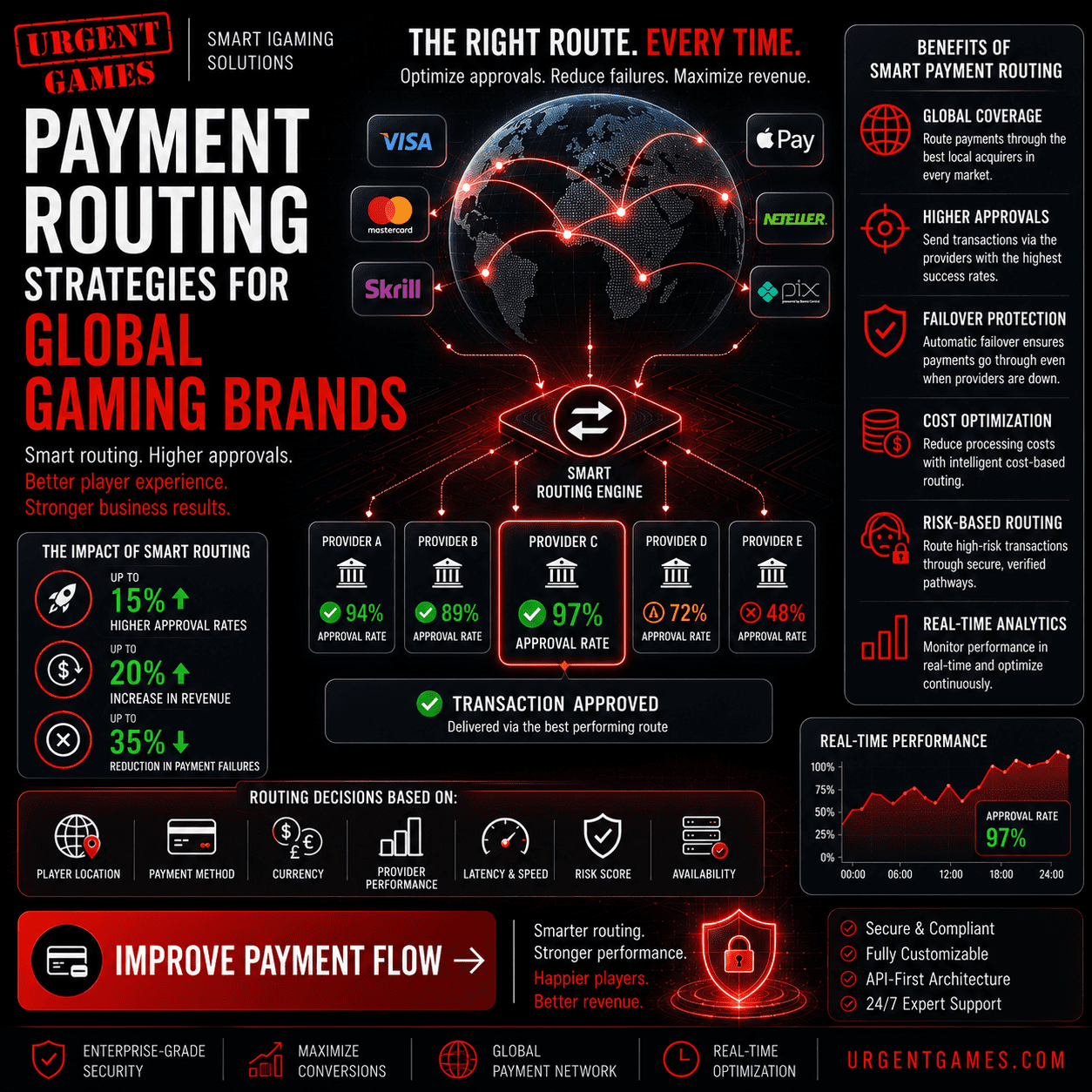
Payments are one of the most critical touchpoints in the online gaming experience.
Every successful deposit and every seamless withdrawal strengthens player confidence.
Every failed transaction creates friction.
For global gaming brands, payment complexity continues to grow as operators expand into new jurisdictions, support multiple currencies, and integrate an increasing number of payment providers.
Relying on a single payment processor is no longer sufficient.
Modern operators are increasingly adopting intelligent casino payment routing strategies to improve approval rates, reduce transaction failures, lower processing costs, and deliver a smoother player experience.
Payment routing has become far more than a technical configuration.
It is now a competitive advantage.
What Is Payment Routing?
Payment routing is the process of determining which payment provider or acquiring bank should process a transaction.
Instead of sending every transaction to a single processor, intelligent routing evaluates multiple factors before selecting the best path.
These factors may include:
- Player location
- Payment method
- Currency
- Transaction value
- Historical approval rates
- Provider availability
- Risk score
The goal is simple:
Increase successful transactions while minimizing cost and delay.
Why Payment Routing Matters
Every failed payment represents more than a declined transaction.
It may also result in:
- Lost revenue
- Abandoned deposits
- Reduced player trust
- Higher support costs
Even small improvements in payment approval rates can have a significant impact on long-term profitability.
For high-volume operators, improving approval rates by just a few percentage points may translate into substantial additional revenue over time.
The Limitations of Single-Provider Processing
Many operators initially integrate one payment gateway.
While simple to manage, this creates several risks.
If that provider experiences:
- Downtime
- Regional restrictions
- Bank outages
- Capacity issues
Every transaction is affected.
Multiple routing options improve resilience.
Intelligent Routing Improves Approval Rates
Different payment providers perform differently across regions.
For example:
A provider that performs exceptionally well in Latin America may have lower approval rates in Europe.
Another provider may specialize in mobile wallets or instant bank transfers.
Smart routing selects the processor most likely to approve each transaction.
This improves conversion while reducing unnecessary declines.
Geographic Routing Improves Performance
Player location plays an important role in payment success.
Routing transactions through local or regional acquiring banks often provides:
- Faster authorization
- Higher approval rates
- Lower processing costs
Regional optimization helps operators deliver more consistent payment experiences.
Multi-Currency Support Is Essential
Global operators increasingly support:
- USD
- EUR
- GBP
- BRL
- MXN
- CAD
- Stablecoins
Payment routing should account for currency preferences to reduce unnecessary conversion costs and improve transaction efficiency.
Supporting local currencies often improves player confidence and reduces abandonment.
Dynamic Routing Creates Better Results
Traditional routing follows fixed rules.
Modern systems increasingly rely on:
Dynamic routing.
Routing decisions adapt in real time based on:
- Current provider performance
- Approval trends
- Latency
- Availability
- Transaction history
This flexibility enables continuous optimization.
Failover Routing Protects Revenue
No payment provider delivers perfect uptime.
When a provider experiences issues, automatic failover ensures transactions are redirected without manual intervention.
Benefits include:
- Higher availability
- Reduced failed deposits
- Better player experience
Business continuity improves significantly.
Risk-Based Routing Enhances Security
Not every transaction carries the same level of risk.
Routing engines increasingly consider:
- Device reputation
- Transaction history
- Velocity checks
- Geographic anomalies
Lower-risk payments may follow the fastest path.
Higher-risk transactions may receive additional verification before processing.
This improves fraud prevention without unnecessarily impacting legitimate players.
Faster Payments Improve Retention
Payment experiences influence player loyalty.
Players expect:
- Instant deposits
- Reliable withdrawals
- Transparent processing
Routing optimization helps reduce delays while increasing consistency.
A smoother financial experience often leads to higher retention.
Routing and Wallet Infrastructure Work Together
Modern wallet systems rely on accurate payment processing.
Routing decisions should integrate seamlessly with:
- Wallet balances
- Reconciliation
- Transaction ledgers
- Settlement workflows
Unified architecture improves operational reliability.
Observability Improves Payment Operations
Modern operators monitor payment systems continuously.
Important metrics include:
- Approval rates
- Decline reasons
- Provider latency
- Settlement performance
- Gateway availability
Visibility enables rapid optimization.
Problems can often be identified before they significantly impact players.
Analytics Drive Continuous Improvement
Payment routing should never remain static.
Historical analytics help operators evaluate:
- Provider performance
- Regional trends
- Processing costs
- Failure patterns
Continuous optimization creates better long-term outcomes.
Compliance Must Remain Central
Payment routing must support regulatory obligations across every operating jurisdiction.
Operators should ensure routing strategies align with:
- AML requirements
- KYC procedures
- Data protection standards
- Financial reporting obligations
Scalable routing balances efficiency with compliance.
The Value of Multiple Payment Partners
Diversification reduces dependency.
Integrating multiple processors allows operators to:
- Improve resilience
- Increase geographic coverage
- Support additional payment methods
- Negotiate better commercial terms
A diversified payment ecosystem provides greater operational flexibility.
Preparing for Future Payment Trends
Player expectations continue to evolve.
Modern payment routing should be flexible enough to support:
- Instant payment networks
- Open banking
- Digital wallets
- Stablecoin settlements
- Emerging local payment methods
Future-ready infrastructure enables faster market expansion.
Key Metrics Every Operator Should Monitor
Payment Metrics
- Authorization rate
- Deposit success rate
- Withdrawal completion time
- Failed transaction percentage
Provider Metrics
- Gateway uptime
- Average processing latency
- Settlement accuracy
- Regional approval performance
Business Metrics
- Deposit conversion rate
- Payment abandonment
- Revenue recovered through routing optimization
- Player retention after successful deposits
Common Payment Routing Mistakes
❌ Relying on a single processor
Creates unnecessary operational risk.
❌ Ignoring regional performance differences
Approval rates vary significantly by market.
❌ No automatic failover
Downtime directly impacts revenue.
❌ Static routing rules
Miss opportunities for continuous optimization.
❌ Limited payment visibility
Makes troubleshooting more difficult.
The Future of Casino Payment Routing
The next generation of payment infrastructure will increasingly include:
- AI-powered routing optimization
- Predictive authorization models
- Real-time provider scoring
- Automated failover
- Intelligent cost optimization
Why?
Because payment performance directly influences player experience and operator profitability.
Final Thoughts
Global gaming brands can no longer rely on one-size-fits-all payment processing.
Modern casino payment routing strategies improve:
- Payment approval rates
- Operational resilience
- Player satisfaction
- Fraud management
- Revenue generation
As competition continues to grow, operators that optimize payment performance will create stronger player experiences and healthier businesses.
Because in modern iGaming:
Every successful payment strengthens trust.
Every failed payment is a missed opportunity.