 English
  简体中文
简体中文  Español
  Русский
  Türkçe
  Tiếng Việt
  Українська
  Български
  Suomi
Suomi  Ελληνικά
  Čeština
  اردو
اردو  Svenska
  עִבְרִית
  हिन्दी
  Français
  Հայերեն
  Italiano
  日本語
日本語  Română
  Polski
  Српски језик
  Latviešu valoda
  Deutsch (Sie)
  Português do Brasil
  한국어
한국어 
Introduction
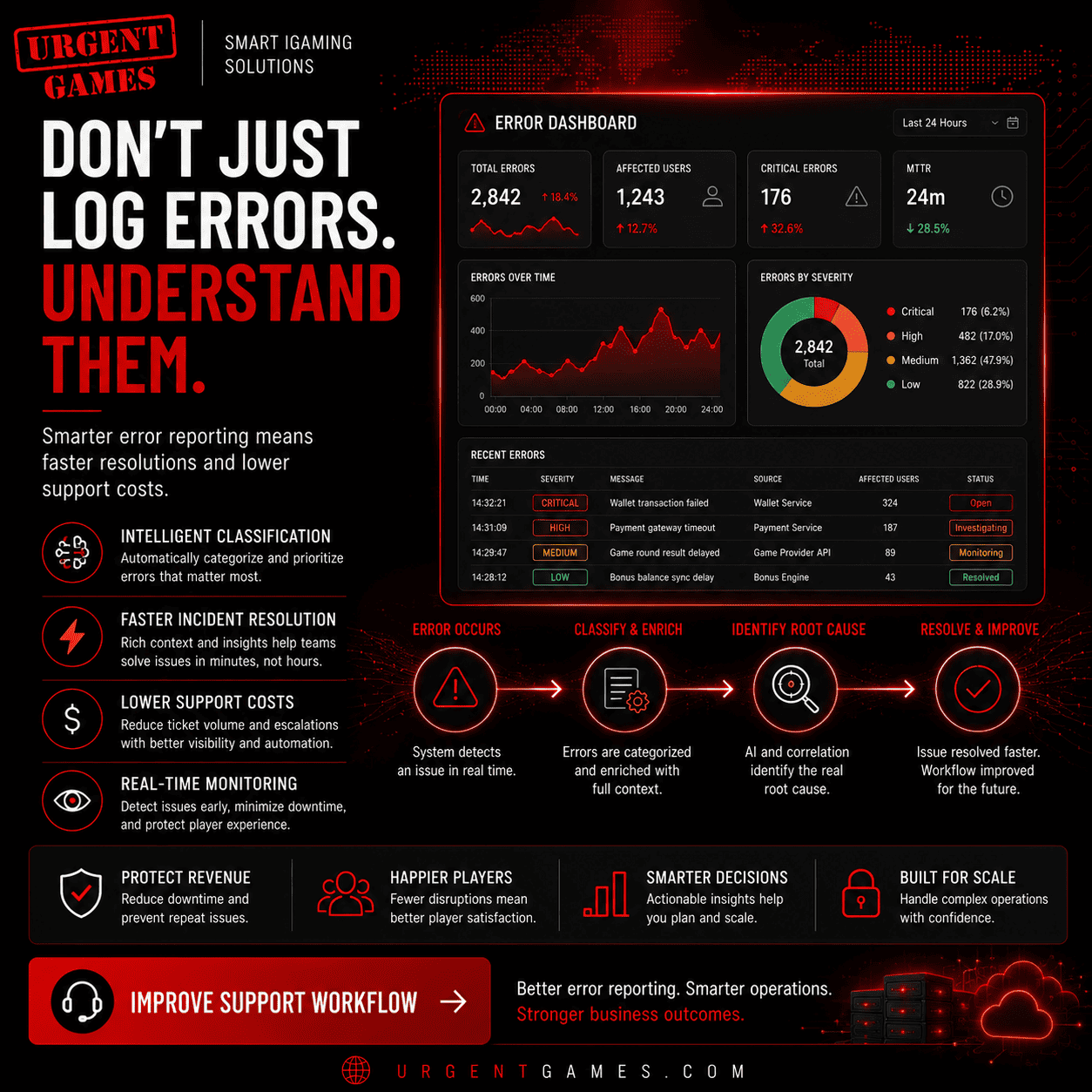
Casino error reporting has become one of the most important operational tools for modern gaming operators. While many operators invest heavily in new games, marketing campaigns, payment solutions, and platform expansion, error reporting often receives less attention.
However, when something breaks on a gaming platform, the real problem is often not the error itself. Instead, the bigger challenge is that nobody immediately knows what happened, why it happened, how many players were affected, or how quickly the issue can be resolved.
Modern gaming platforms generate thousands of events every second. Without effective casino error reporting systems, support teams are left guessing while frustrated players abandon sessions and revenue is lost.
Ultimately, the strongest operators understand a simple truth:
You cannot solve problems efficiently if you cannot identify them accurately.
The Hidden Cost of Poor Casino Error Reporting
Many operators underestimate how expensive poor visibility can be.
As a result, common consequences include:
- Longer downtime
- Increased support tickets
- Slower engineering response times
- Lower player satisfaction
- Higher operational costs
Furthermore, every unresolved issue becomes more expensive over time. Effective reporting helps operators identify and resolve problems before they escalate into major disruptions.
Related Reading: Gaming Platform Monitoring
Why Generic Error Messages Fail
Many platforms still display messages such as:
“Something went wrong. Please try again later.”
For players, this creates frustration.
Meanwhile, support teams are left with little information.
As a result, engineers often face longer investigations and delayed resolutions.
Therefore, nobody gains useful information from generic error messages. Modern reporting systems should provide meaningful diagnostics that accelerate troubleshooting.
The Real Goal of Casino Error Reporting
Modern reporting should answer five critical questions:
- What failed?
- When did it fail?
- Who was affected?
- How severe is the issue?
- What caused it?
Consequently, the faster teams receive these answers, the faster they can restore normal operations.
Error Reporting Is More Than Logging
Many organizations assume:
Logging = Error Reporting
However, that is not always true.
Logs generate raw data.
In contrast, reporting systems transform that data into actionable insights.
The difference is significant. Logging records events, while reporting tools prioritize, classify, and organize issues to support faster decision-making.
For observability best practices, see:
https://opentelemetry.io/
Why Intelligent Error Classification Matters
Not all errors deserve the same level of urgency.
Critical Errors
- Wallet transaction failures
- Deposit issues
- Provider outages
Medium-Priority Errors
- Slow page loads
- Minor API slowdowns
- Temporary service interruptions
Low-Priority Errors
- UI display inconsistencies
- Cosmetic issues
- Non-critical warnings
Therefore, classification enables support and engineering teams to focus on the problems that matter most.
Why Context Matters
An isolated error rarely tells the complete story.
Instead, context reveals the true cause.
Important diagnostic information includes:
- Player ID
- Session information
- Provider involved
- Device type
- Geographic region
- Transaction details
Because of this, comprehensive context dramatically reduces troubleshooting time.
The Problem With Alert Fatigue
Many platforms generate excessive alerts.
Consequently, support and engineering teams can become overwhelmed.
Over time, important issues become buried beneath thousands of notifications.
Therefore, modern monitoring systems should include intelligent filtering to reduce noise and improve operational efficiency.
Error Aggregation Improves Operational Visibility
Moreover, modern platforms group similar issues together.
Instead of reviewing:
- 1,000 identical errors
Teams see:
- One issue affecting 1,000 events
This improves:
- Prioritization
- Investigation speed
- Incident management
- Resource allocation
As a result, teams can focus on solving problems rather than sorting through repetitive data.
Real-Time Detection Reduces Response Times
Traditional reporting often identifies issues after players begin submitting complaints.
By contrast, modern monitoring systems detect:
- API failures
- Transaction errors
- Provider instability
- Authentication problems
- Login failures
As they happen.
Consequently, teams can respond faster and prevent small issues from becoming major outages.
Wallet Errors Require Immediate Attention
Nothing damages player trust faster than:
- Missing balances
- Failed deposits
- Delayed withdrawals
Therefore, reporting around wallet systems should be exceptionally detailed.
In addition, financial issues often require immediate resolution and regulatory compliance.
[Insert Image]
Image Alt Text: Casino error reporting system detecting wallet transaction failures
Provider Error Tracking Is Essential
Most operators depend on third-party services, including:
- Aggregators
- Game studios
- Sportsbook providers
- Payment gateways
However, when issues occur, players usually blame the operator—not the provider.
Because of this, visibility across every service is critical for maintaining quality and trust.
Related Reading: Payment Gateway Monitoring
Better Error Reporting Improves Customer Support
Support agents frequently receive vague reports such as:
“The game isn’t working.”
Unfortunately, without proper diagnostics, investigations become slow and inefficient.
Modern support systems should provide:
- Error history
- Session context
- Provider information
- Resolution recommendations
As a result, agents can deliver faster answers and improve customer satisfaction.
Related Reading: Player Support Automation
How Error Reporting Reduces Support Costs
Improved diagnostics create measurable operational benefits:
- Faster resolutions
- Fewer escalations
- Lower ticket volume
- Reduced investigation time
Consequently, support teams operate more efficiently while maintaining higher service standards.
Observability Completes the Picture
Furthermore, leading operators increasingly combine:
- Logs
- Metrics
- Traces
- Error reporting
Into a unified monitoring platform.
This approach provides a complete view across infrastructure, applications, providers, and player experiences.
For monitoring insights, visit:
https://www.datadoghq.com/
[Insert Image]
Image Alt Text: Casino error reporting integrated with observability and monitoring tools
Error Trends Reveal Bigger Operational Problems
However, one isolated issue may be insignificant.
A recurring pattern may indicate:
- Infrastructure weaknesses
- Provider instability
- User experience friction
- Growing technical issues
Therefore, trend analysis helps operators find the cause of problems before they become outages.
Automation Improves Incident Response
Additionally, modern gaming platforms increasingly automate:
- Error classification
- Alert routing
- Issue creation
- Escalation workflows
The result is:
- Faster response times
- Less manual effort
- Improved operational resilience
As a result, teams spend more time solving problems and less time managing processes.
AI Is Transforming Error Analysis
Meanwhile, advanced monitoring tools increasingly use artificial intelligence to:
- Detect anomalies
- Find the cause of issues
- Connect related problems
- Recommend solutions
Because of this, operations teams can become more proactive rather than reactive.
Learn more about monitoring innovation:
https://newrelic.com/
Key Metrics Operators Should Monitor
Operational Metrics
- Error rate
- Issue frequency
- Mean time to resolution (MTTR)
Support Metrics
- Ticket volume
- Escalation rate
- First-response time
Technical Metrics
- API failures
- Provider errors
- Wallet incidents
- Authentication failures
Ultimately, tracking these metrics helps operators continuously improve platform reliability.
Common Reporting Mistakes
Logging Everything Without Classification
Noise hides important issues.
Generic Error Messages
They provide no diagnostic value.
No Provider-Level Visibility
Third-party failures become difficult to isolate.
Reactive Monitoring
Problems are discovered too late.
Therefore, avoiding these mistakes can significantly improve operational performance.
The Future of Casino Error Reporting
The next generation of systems will increasingly include:
- AI-assisted root cause analysis
- Automated incident response
- Predictive alerting
- Real-time anomaly detection
- Cross-provider correlation
Why?
Because operational complexity continues to grow as gaming platforms scale globally.
Final Thoughts
Errors are inevitable.
However, extended downtime and slow resolutions are not.
Modern casino error reporting systems help operators:
- Reduce support costs
- Improve uptime
- Accelerate troubleshooting
- Protect player trust
- Scale operations efficiently
The most successful operators do not simply monitor failures.
Instead, they build systems that explain failures instantly.
Ultimately, in modern gaming, the faster you understand an issue, the faster you protect revenue, reputation, and player trust.
[Insert Image]
Image Alt Text: Casino error reporting improving support workflow and incident response
Improve Support Workflow
Want better visibility into platform issues, faster incident resolution, and lower support costs?