 English
  简体中文
简体中文  Español
  Русский
  Türkçe
  Tiếng Việt
  Українська
  Български
  Suomi
Suomi  Ελληνικά
  Čeština
  اردو
اردو  Svenska
  עִבְרִית
  हिन्दी
  Français
  Հայերեն
  Italiano
  日本語
日本語  Română
  Polski
  Српски језик
  Latviešu valoda
  Deutsch (Sie)
  Português do Brasil
  한국어
한국어 
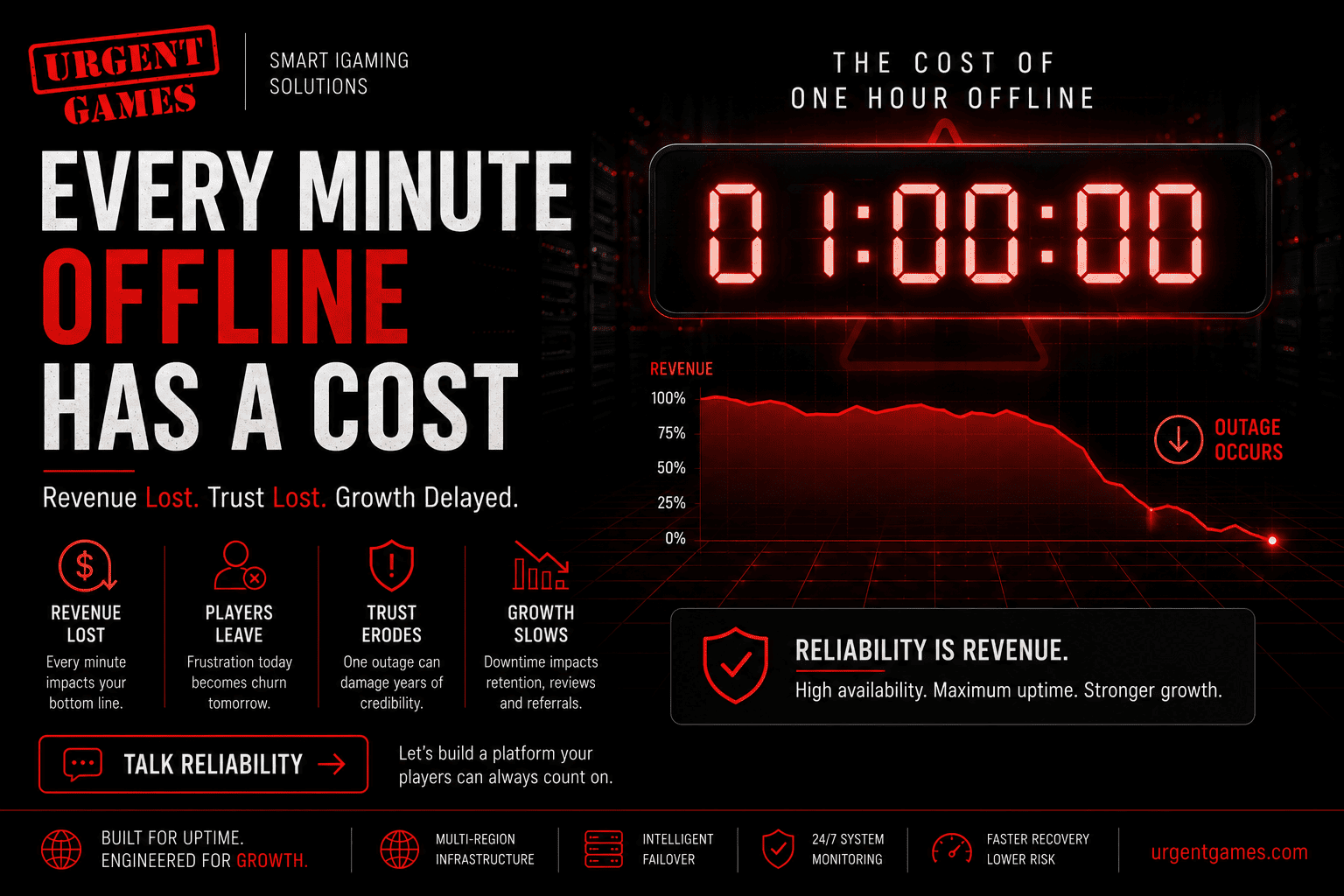
Casino downtime costs are far higher than most operators realize. In modern iGaming, even short outages can impact revenue, player trust, retention, and long-term growth. As competition increases, operators are discovering that platform reliability is no longer just a technical issue — it is a core business strategy.
Most operators understand downtime is bad.
However, very few fully calculate how expensive downtime actually becomes over time.
When a gaming platform goes offline, the immediate concern is usually:
- lost gameplay
- failed deposits
- interrupted sessions
Yet these are only the visible problems.
The real impact extends much further and affects:
- revenue
- player trust
- retention
- brand reputation
- future growth
Because in today’s competitive market, every minute offline creates consequences that continue long after systems recover.
Why Casino Downtime Costs Continue Rising
Years ago, outages were mostly viewed as IT problems.
Today, downtime is:
- a business problem
- a revenue problem
- a trust problem
Modern players expect:
- instant access
- fast gameplay
- real-time transactions
- uninterrupted sessions
The moment those expectations fail, confidence begins to decline.
As online gaming becomes increasingly mobile-first and real-time, reliability has become one of the most important competitive advantages for operators.
The Immediate Revenue Impact of Casino Downtime Costs
The most obvious impact is direct revenue loss.
When players cannot:
- log in
- launch games
- place bets
- make deposits
revenue generation stops immediately.
For example:
If an operator earns $10,000 per hour, a two-hour outage can instantly create $20,000 in direct losses.
However, direct losses are only the beginning.
Failed Deposits Create Long-Term Revenue Damage
Players who experience failed transactions often do not retry immediately.
Instead, they may:
- abandon the session
- delay spending
- move to competitors
As a result, operators rarely recover all lost revenue after a serious outage.
This is one reason casino downtime costs continue affecting profitability long after systems come back online.
Session Interruptions Hurt Player Retention
Gaming behavior is highly momentum-driven.
When players are actively engaged, they tend to:
- continue playing
- explore additional games
- deposit more frequently
Unfortunately, downtime breaks that momentum.
Once players leave during an interruption, many never return during the same session.
Over time, repeated interruptions increase player churn significantly.
Trust Loss Is One of the Biggest Casino Downtime Costs
Revenue loss is measurable.
Trust loss is harder to quantify, yet often far more damaging.
Players immediately begin asking:
“Can I trust this platform?”
This becomes especially serious when downtime affects:
- wallet balances
- withdrawals
- deposits
- live events
Financial uncertainty creates emotional reactions quickly.
Even when funds remain safe, perception matters enormously.
Financial Downtime Creates Panic Quickly
Nothing creates player anxiety faster than:
- delayed withdrawals
- failed transactions
- missing balances
Players remember these experiences.
Additionally, they frequently share them publicly through:
- Telegram
- Discord
- social media
- review platforms
As a result, reputation damage often outlasts the technical outage itself.
For additional reliability best practices, operators can review guidance from Cloudflare and AWS Architecture Center.
Customer Support Costs Increase Immediately
Outages trigger sudden spikes in support activity.
Teams often experience:
- higher live chat volume
- increased email tickets
- social media complaints
Consequently, operators face:
- slower response times
- higher staffing costs
- increased player frustration
Without proper incident management, support overload can worsen the overall experience.
Churn Is the Hidden Cost Most Operators Ignore
Many operators track outage duration.
Far fewer measure post-outage churn.
This is dangerous because some players never return after a poor experience.
Since competitors are only one click away, reliability directly affects retention and lifetime value.
Peak-Time Downtime Is Especially Expensive
Not all outages carry the same financial impact.
A short outage during low traffic periods is very different from downtime during:
- major sporting events
- tournaments
- large promotions
- new market launches
Revenue exposure rises dramatically during peak activity windows.
Therefore, operators increasingly invest in redundancy and failover systems before major events.
Third-Party Failures Still Increase Casino Downtime Costs
Many gaming platforms rely heavily on:
- aggregators
- payment providers
- game suppliers
- third-party APIs
However, players blame the operator — not the vendor.
This means external provider instability still damages operator trust and retention.
To reduce dependency risk, many businesses now implement multi-provider architectures and intelligent failover systems.
You can also read our internal guide on Multi-Provider Aggregation Strategies to learn how operators improve uptime resilience.
Modern Platforms Depend on Complex Infrastructure
Today’s gaming ecosystems rely on many connected services, including:
- authentication systems
- wallet infrastructure
- payment gateways
- fraud engines
- provider APIs
When one system fails, cascading failures often follow.
Because of this, modern observability and monitoring have become essential.
Observability Helps Reduce Casino Downtime Costs
Strong monitoring systems help teams detect:
- latency spikes
- API failures
- provider instability
- database bottlenecks
before players notice them.
Early detection allows operators to reduce:
- outage duration
- player frustration
- revenue disruption
Modern infrastructure teams increasingly use:
- predictive monitoring
- AI-assisted anomaly detection
- automated failover
- multi-region deployments
to improve resilience.
The Metrics Operators Should Monitor
To properly measure casino downtime costs, operators should track:
- uptime percentage
- mean time to recovery (MTTR)
- session interruption rate
- failed deposit rate
- churn after incidents
- revenue lost per outage
These metrics provide a more accurate picture of operational risk.
Common Mistakes Operators Make
Ignoring Long-Term Revenue Loss
Many teams only calculate revenue lost during the outage itself.
However, long-term churn and reputation damage are often much larger.
Weak Incident Communication
Poor communication increases player frustration quickly.
Transparent updates help reduce trust erosion.
No Redundancy Strategy
Single points of failure remain one of the largest operational risks in iGaming.
Failing to Monitor Player Impact
Technical recovery does not always mean player confidence has recovered.
Why Reliability Is Becoming a Competitive Advantage
Leading operators increasingly compete on:
- uptime
- speed
- transaction reliability
- operational resilience
Players naturally stay longer on platforms that feel:
- stable
- fast
- trustworthy
As expectations continue rising, reliability is becoming one of the strongest retention drivers in online gaming.
For more operational guidance, visit Google Cloud Reliability Best Practices.
Final Thoughts
Casino downtime costs extend far beyond temporary outages.
The strongest operators understand that downtime impacts:
- revenue
- player trust
- retention
- customer support
- reputation
- future growth
Because in modern iGaming, reliability is no longer just an engineering metric.
It is a business growth strategy.
Internal Link Suggestions
- Multi-Provider Aggregation Strategies
- Fraud Prevention Layers for iGaming Platforms
- Casino Localization Strategy Guide
- UX Strategies for Casino Player Retention
CTA: Talk Reliability
Explore scalable reliability solutions built for modern gaming platforms.