 English
  简体中文
简体中文  Español
  Русский
  Türkçe
  Tiếng Việt
  Українська
  Български
  Suomi
Suomi  Ελληνικά
  Čeština
  اردو
اردو  Svenska
  עִבְרִית
  हिन्दी
  Français
  Հայերեն
  Italiano
  日本語
日本語  Română
  Polski
  Српски језик
  Latviešu valoda
  Deutsch (Sie)
  Português do Brasil
  한국어
한국어 
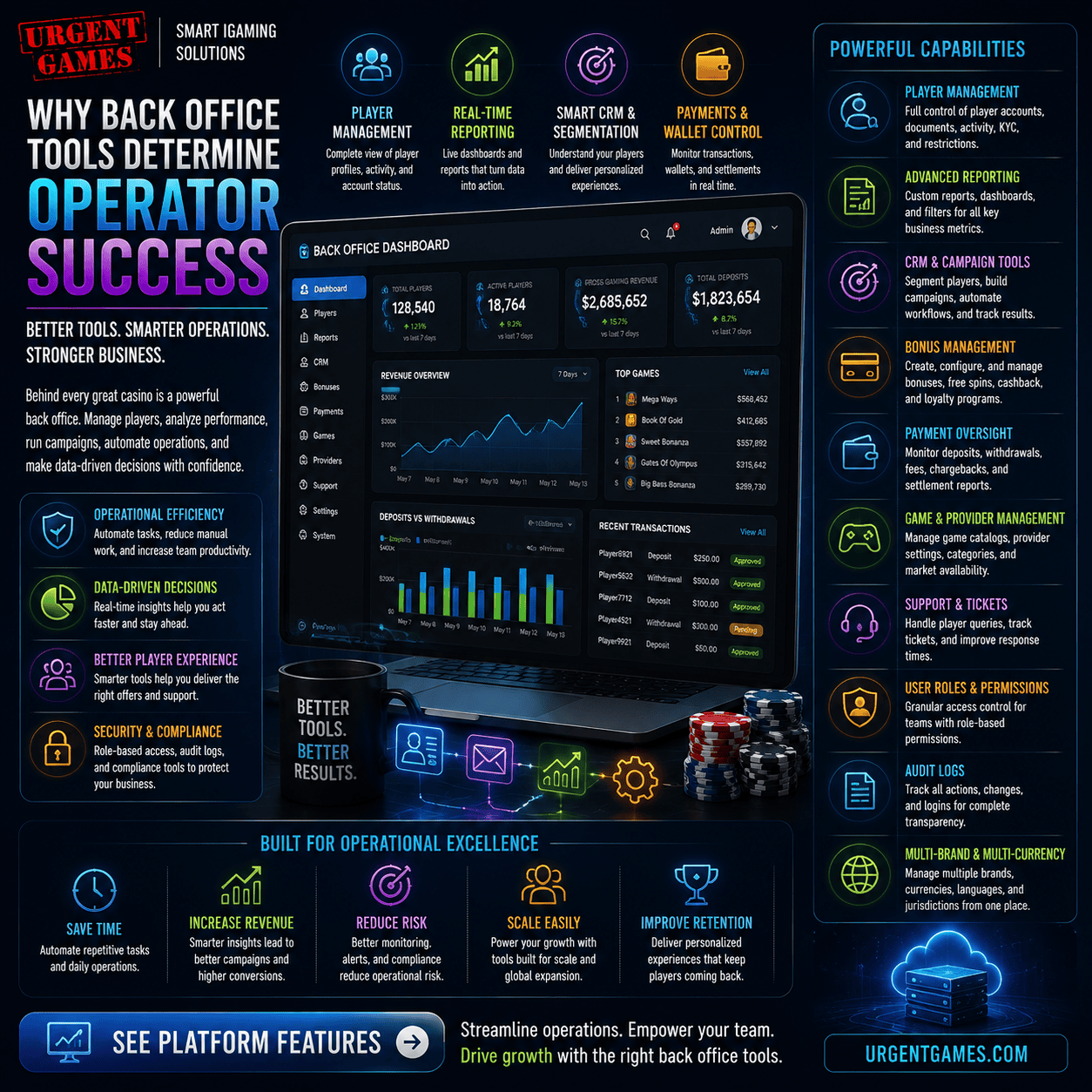
Why Back Office Tools Determine Operator Success
Players may never see an operator’s back office, but almost every successful player experience depends on it.
Behind the casino lobby, games, promotions, payments, and customer support sits an operational layer responsible for managing the entire business. From monitoring transactions and reviewing player accounts to analyzing performance and configuring campaigns, the quality of these tools directly affects how efficiently an operator can grow.
A modern casino back office is therefore much more than an administration panel.
It is the operational control center of an iGaming platform.
Operators with fragmented or outdated back-office systems often spend valuable time switching between applications, exporting spreadsheets, resolving manual errors, and waiting for technical teams to make routine changes.
Operators with unified, intelligent tools can move faster.
Here is why back-office capabilities increasingly determine operator success.
What Is a Casino Back Office?
A casino back office is the administrative environment used by operational teams to manage and monitor an online gaming platform.
Depending on the platform, it may include:
- Player management
- Financial reporting
- CRM capabilities
- Game and provider management
- Bonus configuration
- Payment monitoring
- User permissions
- Compliance tools
- Support workflows
- Real-time analytics
Instead of managing these functions through disconnected systems, a strong back office brings critical operational data and controls together.
Centralized Player Management
Operators need a complete understanding of every player account.
A well-designed player management system can provide authorized teams with visibility into:
- Account information
- Verification status
- Wallet activity
- Game history
- Bonuses
- Deposits and withdrawals
- Support activity
- Account restrictions
Centralizing this information makes it easier for support, compliance, and operations teams to work from a consistent source of truth.
It also reduces unnecessary switching between tools when resolving player issues.
Reporting Turns Activity Into Decisions
Gaming platforms generate enormous amounts of data.
Without effective reporting, much of that information provides little operational value.
A modern casino back office should help operators analyze areas such as:
- Gross gaming revenue
- Net gaming revenue
- Player activity
- Game performance
- Provider performance
- Deposits and withdrawals
- Bonus costs
- Market performance
Clear reporting allows teams to identify trends and make decisions faster.
Instead of asking what happened last month, operators can increasingly understand what is happening now.
CRM Helps Operators Understand Player Relationships
CRM functionality connects player information with engagement workflows.
Operators can use segmentation to organize audiences based on factors such as:
- Activity level
- Lifecycle stage
- Game preferences
- Geography
- Communication preferences
- Engagement history
This allows teams to create more relevant communication instead of relying on broad, repetitive messaging.
The objective should not be to send more promotions.
It should be to create better player experiences.
Operational Efficiency Becomes a Competitive Advantage
Many back-office tasks are repetitive.
Examples include:
- Reviewing transactions
- Updating configurations
- Exporting reports
- Checking provider status
- Managing player accounts
- Investigating support cases
Every unnecessary manual step consumes time.
Better back-office tools reduce friction through centralized workflows and automation, enabling employees to focus on decisions rather than administration.
At scale, those efficiency gains become significant.
Real-Time Dashboards Improve Visibility
Operators should not need to wait for end-of-day reports to understand platform health.
Real-time dashboards can provide immediate visibility into:
- Active players
- Transaction volume
- Payment success
- Revenue performance
- Provider availability
- Platform alerts
This helps teams identify unusual behavior or operational problems sooner.
Fast visibility enables faster action.
Better Payment and Wallet Oversight
Financial operations are particularly important in iGaming.
Back-office teams need tools for monitoring:
- Deposits
- Withdrawals
- Wallet adjustments
- Transaction failures
- Provider settlements
- Reconciliation exceptions
When financial information is fragmented across systems, investigating discrepancies becomes slow and difficult.
Centralized transaction visibility improves accuracy and accelerates issue resolution.
Game and Provider Management
Operators working with multiple providers may manage hundreds or thousands of games.
The back office should make it easy to:
- Enable or disable games
- Organize categories
- Configure markets
- Review provider status
- Manage availability
- Monitor performance
Without centralized controls, even simple catalog changes can become unnecessarily complicated.
Role-Based Access Protects Operations
Not every employee should have access to every capability.
A secure casino back office should support granular role-based access control.
For example:
Customer support may require player account information but not platform configuration.
Finance teams may require transaction reporting but not marketing controls.
Administrators may require broader permissions.
Combining permissions with strong authentication and audit trails reduces operational and security risk.
Audit Logs Create Accountability
Important administrative actions should be traceable.
Audit logs can record:
- Who performed an action
- What was changed
- When it happened
- Which account or system was affected
This information supports internal investigations, compliance processes, and operational accountability.
As organizations grow, auditability becomes increasingly important.
Automation Reduces Manual Work
Modern back-office platforms increasingly automate repetitive processes.
Examples can include:
- Scheduled reports
- Player segmentation
- Operational alerts
- Transaction monitoring
- Workflow routing
- Compliance checks
Automation does not remove the need for experienced teams.
It gives those teams better tools to operate efficiently.
Better Tools Improve Customer Support
Support quality depends heavily on access to accurate information.
When a player contacts support about a transaction, game session, or account issue, agents should be able to find relevant information quickly.
An integrated back office can reduce:
- Investigation time
- Internal escalation
- Duplicate work
- Resolution delays
Faster access to context produces better support experiences.
Multi-Brand Operations Need Centralized Control
Operators managing several casino brands face another layer of complexity.
A scalable back office can provide centralized oversight while maintaining separate configurations for:
- Brands
- Markets
- Currencies
- Providers
- Player segments
This allows operators to expand without creating an entirely separate operational environment for every new brand.
What Operators Should Look For
When evaluating casino back-office capabilities, operators should consider:
- Unified player management
- Real-time reporting
- Flexible CRM and segmentation
- Payment and wallet visibility
- Game/provider administration
- Granular user permissions
- Comprehensive audit logs
- Multi-brand capabilities
- Workflow automation
- API accessibility
Usability matters too.
A powerful system that employees struggle to operate can still create inefficiency.
Common Back Office Problems
❌ Fragmented operational data
Teams waste time moving between disconnected applications.
❌ Excessive manual reporting
Spreadsheet-heavy workflows slow decision-making and increase the chance of errors.
❌ Weak permission controls
Overly broad access creates unnecessary operational risk.
❌ Limited real-time visibility
Problems may remain unnoticed until they affect more players.
❌ Poor scalability
Tools designed for one brand or market can become bottlenecks during expansion.
The Future of Casino Back Office Technology
Back-office platforms are becoming increasingly intelligent.
The next generation will likely rely more heavily on:
- AI-assisted analytics
- Automated anomaly detection
- Predictive operational insights
- Intelligent support workflows
- Real-time reporting
- Unified multi-brand management
- Automated compliance processes
The goal is not simply more data.
It is faster access to the information and controls operators need to make better decisions.
Final Thoughts
The player-facing casino may receive most of the attention, but long-term operational performance is often determined behind the scenes.
A strong casino back office gives operators the visibility, control, and automation required to manage complex gaming businesses efficiently.
With better tools, operators can:
- Understand players more effectively
- Improve reporting
- Simplify daily operations
- Resolve issues faster
- Strengthen financial oversight
- Scale across brands and markets
A great gaming platform is not defined only by what players see.
It is also defined by how effectively the business behind it can operate.