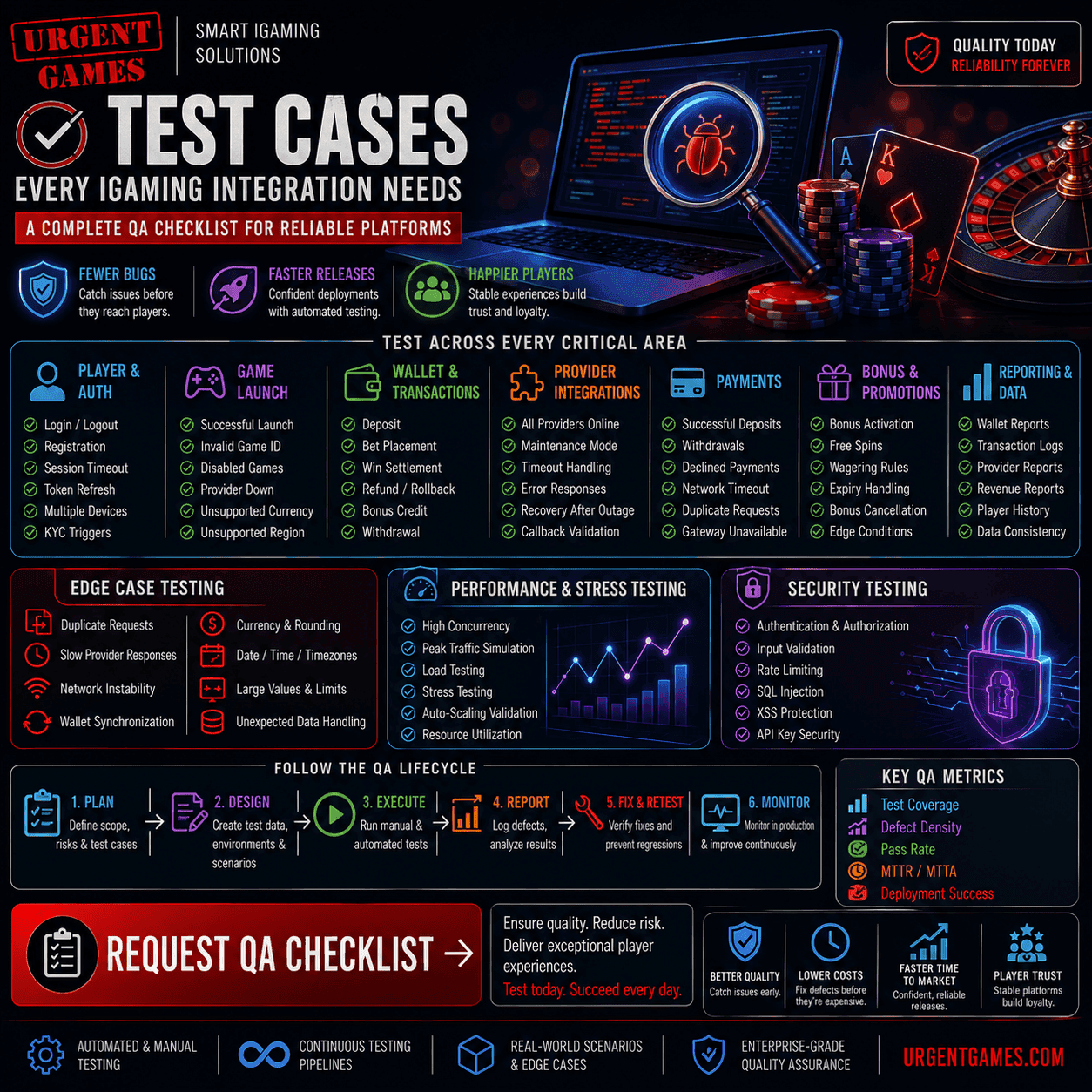
Introduction: Why Casino API Testing Is Critical
Casino API testing is one of the most important steps before launching or updating an iGaming platform. Connecting APIs and making games available is only part of the process. Every integration must perform reliably under real-world conditions, where thousands of players interact simultaneously with casino providers, payment gateways, wallet services, bonus engines, and reporting systems.
Many production issues are not caused by poor code—they result from insufficient testing. Missed edge cases, inconsistent provider behavior, race conditions, and unexpected failures can negatively affect player experience, compliance, and revenue.
A comprehensive casino API testing strategy ensures your platform remains stable, secure, and scalable under every realistic scenario.
Internal Link Suggestion: Link to your Casino API Integration page.
Why Casino API Testing Matters
Every integration supports business-critical functions, including:
- Player authentication
- Wallet transactions
- Game launches
- Session management
- Bonus systems
- Payment processing
- Reporting
A single failure may lead to:
- Lost revenue
- Player complaints
- Increased support tickets
- Compliance issues
- Brand reputation damage
Comprehensive testing protects both operators and players.
Build a Casino API Testing Strategy
Effective quality assurance should include multiple testing layers.
A complete strategy combines:
- Functional testing
- Integration testing
- Regression testing
- Performance testing
- Security testing
- Failover testing
- User Acceptance Testing (UAT)
No single testing method is sufficient for a modern gaming platform.
Functional Casino API Testing
Every release should verify core platform functionality.
Player Authentication Testing
Validate:
- Successful login
- Invalid credentials
- Expired sessions
- Token refresh
- Session timeout
- Multiple device logins
Expected Result: Authentication works consistently across every provider.
Player Registration Testing
Verify:
- New account creation
- Duplicate accounts
- Required fields
- Email validation
- Phone verification
- KYC triggers
Game Launch Testing
Test:
- Successful launches
- Invalid game IDs
- Disabled games
- Provider outages
- Unsupported currencies
- Restricted jurisdictions
Every error should return a meaningful response.
Wallet Transaction Testing
Validate:
- Deposits
- Bet placement
- Win settlement
- Refunds
- Rollbacks
- Bonus credits
- Withdrawals
Wallet balances should remain accurate throughout every transaction.
Session Management Testing
Verify:
- Session creation
- Session expiration
- Forced logout
- Multiple simultaneous sessions
- Reconnection handling
API Endpoint Testing
Each API endpoint should validate:
- Correct HTTP status codes
- Required parameters
- Optional parameters
- Invalid requests
- Authentication failures
- Timeout behavior
Consistency across all endpoints improves reliability.
Provider Integration Testing
Each provider should be tested independently.
Verify:
- Game launches
- Wallet requests
- Callback events
- Error handling
- Maintenance mode
- Recovery after outages
Every provider behaves differently, making independent validation essential.
Payment System Testing
Payment processing requires extensive validation.
Successful scenarios:
- Deposits
- Withdrawals
- Refunds
Failure scenarios:
- Declined payments
- Network timeouts
- Duplicate requests
- Partial failures
- Payment gateway outages
Reliable payment processing is critical for player trust.
Bonus and Promotion Testing
Confirm:
- Bonus activation
- Bonus expiration
- Free spins
- Wagering requirements
- Bonus cancellation
Financial incentives require precise validation.
Reporting and Data Validation
Reporting accuracy supports compliance and business intelligence.
Compare:
- Wallet balances
- Provider reports
- Transaction logs
- Revenue reports
- Player history
Every report should match transactional data.
Performance Testing for Casino API Testing
Platforms should perform under realistic load conditions.
Simulate:
- Thousands of concurrent players
- Peak sporting events
- Marketing campaigns
- High-frequency betting activity
Measure:
- API latency
- Database performance
- Infrastructure utilization
- Response consistency
Stress Testing
Push the platform beyond expected capacity.
Measure:
- System breaking point
- Recovery behavior
- Auto-scaling
- Queue management
Controlled stress testing exposes weaknesses before production.
Failover Testing
Validate platform resilience during outages.
Simulate:
- Provider failures
- Database outages
- Payment gateway failures
- Cache failures
- Network interruptions
The expected outcome is continued platform availability with minimal disruption.
Edge Case Testing
Edge cases frequently cause production incidents.
Duplicate Transactions
Submit identical requests repeatedly.
Expected Result:
Only one transaction should be processed.
Slow Provider Responses
Simulate delayed API responses.
Verify:
- Timeouts
- Automatic retries
- User messaging
Wallet Synchronization
Test:
- Interrupted settlements
- Delayed callbacks
- Duplicate settlements
Balances should remain accurate.
Network Stability
Simulate:
- Packet loss
- Connection interruptions
- Intermittent failures
Applications should recover gracefully.
Currency Handling
Validate:
- Exchange rates
- Decimal precision
- Unsupported currencies
- Large transaction values
Financial calculations must remain accurate.
Date and Time Validation
Test:
- Time zones
- Daylight Saving Time
- Midnight processing
- Leap years
Incorrect timestamps often create reporting inconsistencies.
Security Testing
Every deployment should include security validation.
Test:
- Authentication
- Authorization
- SQL Injection
- Cross-Site Scripting (XSS)
- Rate limiting
- API key validation
- Input validation
Strong security protects platform integrity.
Regression Testing
Every new feature introduces risk.
Regression testing should cover:
- Wallet functionality
- Authentication
- Reporting
- Payments
- Providers
- Bonus systems
Automated regression suites improve release confidence.
Automation Strengthens Casino API Testing
Modern QA pipelines increasingly automate:
- API testing
- UI testing
- Regression suites
- Performance benchmarks
- Smoke testing
Automation enables faster releases while reducing human error.
Monitor Performance After Deployment
Testing should continue after release.
Monitor:
- Error rates
- API latency
- Failed transactions
- Wallet discrepancies
- Provider performance
Production monitoring validates real-world behavior.
Internal Link Suggestion: Link to your Monitoring & Analytics page.
Key Casino API Testing Metrics
Quality Metrics
- Test coverage
- Pass rate
- Defect density
- Regression failures
Performance Metrics
- API response time
- Concurrent users
- Throughput
- Database latency
Operational Metrics
- Deployment success
- Incident frequency
- Mean Time to Resolve (MTTR)
- Failed releases
Common Casino API Testing Mistakes
❌ Testing Only Happy Paths
Unexpected user behavior often exposes hidden issues.
❌ Ignoring Provider Differences
Each provider has unique behaviors.
❌ Limited Performance Testing
Production traffic regularly exceeds expectations.
❌ Weak Regression Coverage
Previously fixed bugs often reappear.
❌ Skipping Failover Validation
Recovery capabilities are as important as functionality.
The Future of Casino API Testing
Modern QA environments increasingly use:
- AI-generated test cases
- Intelligent regression analysis
- Automated API validation
- Synthetic monitoring
- Chaos engineering
- Continuous testing pipelines
As release cycles become shorter, automated testing becomes increasingly important.
Final Thoughts
Reliable gaming platforms are built through disciplined testing.
Comprehensive casino API testing enables operators to:
- Reduce production defects
- Improve player experience
- Protect financial accuracy
- Accelerate deployments
- Increase platform stability
The best platforms are not simply feature-rich.
They are dependable, resilient, and trusted by players.
Because in modern iGaming:
Great engineering builds products.
Great testing builds trust.
✅ Request the QA Checklist
Planning a new integration or preparing for your next platform release?