
 English
  简体中文
简体中文  Español
  Русский
  Türkçe
  Tiếng Việt
  Українська
  Български
  Suomi
Suomi  Ελληνικά
  Čeština
  اردو
اردو  Svenska
  עִבְרִית
  हिन्दी
  Français
  Հայերեն
  Italiano
  日本語
日本語  Română
  Polski
  Српски језик
  Latviešu valoda
  Deutsch (Sie)
  Português do Brasil
  한국어
한국어 
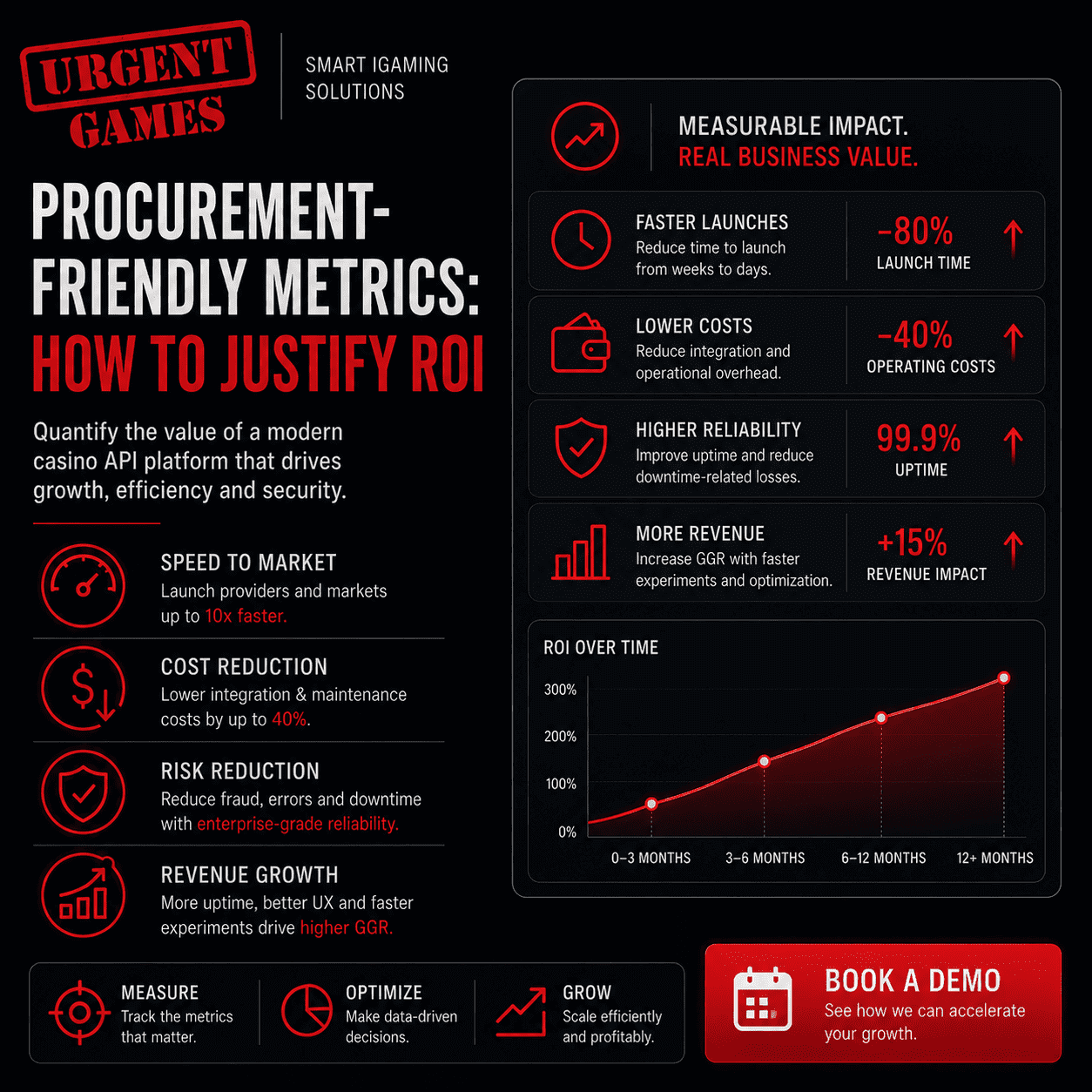
Modern iGaming infrastructure decisions are no longer based only on technical capability. Today, procurement teams evaluate platforms through measurable business outcomes like speed, operational efficiency, scalability, and risk reduction.
That’s why understanding casino API ROI has become critical for operators evaluating new aggregation platforms, wallet infrastructure, or unified API systems.
Technical features may attract attention—but procurement approvals depend on quantifiable impact.
Why Procurement Teams Evaluate Infrastructure Differently
Engineering teams often focus on:
- Scalability
- Flexibility
- System architecture
- API performance
Procurement teams focus on different priorities:
- Cost predictability
- Operational efficiency
- Vendor reliability
- Financial return
- Long-term maintainability
To secure buy-in, technical benefits must be translated into measurable business outcomes.
The Four ROI Categories That Matter Most
Most successful infrastructure proposals map directly into four measurable categories:
- Speed
- Cost reduction
- Revenue protection
- Risk reduction
These are the metrics procurement teams can justify internally.
Faster Launches Create Faster Revenue
In iGaming, speed-to-market directly affects monetization.
Faster provider integrations enable:
- Faster market entry
- Faster deployment cycles
- Faster experimentation
- Faster regional expansion
Procurement-Friendly Metric Example
“Reduced provider launch timelines from 8 weeks to 5 days.”
This type of measurable operational improvement clearly supports casino API ROI discussions.
Operational Efficiency Reduces Long-Term Costs
Fragmented infrastructure increases:
- Engineering workload
- Manual reconciliation
- Support overhead
- Integration maintenance
Modern unified systems reduce duplication and simplify operations.
Example ROI Framing
“Reduced integration maintenance costs by 40%.”
Operational simplicity is one of the most valuable long-term infrastructure advantages.
For background on modern infrastructure efficiency models:
https://aws.amazon.com/microservices/
https://martinfowler.com/articles/microservices.html
Reliability Protects Revenue
Downtime creates direct financial loss.
Operators can quantify infrastructure impact using:
- Revenue per hour
- Average session volume
- Incident frequency
- Recovery timelines
Example
If platform downtime costs:
- $15,000 per hour
And improved infrastructure reduces outages by:
- 80%
The financial justification becomes clear.
Risk Reduction Is Often the Hidden ROI Driver
One of the most underestimated categories in infrastructure evaluation is operational risk reduction.
Modern API systems help reduce:
- Fraud exposure
- Chargebacks
- Reconciliation inconsistencies
- Compliance blind spots
This creates measurable financial stability.
Procurement-Friendly Positioning
“Reduced operational risk exposure and improved transaction consistency.”
For broader industry compliance standards:
https://www.gamblingcommission.gov.uk/
https://www.gamcare.org.uk/
Infrastructure Metrics Procurement Teams Actually Care About
Time-to-Market Metrics
Track:
- Provider launch timelines
- Brand deployment speed
- Regional rollout efficiency
Why it matters:
Speed directly impacts revenue generation.
Operational Efficiency Metrics
Track:
- Engineering hours saved
- Support ticket reduction
- Integration maintenance costs
Operational efficiency compounds over time.
Stability & Reliability Metrics
Track:
- Uptime percentage
- Mean Time to Recovery (MTTR)
- Incident frequency reduction
Reliable systems improve both retention and revenue consistency.
Wallet & Transaction Metrics
Track:
- Payment success rates
- Duplicate transaction reduction
- Reconciliation accuracy
Financial consistency improves operational trust.
Predictability Is a Major Procurement Advantage
One of the strongest advantages of modern infrastructure is predictable operational performance.
Fragmented systems create:
- Variable maintenance costs
- Unplanned outages
- Escalating support requirements
Unified infrastructure creates:
- Stable forecasting
- Predictable scaling costs
- Cleaner operational planning
This matters significantly during procurement evaluation.
Quantifying Developer Efficiency
Developer productivity is often overlooked in ROI calculations.
Better APIs reduce:
- Integration complexity
- Debugging time
- Custom workaround development
Example Metric
“Engineering onboarding time reduced by 60%.”
This directly impacts staffing pressure and delivery speed.
Multi-Tenant Systems Increase Scalability Efficiency
Multi-tenant infrastructure amplifies ROI because operators can:
- Launch more brands
- Expand into more regions
- Reuse shared infrastructure
Without proportional operational cost increases.
This improves scalability efficiency per dollar spent.
Why Total Cost of Ownership Matters
Procurement teams evaluate more than upfront integration cost.
They also assess:
- Long-term maintenance
- Upgrade complexity
- Support overhead
- Infrastructure scalability
Cheap systems often become expensive over time due to operational drag.
Better ROI Communication for Procurement Teams
Technical jargon rarely helps procurement discussions.
Avoid phrases like:
- “Distributed infrastructure layers”
- “Scalable microservice orchestration”
Instead communicate outcomes like:
- Faster launches
- Reduced downtime
- Lower operational overhead
- Faster experimentation
- Revenue protection
Example: Weak vs Strong ROI Messaging
Weak Positioning
“We provide scalable APIs with distributed infrastructure.”
Strong Positioning
“Our platform reduces provider launch timelines by 80% while lowering operational support costs.”
Procurement teams respond better to measurable outcomes than technical terminology.
Common Vendor Mistakes
Selling Features Instead of Outcomes
Features alone do not justify budget allocation.
Ignoring Operational Costs
Long-term operational simplicity matters more than initial setup.
Failing to Quantify Business Impact
Claims require measurable benchmarks.
Overcomplicating Technical Explanations
Procurement teams prioritize clarity and predictability.
Internal Linking Opportunities
Add internal links to strengthen topic authority:
- /unified-casino-platform-guide
- /igaming-api-integration
- /multi-tenant-casino-infrastructure
- /wallet-infrastructure-optimization
Visual Infrastructure & ROI Overview
Suggested Image Alt Text
- Casino API ROI dashboard showing operational efficiency metrics
- Unified iGaming infrastructure reducing operational costs and downtime
- Procurement-friendly metrics for modern casino platform architecture
The Future of Infrastructure Procurement in iGaming
As the industry becomes more competitive, operators increasingly evaluate vendors based on:
- Operational efficiency
- Reliability economics
- Speed-to-market
- Scalability efficiency
Infrastructure decisions are no longer purely technical.
They are strategic financial decisions.
Final Thoughts
The strongest infrastructure investments do more than support growth.
They also reduce:
- Complexity
- Downtime
- Operational risk
- Maintenance overhead
That is the real value behind modern casino API ROI.
The best platforms help operators:
- Accelerate growth
- Protect revenue
- Simplify operations
- Scale efficiently
And procurement teams understand that better than anyone.
CTA: Book a Demo
👉 Book a demo to explore a unified iGaming platform designed for scalable growth.