
 English
  简体中文
简体中文  Español
  Русский
  Türkçe
  Tiếng Việt
  Українська
  Български
  Suomi
Suomi  Ελληνικά
  Čeština
  اردو
اردو  Svenska
  עִבְרִית
  हिन्दी
  Français
  Հայերեն
  Italiano
  日本語
日本語  Română
  Polski
  Српски језик
  Latviešu valoda
  Deutsch (Sie)
  Português do Brasil
  한국어
한국어 
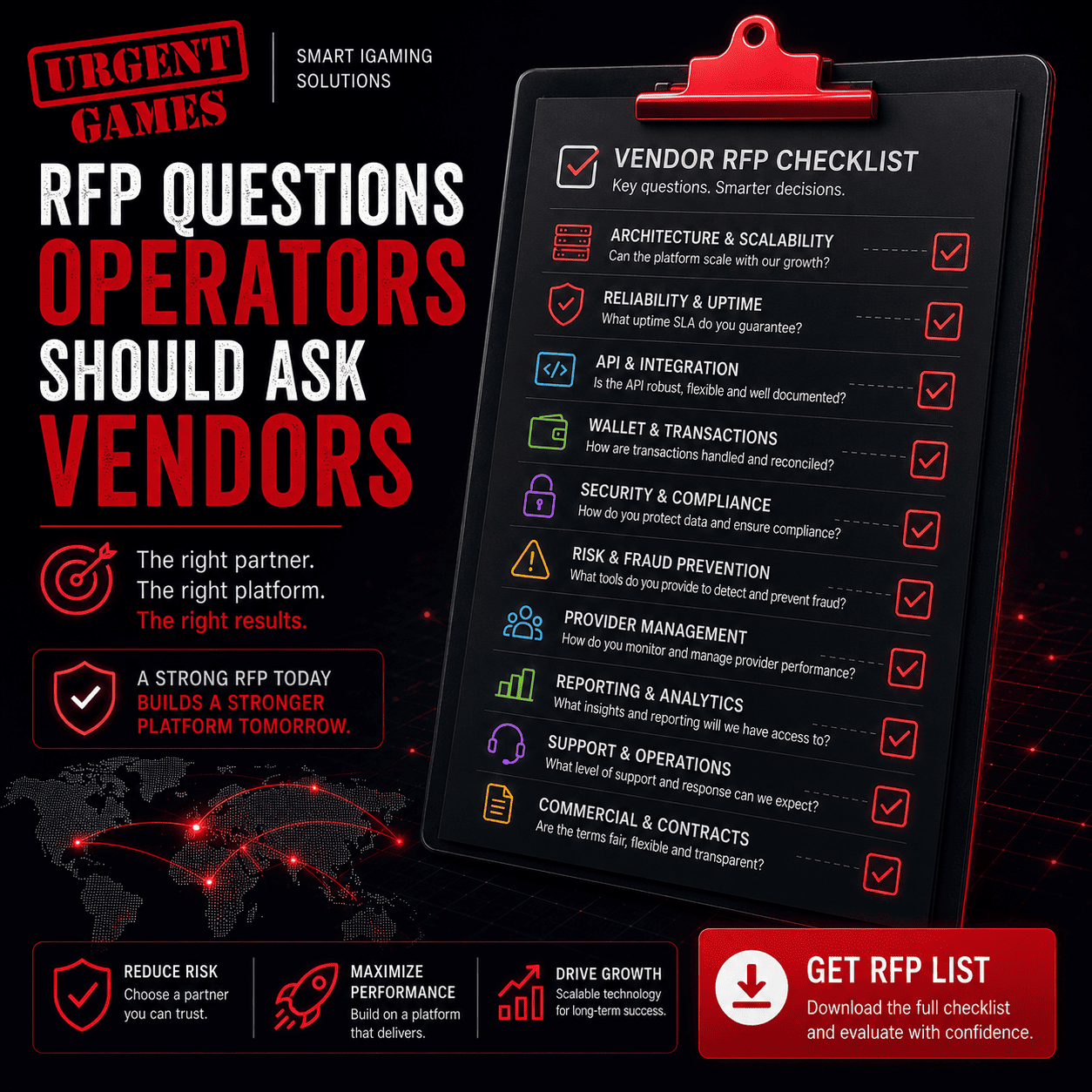
Choosing the right vendor in iGaming is a critical decision. A well-structured casino API RFP helps operators avoid costly mistakes and select reliable technology partners.
However, many teams still rely on demos and feature lists. Because of this, they often miss deeper technical risks that only appear later in production.
Therefore, a strong evaluation process should focus on real system behavior, not just marketing claims.
👉 Related guide: /vendor-selection-best-practices
Why Vendor Evaluations Often Fail
Many RFP processes fail because they rely on surface-level questions.
For example, operators often ask:
- Is your platform scalable?
- Do you support integrations?
- Do you offer reporting tools?
Although these seem useful, they rarely reveal real system limitations.
Instead, most vendors can answer “yes” without proving performance under stress.
So, a better approach is to test real-world reliability and operational depth.
Architecture and Scaling Considerations
Before choosing a vendor, operators should understand system design.
Key questions include:
- Is the system multi-tenant or isolated per operator?
- How does it handle traffic spikes?
- What is the maximum concurrent load supported?
- Is horizontal scaling available?
In many cases, platforms perform well at small scale but struggle when growth increases.
For cloud scaling principles, see AWS Architecture Center.
Reliability and Uptime Expectations
System uptime directly impacts revenue.
Therefore, operators should evaluate:
- SLA guarantees
- Failover mechanisms
- Active-active vs active-passive setups
- Behavior during outages
In addition, requesting real incident reports helps validate vendor claims.
👉 Related: /platform-reliability-guide
API and Integration Capabilities
API design defines operational flexibility.
A strong evaluation should include:
- API type (REST, GraphQL, hybrid)
- Webhook support availability
- Version control strategy
- Average integration timeline
Moreover, operators should always request full API documentation early in the process.
For API standards, visit Postman Learning Center.
Wallet and Transaction Design
Wallet systems affect long-term stability.
Important questions include:
- Is the wallet shared or isolated?
- How are duplicate transactions prevented?
- Are transactions idempotent?
- How is reconciliation handled?
If wallet design is weak, operational issues will grow over time.
Security and Compliance Standards
Security must be verified, not assumed.
Operators should check:
- Authentication methods for APIs
- Role-based access controls
- Audit log immutability
- Compliance certifications
For security best practices, see OWASP.
Monitoring and System Visibility
Without monitoring, systems become difficult to manage.
Operators should ask:
- What dashboards are included?
- Can latency be tracked in real time?
- Are alerts configurable?
- What metrics are exposed via API?
As a result, better visibility improves operational response time.
Fraud Prevention and Risk Controls
Fraud tools should be part of the core platform.
Key areas to evaluate:
- Geo and device risk scoring
- Custom rule configuration
- Suspicious activity detection
- Transaction monitoring tools
👉 Related: /fraud-prevention-strategies
Provider Management and Routing
Provider quality affects performance more than quantity.
Operators should evaluate:
- Provider monitoring systems
- Failure handling methods
- Smart routing capabilities
- Onboarding speed for new providers
Because of this, operational flexibility becomes critical.
User Experience and Product Flexibility
User experience directly impacts retention.
Important questions include:
- Can the lobby be customized?
- Is the platform mobile-first?
- Can UX differ by region?
- How are session interruptions handled?
Reporting and Data Access
Data access improves decision-making.
Operators should check:
- Available standard reports
- Custom report creation options
- Export capabilities
- BI tool integrations
👉 Internal link: /igaming-analytics-reporting
Support and Operational Readiness
Support quality becomes crucial during incidents.
Operators should ask:
- Is support available 24/7?
- What are response time SLAs?
- Is there a dedicated account manager?
- How are escalations handled?
Strong support often outweighs feature differences.
Commercial and Contract Terms
Contracts can create long-term limitations.
Operators should evaluate:
- Minimum commitments
- Data ownership rights
- Exit conditions
- Vendor lock-in risks
Therefore, commercial flexibility is just as important as technical strength.
Final Thoughts
A strong casino API RFP process focuses on real system behavior, not marketing claims.
Instead of comparing feature lists, operators should evaluate:
- Reliability
- Scalability
- Security
- Support quality
- Architectural maturity
As a result, they reduce risk and avoid costly migrations later.
Ultimately, vendor selection is not just a procurement task. It is a long-term infrastructure decision.
Get the Vendor Evaluation Checklist
Want a structured way to evaluate iGaming vendors?
Download the full checklist to improve your casino API RFP process.