
 English
  简体中文
简体中文  Español
  Русский
  Türkçe
  Tiếng Việt
  Українська
  Български
  Suomi
Suomi  Ελληνικά
  Čeština
  اردو
اردو  Svenska
  עִבְרִית
  हिन्दी
  Français
  Հայերեն
  Italiano
  日本語
日本語  Română
  Polski
  Српски језик
  Latviešu valoda
  Deutsch (Sie)
  Português do Brasil
  한국어
한국어 
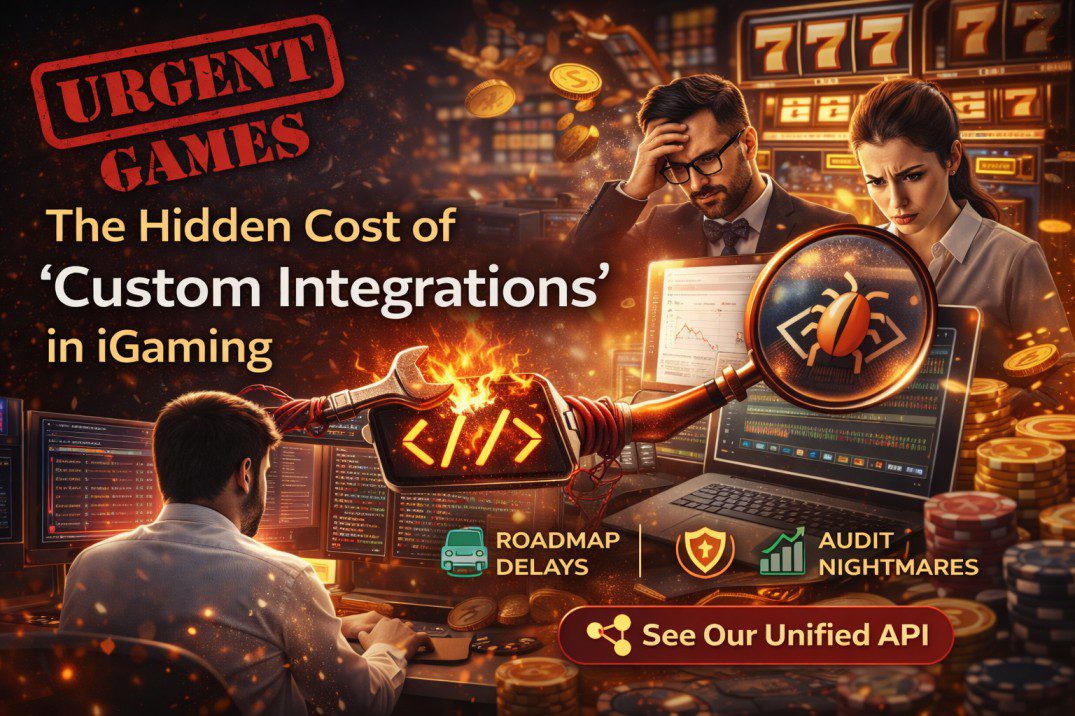
Introduction: When “Custom” Sounds Better Than It Is
Casino API integration is often treated as a technical detail, but it has a direct impact on speed to market, compliance risk, and long-term scalability.
Custom integrations promise flexibility, control, and differentiation. On paper, they sound like the fastest way to build a unique platform tailored exactly to your needs.
In reality, many operators discover too late that custom integrations quietly drain time, money, and momentum—long after the initial launch excitement fades.
This article breaks down the real, often hidden costs of bespoke integrations in iGaming, and explains why modern operators are shifting toward unified API platforms instead.
What Operators Mean by “Custom Integration”
A custom integration typically means:
- Bespoke wallet logic per provider
- Provider-specific APIs with unique edge cases
- One-off settlement, rollback, and reporting flows
- Custom error handling and reconciliation logic
At launch, this can feel manageable—especially with one or two providers.
The problems begin when you try to scale.
Hidden Cost #1: Slower Roadmaps Over Time
Custom integrations don’t just take longer to build—they slow everything that comes after.
Every new feature must account for:
- Different provider behaviors
- Inconsistent transaction flows
- Edge cases unique to each integration
Instead of building once, your team is constantly adapting.
What starts as a sprint turns into a permanent tax on your roadmap.
Hidden Cost #2: Maintenance Grows Exponentially
One custom integration is manageable.
Five custom integrations are not five times the work—they’re closer to twenty times.
Why?
- Providers update APIs on different schedules
- Bug fixes must be replicated across integrations
- Regression testing multiplies with every change
Engineering teams end up maintaining old code instead of shipping new value.
Hidden Cost #3: Fragile Compliance & Audits
Regulators don’t care how “custom” your platform is.
They care about:
- Consistent transaction records
- Clear balance ownership
- Deterministic rule enforcement
Custom integrations often produce:
- Inconsistent logs
- Provider-dependent interpretations of rules
- Manual reconciliation during audits
This increases regulatory risk—and audit stress—significantly.
Hidden Cost #4: Provider Lock-In
Bespoke integrations create invisible handcuffs.
Once deeply integrated:
- Removing a provider becomes expensive
- Negotiating leverage decreases
- Poor-performing content stays longer than it should
Operators lose agility—not because of contracts, but because of code.
Hidden Cost #5: Onboarding New Providers Takes Longer
Ironically, custom builds often slow new integrations.
Each new provider requires:
- Fresh API mapping
- New edge-case handling
- Separate testing pipelines
What should take weeks turns into months—directly impacting revenue.
The Opportunity Cost No One Budgets For
The biggest cost of custom integrations isn’t technical—it’s strategic.
While teams are:
- Debugging provider-specific issues
- Rewriting settlement logic
- Reconciling inconsistent reports
Competitors are:
- Launching new markets
- Adding content faster
- Improving player experience
Speed compounds. So does technical debt.
Why Unified APIs Change the Equation
A unified casino API abstracts provider complexity behind a single, consistent interface.
This means:
- One wallet logic
- One transaction model
- One reporting structure
Providers change. Your core systems don’t.
Faster Development, Cleaner Compliance
With a unified API:
- Features are built once and reused everywhere
- Compliance rules apply consistently
- Audits rely on a single source of truth
Instead of managing integrations, teams focus on growth.
Cost Comparison: Custom vs Unified
| Area | Custom Integrations | Unified API |
|---|---|---|
| Initial Build | Medium | Medium |
| Long-Term Maintenance | High | Low |
| Provider Onboarding | Slow | Fast |
| Audit Readiness | Fragmented | Centralized |
| Scalability | Painful | Predictable |
The difference becomes clear within the first year.
Why Leading Operators Are Moving Away from Bespoke Builds
In 2026, successful operators optimize for:
- Speed to market
- Predictable costs
- Regulatory confidence
Custom integrations fight all three.
That’s why many operators now choose platforms like Urgent Games, which offer a unified API supporting multiple providers, wallets, and integration models—without sacrificing flexibility.
When Custom Still Makes Sense (Rarely)
Custom integrations can work if:
- You operate with one provider only
- You have a large, long-term internal engineering team
- Regulatory requirements are minimal
For most growing operators, these conditions don’t last.
Conclusion: Custom Is Expensive—Unified Is Strategic
Custom integrations don’t fail immediately.
They fail slowly—through missed deadlines, rising costs, and lost agility.
Unified APIs don’t just reduce complexity—they protect your roadmap.
In modern iGaming, the smartest operators don’t build everything themselves. They build on platforms designed to scale.
See Our Unified API
Urgent Games provides a unified casino API that eliminates bespoke integration complexity while supporting seamless, wallet, and reverse models.
See Our Unified API and discover how to move faster without accumulating technical debt.