
 English
  简体中文
简体中文  Español
  Русский
  Türkçe
  Tiếng Việt
  Українська
  Български
  Suomi
Suomi  Ελληνικά
  Čeština
  اردو
اردو  Svenska
  עִבְרִית
  हिन्दी
  Français
  Հայերեն
  Italiano
  日本語
日本語  Română
  Polski
  Српски језик
  Latviešu valoda
  Deutsch (Sie)
  Português do Brasil
  한국어
한국어 
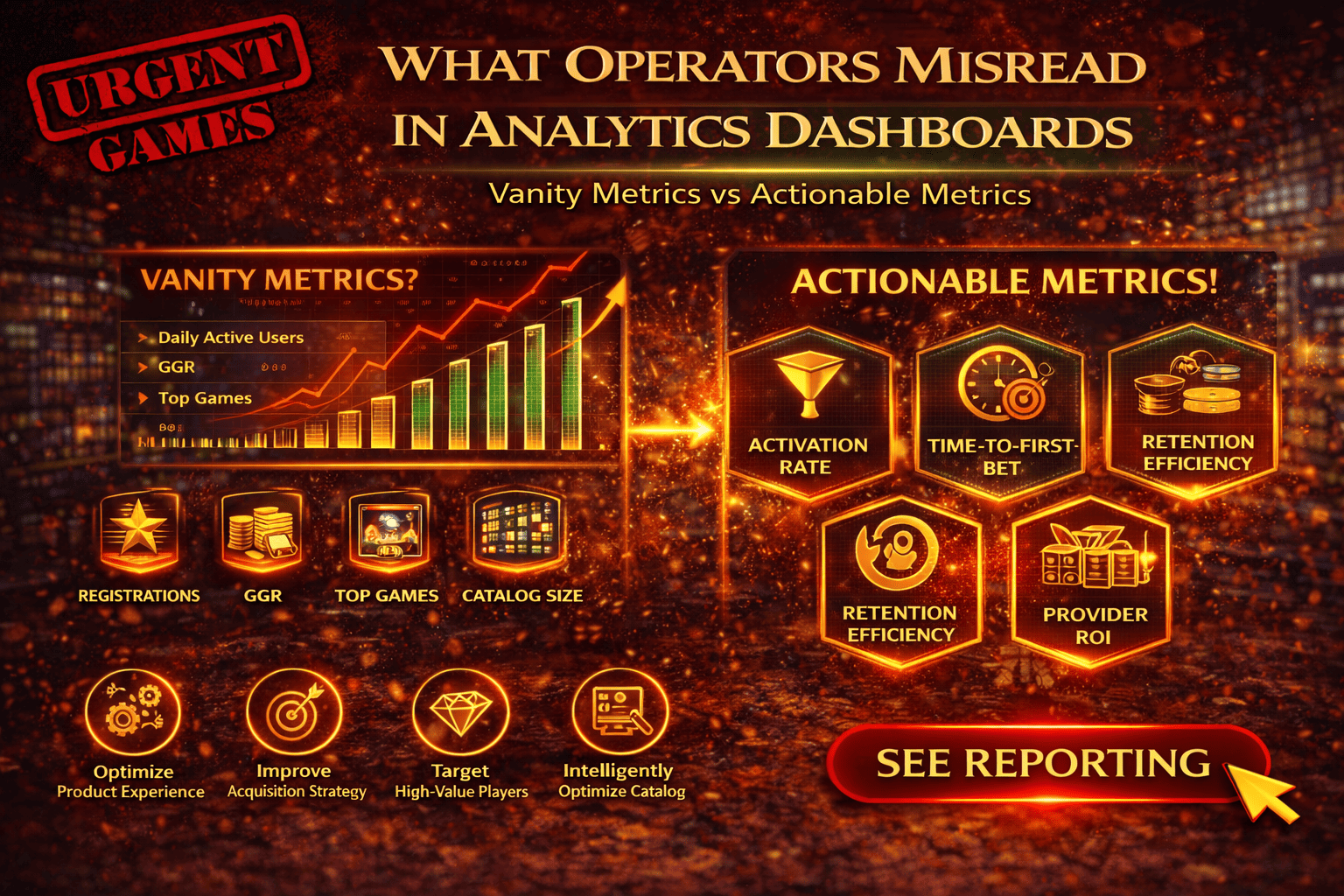
The Illusion of Data Clarity
Modern casino platforms generate enormous amounts of data.
Operators track:
Daily active users
GGR
Session counts
Game popularity
Conversion rates
Most dashboards are full of impressive charts and real-time graphs.
But here’s the uncomfortable truth:
Many operators are looking at the wrong numbers.
Or worse — interpreting the right numbers incorrectly.
The difference between vanity metrics and actionable metrics is where real competitive advantage lies in casino analytics.
Let’s explore the most common misinterpretations and how smarter operators read their dashboards differently.
Vanity Metrics vs Actionable Metrics
Vanity metrics look impressive but rarely influence decisions.
Examples include:
Total registrations
Total games in catalog
Total sessions
Raw GGR numbers
These metrics show activity, but they don’t explain why performance happens.
Actionable metrics reveal leverage points.
They answer questions like:
Where users drop off
What drives retention
Which games increase LTV
Which providers deliver ROI
Strong casino analytics focuses on decision-making signals, not just activity levels.
Misread #1: Total Registrations
Many dashboards celebrate growing registration numbers.
But registration alone does not equal growth.
The real question is:
How many registrants actually activate?
The more useful metric is:
Registration → Deposit Conversion Rate
Even more insightful:
Registration → First Game Conversion
If thousands of users register but never play, acquisition spend is leaking value.
Smart operators prioritize activation rate, not just sign-ups.
Misread #2: GGR Without Context
GGR is one of the most common metrics in casino analytics dashboards.
But raw GGR hides important context.
Consider two providers:
Provider A
High GGR
High bonus spending
Short session depth
Provider B
Moderate GGR
Low promotional reliance
High repeat engagement
Which one performs better?
Without examining:
Bonus-to-GGR ratio
Retention contribution
Player lifetime value
GGR alone can mislead decision-making.
Profitability matters more than raw revenue.
Misread #3: “Top Games” Lists
Most dashboards show:
Top 10 Games by GGR.
While useful, this metric can be deceptive.
Why?
Because high exposure often drives high revenue.
Games featured on the homepage naturally receive more traffic.
The better question is:
Which games outperform their exposure?
A strong casino analytics model compares:
Game Revenue ÷ Game Visibility
This reveals hidden performers that deserve better placement.
Misread #4: Daily Active Users
DAU is frequently treated as a health indicator.
But DAU alone doesn’t show engagement quality.
A user who logs in for 10 seconds counts the same as one who plays for 30 minutes.
More meaningful metrics include:
Average session duration
Bets per session
Time-to-first-bet
Session frequency per player
These metrics reflect real engagement, not just login behavior.
Misread #5: Game Catalog Size
Operators often believe:
“More games means better performance.”
Dashboards may show:
Total game count
Number of providers
But catalog expansion does not automatically improve engagement.
In fact, too many options can cause decision fatigue.
Better metrics include:
Games played per user
Discovery efficiency
Catalog utilization rate
If only 5% of games generate most activity, the rest may be clutter.
Effective casino analytics highlights content performance, not just catalog size.
Misread #6: Deposit Volume
Deposit volume can appear as a strong growth signal.
But deposit size alone doesn’t guarantee long-term value.
Key questions include:
How quickly does the deposit convert into gameplay?
Does the player return after the first session?
What is the deposit-to-bet ratio?
Some users deposit once and disappear.
Others deposit smaller amounts but play consistently.
Long-term retention often matters more than initial deposit size.
Misread #7: Session Counts
Session counts are another metric that can mislead.
A platform may report:
“Sessions increased by 20%.”
But what caused the increase?
Possibilities include:
Shorter sessions
More fragmented gameplay
UX friction causing restarts
Instead of session count alone, operators should monitor:
Average session depth
Bets per session
Session duration distribution
Understanding session quality is more valuable than session volume.
What Smart Operators Actually Measure
The most mature casino analytics strategies focus on behavioral metrics.
Key examples include:
Activation Metrics
Registration → Deposit rate
Deposit → First Game rate
Time-to-first-bet
These reveal onboarding efficiency.
Engagement Metrics
Average bets per session
Session depth
Category engagement mix
These show product experience quality.
Retention Metrics
D1 retention
D7 retention
D30 retention
These metrics determine long-term revenue potential.
Content Performance Metrics
Revenue per game exposure
Provider ROI score
Volatility engagement patterns
These guide catalog optimization.
The Dashboard Design Problem
Sometimes the issue isn’t interpretation — it’s the dashboard itself.
Many reporting tools emphasize:
High-level KPIs
Aggregate numbers
Simplified visuals
But operational decisions require segmentation.
Strong casino analytics dashboards allow slicing by:
Player cohort
Geography
device type
acquisition source
game category
Without segmentation, patterns remain hidden.
The Shift from Reporting to Intelligence
In the past, dashboards were used primarily for reporting.
Today, they must drive decision-making.
Modern analytics systems focus on:
Behavioral insights
Predictive signals
real-time alerts
automated optimization
This shift transforms dashboards from information displays into growth tools.
The Strategic Advantage
Operators who interpret casino analytics correctly gain powerful advantages:
Faster product optimization
Smarter provider selection
Better player segmentation
Higher retention efficiency
Improved marketing ROI
Those who rely on vanity metrics often make reactive decisions.
Those who focus on actionable metrics make strategic ones.
Final Thought
Data is not the advantage.
Understanding the right data is.
Dashboards filled with impressive numbers can still hide weak insights.
The best operators don’t just track activity.
They track the signals that drive growth.
📊 See Reporting
If you’re ready to move beyond vanity metrics and unlock actionable casino analytics, it’s time to build reporting systems that highlight what truly drives performance.
Turn data into strategic insight.