
 English
  简体中文
简体中文  Español
  Русский
  Türkçe
  Tiếng Việt
  Українська
  Български
  Suomi
Suomi  Ελληνικά
  Čeština
  اردو
اردو  Svenska
  עִבְרִית
  हिन्दी
  Français
  Հայերեն
  Italiano
  日本語
日本語  Română
  Polski
  Српски језик
  Latviešu valoda
  Deutsch (Sie)
  Português do Brasil
  한국어
한국어 
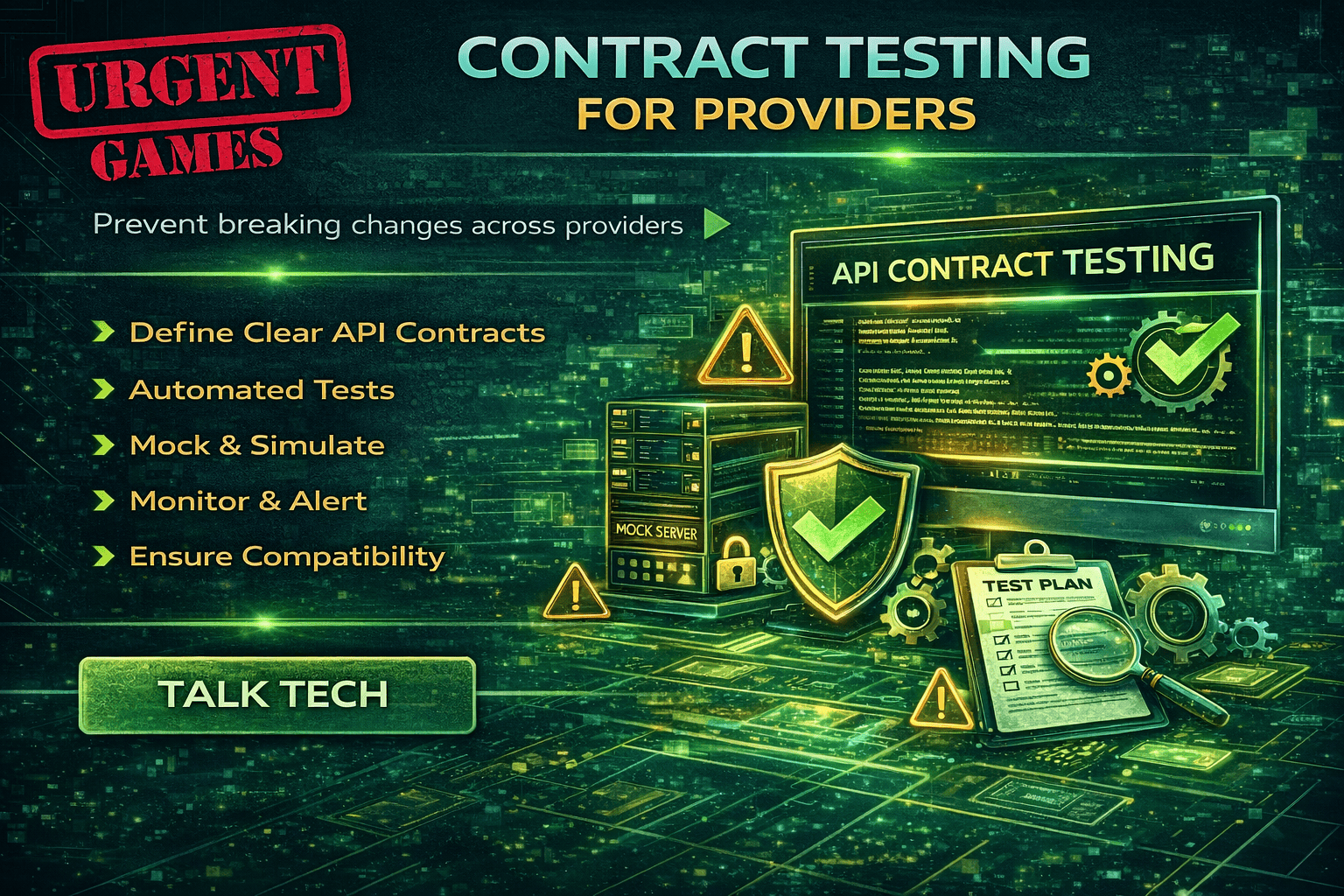
Introduction: Why Contract Testing Is Critical
In modern iGaming systems, API contract testing plays a key role in preventing silent integration failures.
Integrations rarely fail loudly—they fail quietly.
A provider might change:
- A field name
- A response format
- A validation rule
As a result:
- Bets fail
- Wins don’t process
- Wallets desync
- Players complain
Even worse, these issues often go unnoticed until real money is affected.
That’s why relying only on manual QA is no longer enough. A structured contract validation system ensures stability before problems reach production.
What Contract Testing Means in Practice
Contract testing ensures that both sides of an API follow an agreed structure and behavior.
A contract defines:
- Endpoints
- Request formats
- Response structures
- Data types
- Required fields
If something changes unexpectedly, automated tests catch it immediately.
Why Contract Validation Matters in iGaming Systems
iGaming integrations are especially sensitive due to:
- Multiple external providers
- Real-time financial transactions
- Inconsistent API standards
Without proper validation:
- Updates introduce hidden risks
- QA becomes reactive
- Bugs reach production faster
👉 Internal link suggestion:
Read your “Aggregator Integration Guide” for more on provider complexity.
The Core Principle: Verify Integrations Automatically
Providers don’t always:
- Announce changes
- Maintain backward compatibility
- Follow strict versioning
Because of this, automated validation becomes essential. It ensures that any unexpected change is detected before it impacts users.
1. Define Clear API Contracts
Start with a well-defined structure.
Include:
- Endpoints
- Required and optional fields
- Data types
- Response formats
- Error handling
Reference standard API specifications here:
https://swagger.io/specification/
Why it matters:
Without a clear definition, validation cannot work effectively.
2. Consumer-Driven Testing Approach
Instead of relying on provider documentation, define your own expectations.
How it works:
- You define expected responses
- Tests are generated from your requirements
- Provider outputs are validated against them
Why it matters:
You protect your system based on real dependencies.
3. Automated Validation Pipelines
Manual testing doesn’t scale.
Implement:
- Automated test suites
- Continuous validation checks
- CI/CD integration
Learn more about CI/CD principles:
https://martinfowler.com/articles/continuousIntegration.html
Why it matters:
Issues are detected immediately—not after deployment.
4. Mocking and Simulation
Testing against live providers is risky and limited.
Use:
- Mock servers
- Simulated responses
- Edge-case testing
Why it matters:
You can safely test failure scenarios and unusual conditions.
5. Versioning and Compatibility Controls
APIs evolve over time.
Enforce:
- Versioned endpoints
- Backward compatibility
- Controlled deprecation
Why it matters:
Prevents sudden breaking changes.
6. Runtime Schema Validation
Testing shouldn’t stop after deployment.
Add:
- Runtime validation checks
- Schema enforcement
- Real-time alerts
Why it matters:
Catches issues that slip through testing.
7. Transaction Reliability Rules
In iGaming, behavior matters as much as structure.
Validate:
- Idempotency
- Retry handling
- Consistent responses
Why it matters:
Prevents duplicate bets and payout errors.
8. Detecting Provider Changes Early
Not all changes are documented.
Implement:
- Response monitoring
- Change detection systems
- Alerting mechanisms
Why it matters:
You catch silent changes instantly.
9. Centralized Contract Management
Managing multiple providers requires structure.
Use:
- Central contract repository
- Version tracking
- Standardized schemas
Why it matters:
Keeps integrations organized and scalable.
10. CI/CD Integration for Testing
Validation must be part of your deployment pipeline.
Workflow:
- Code changes trigger tests
- Contracts are validated automatically
- Failures block release
Why it matters:
Broken integrations never reach production.
The Hidden Value of Reliability
Players never see APIs—but they feel every failure.
- Failed bets create frustration
- Missing wins create distrust
- Delays increase churn
👉 Reliability only becomes visible when it breaks.
Common Mistakes to Avoid
Relying Only on Documentation
Often outdated or incomplete
Testing Only Ideal Scenarios
Real failures happen in edge cases
Skipping Runtime Checks
Issues appear after deployment
No Ownership of Contracts
Expectations must be defined internally
The Future of Integration Testing
This space is evolving fast.
We’re moving toward:
- AI-based anomaly detection
- Real-time validation systems
- Adaptive schema handling
- Performance-based provider scoring
As a result, integrations will become more resilient and easier to scale.
Final Thoughts: Stability Drives Growth
In iGaming, integrations are your foundation.
If they fail:
- Revenue stops
- Trust drops
- Support costs rise
A strong contract validation system turns fragile integrations into reliable infrastructure.
🚀 CTA: Talk Tech
If you want to build a resilient integration layer with strong validation, stable provider connections, and scalable infrastructure—
Talk to Urgent Games and build systems that don’t break under pressure.