
 English
  简体中文
简体中文  Español
  Русский
  Türkçe
  Tiếng Việt
  Українська
  Български
  Suomi
Suomi  Ελληνικά
  Čeština
  اردو
اردو  Svenska
  עִבְרִית
  हिन्दी
  Français
  Հայերեն
  Italiano
  日本語
日本語  Română
  Polski
  Српски језик
  Latviešu valoda
  Deutsch (Sie)
  Português do Brasil
  한국어
한국어 
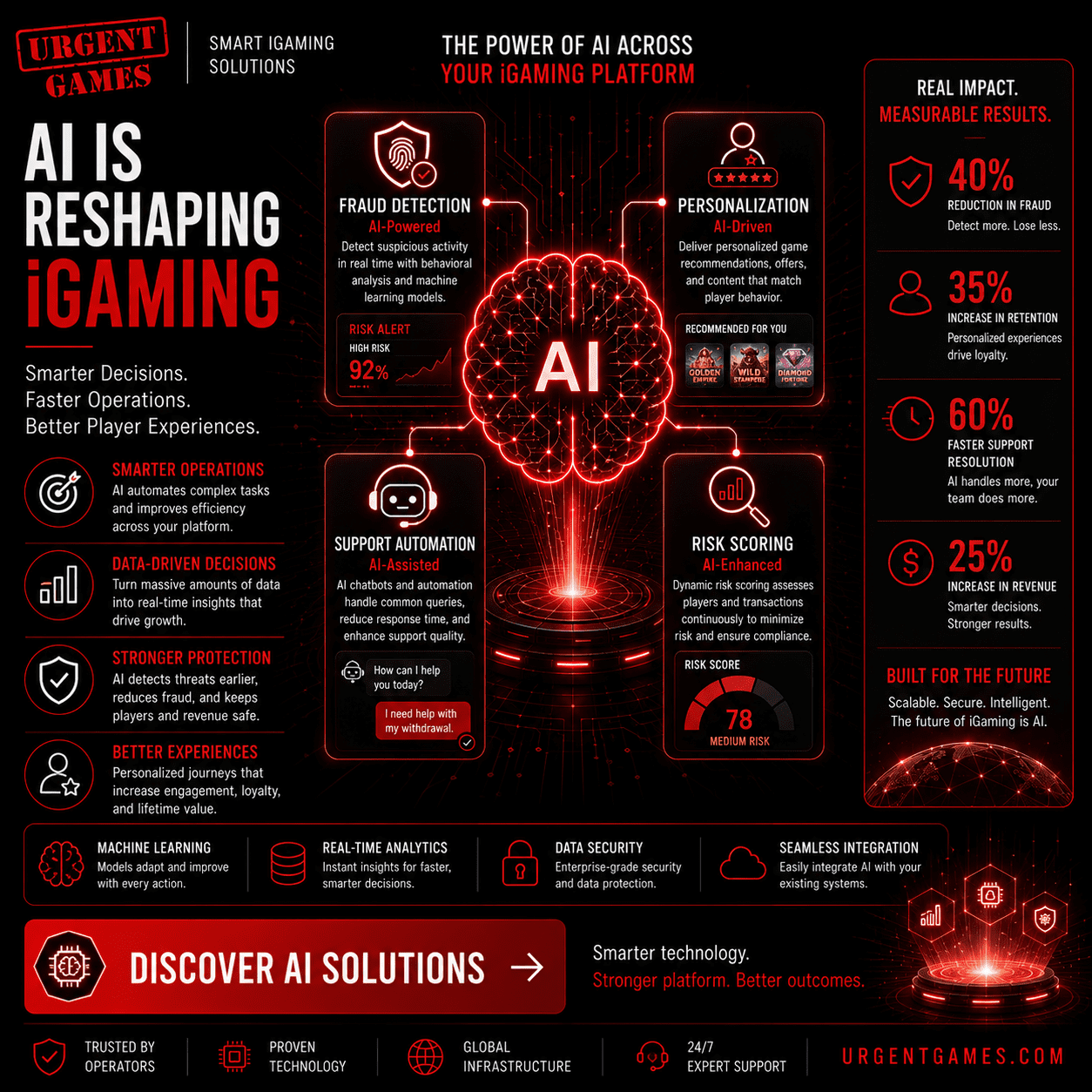
Introduction: Why AI in iGaming Is Becoming Essential
AI in iGaming is rapidly transforming how online gaming operators manage fraud prevention, player engagement, customer support, compliance, and operational efficiency. As gaming platforms generate more data than ever before, artificial intelligence enables operators to make faster decisions, automate complex processes, and deliver better player experiences at scale.
Just a few years ago, AI adoption in online gaming was largely experimental. Today, however, it has become a critical component of modern gaming infrastructure.
The most successful operators are no longer asking:
“Should we use AI?”
Instead, they are asking:
“Where can AI create the greatest competitive advantage?”
From fraud prevention and personalization to support automation and predictive analytics, AI in iGaming is transforming nearly every operational layer of the industry.
As a result, operators that embrace AI strategically are positioning themselves for stronger growth, greater efficiency, and improved player satisfaction.
Why AI in iGaming Adoption Is Accelerating
Modern gaming platforms generate enormous amounts of operational data every day.
Operators process:
- Millions of transactions
- Thousands of deposits and withdrawals
- Continuous gameplay activity
- Customer support interactions
- Marketing engagement data
- Risk and compliance events
Human teams alone cannot efficiently analyze this volume of information.
Therefore, AI in iGaming helps operators convert data into actionable insights faster, more consistently, and at scale.
Consequently, businesses can make better decisions while reducing operational overhead.
AI in iGaming Fraud Detection and Risk Management
Fraud remains one of the largest operational risks facing gaming operators.
Traditionally, fraud prevention relied on:
- Static rules
- Manual reviews
- Fixed thresholds
- Reactive investigations
Although these methods can be effective, they often struggle to adapt to evolving fraud techniques.
How AI Improves Fraud Detection
Modern AI systems can analyze:
- Device behavior
- Transaction activity
- Session patterns
- Geographic anomalies
- Account relationships
Simultaneously and in real time.
As a result, AI in iGaming significantly improves fraud detection accuracy while reducing false positives.
Real-Time Fraud Monitoring
AI-powered systems can identify:
- Bonus abuse
- Multi-accounting
- Account takeovers
- Suspicious withdrawals
- Payment anomalies
As activity occurs.
Consequently, operators can intervene earlier and reduce financial losses.
Dynamic Risk Scoring
Traditional risk scoring often evaluates a limited number of indicators.
AI, however, can analyze hundreds of signals simultaneously.
This creates:
- More accurate risk assessments
- Better fraud prevention
- Improved operational efficiency
Therefore, dynamic risk scoring has become one of the most valuable applications of AI in iGaming.
AI in iGaming Personalization and Player Retention
Modern players expect experiences tailored to their preferences.
Therefore, personalization has become a significant competitive advantage.
AI helps operators personalize:
- Game recommendations
- Lobby experiences
- Promotional offers
- Communication timing
- Retention campaigns
As a result, players receive more relevant experiences.
Recommendation Engines Improve Engagement
Streaming platforms have transformed consumer expectations around personalization.
Gaming platforms are now following the same model.
AI recommendation engines can suggest:
- Similar games
- New providers
- Trending content
- Relevant promotions
Based on player behavior.
Consequently, better content discovery often increases session duration and retention rates.
Personalized Marketing Campaigns
AI in iGaming allows operators to segment audiences more effectively.
Rather than sending identical promotions to everyone, operators can deliver highly targeted campaigns that improve:
- Open rates
- Click-through rates
- Conversion rates
- Retention
Therefore, marketing budgets become more efficient.
AI in iGaming Responsible Gaming Programs
Responsible gaming is becoming increasingly important for operators and regulators alike.
AI can help identify:
- Unusual spending patterns
- Behavioral changes
- Escalating deposit activity
- Extended gaming sessions
Earlier than traditional monitoring systems.
As a result, operators can intervene proactively and support safer gaming environments.
This not only improves compliance but also strengthens player trust.
AI in iGaming Customer Support Automation
Customer support remains one of the largest operational expenses in online gaming.
Fortunately, AI-powered support systems can automate many repetitive tasks.
Examples include:
- Frequently asked questions
- Account inquiries
- Payment status requests
- Bonus explanations
- Basic troubleshooting
Consequently, response times improve significantly.
AI Enhances Human Support Teams
The goal is not to replace support agents.
Instead, AI handles repetitive interactions while human agents focus on:
- Complex issues
- Escalations
- VIP support
- Sensitive player situations
Therefore, operators can improve efficiency without sacrificing service quality.
AI in iGaming Operational Monitoring
Modern gaming platforms generate enormous volumes of:
- Logs
- Metrics
- Alerts
- Error reports
Manually identifying operational issues can be difficult.
However, AI-powered monitoring systems can detect patterns that humans might overlook.
Intelligent Error Detection
AI can identify:
- Provider degradation
- API instability
- Transaction failures
- Emerging incidents
Earlier than traditional monitoring tools.
As a result, operators can resolve issues before they affect players.
Predictive Infrastructure Monitoring
Advanced observability systems can:
- Detect anomalies
- Predict failures
- Identify bottlenecks
- Monitor performance trends
Therefore, prevention becomes easier than recovery.
AI in iGaming Marketing and Predictive Analytics
Marketing teams are increasingly leveraging AI to optimize performance.
AI can improve:
- Campaign targeting
- Audience segmentation
- Bonus allocation
- Retention strategies
- Customer lifetime value analysis
Consequently, marketing resources are allocated more effectively.
Predictive Analytics for Better Decisions
Traditionally, operators focused on understanding what happened.
Today, AI enables them to understand what is likely to happen next.
Examples include:
- Churn prediction
- Revenue forecasting
- Fraud forecasting
- Engagement forecasting
Therefore, predictive analytics supports smarter planning and resource allocation.
AI in Multi-Brand Gaming Operations
Multi-brand operators generate even more data than single-brand businesses.
AI helps identify:
- Cross-brand player behavior
- Fraud networks
- Shared customer preferences
- Market opportunities
As a result, operators gain strategic insights that would otherwise be difficult to uncover.
Shared intelligence becomes a powerful competitive advantage.
Data Quality and AI in iGaming Success
AI systems are only as effective as the data they receive.
Poor-quality data often leads to:
- Inaccurate recommendations
- Weak risk scoring
- Poor decision-making
- Reduced model performance
Therefore, strong data infrastructure remains essential for successful AI implementation.
Operators should prioritize:
- Data accuracy
- Data consistency
- Governance frameworks
- Real-time data availability
Human Oversight Still Matters
Although AI is powerful, it should not operate without oversight.
Important decisions still require:
- Governance
- Validation
- Monitoring
- Human review
The most successful operators combine artificial intelligence with human expertise.
This balance helps ensure accountability, transparency, and operational control.
Compliance Considerations for AI in iGaming
As AI adoption increases, regulators are paying closer attention.
Operators must understand:
- How AI decisions are made
- How risk models function
- How player data is used
- How automated decisions affect outcomes
Therefore, transparency and explainability are becoming increasingly important.
Responsible AI adoption will remain a critical component of future compliance strategies.
Common AI Implementation Mistakes
Not every AI project succeeds.
Common mistakes include:
- Automating without strategy
- Using poor-quality data
- Ignoring model explainability
- Over-relying on automation
- Measuring the wrong outcomes
Therefore, operators should focus on solving real business problems rather than adopting AI simply because it is available.
Key Metrics for Measuring AI in iGaming Performance
Fraud Metrics
Track:
- Fraud detection rate
- False positive rate
- Fraud loss reduction
- Investigation efficiency
Customer Support Metrics
Monitor:
- Ticket volume reduction
- Resolution time
- Customer satisfaction
- First-response speed
Personalization Metrics
Measure:
- Session duration
- Retention rate
- Recommendation engagement
- Promotion conversion rate
Risk Management Metrics
Review:
- Churn prediction accuracy
- Risk scoring effectiveness
- Intervention success rate
- Compliance outcomes
These metrics help operators evaluate the effectiveness of AI initiatives.
The Future of AI in iGaming
The next generation of gaming platforms will increasingly leverage AI for:
- Hyper-personalization
- Predictive fraud detection
- Dynamic risk scoring
- Automated compliance monitoring
- Intelligent support workflows
- Real-time operational optimization
Why?
Because operational complexity continues to increase.
Meanwhile, AI can scale significantly faster than manual processes.
As a result, AI in iGaming will become even more deeply integrated into gaming infrastructure over the coming years.
Final Thoughts
Artificial intelligence is no longer an optional innovation layer within online gaming.
Today, AI in iGaming is becoming core infrastructure for modern operations.
When implemented effectively, AI helps operators:
- Detect fraud faster
- Personalize player experiences
- Improve support efficiency
- Strengthen risk management
- Scale operations intelligently
The operators that succeed over the next decade will not necessarily be those with the largest marketing budgets.
Instead, they will be the ones capable of making better decisions faster.
Increasingly, AI is becoming the engine behind those decisions.
Because in modern iGaming, the future belongs to operators that can transform data into action in real time.
Discover AI Solutions
👉 Discover AI solutions and future-proof your gaming operations today.